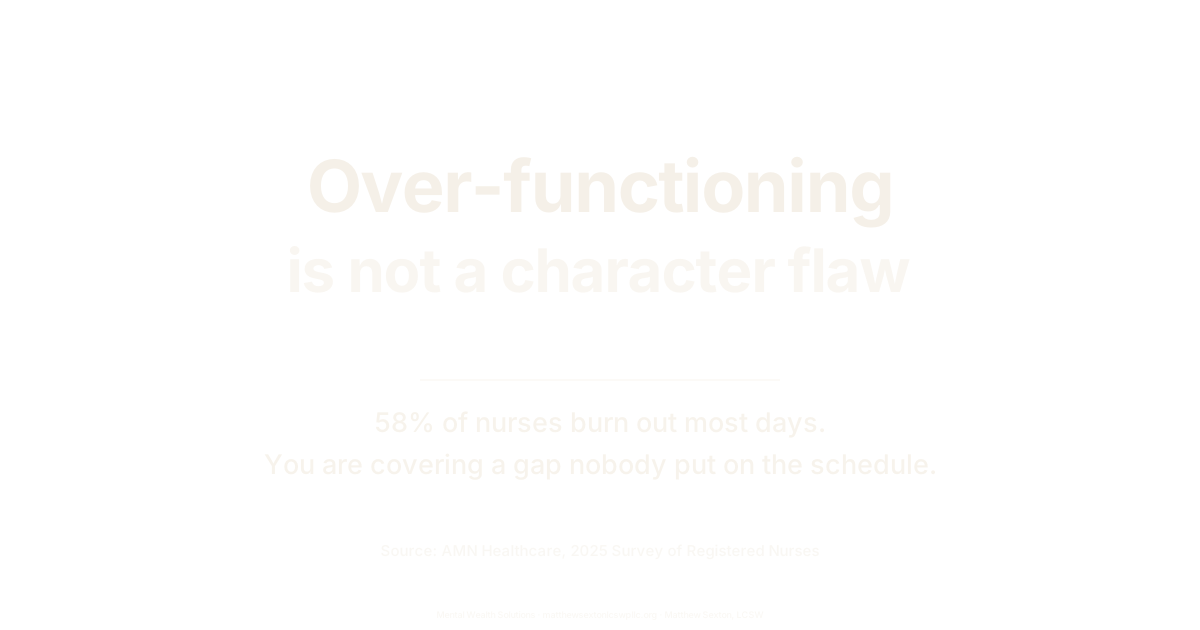
Healthcare workers burn out first because the job runs on their willingness to absorb whatever the system cannot. In AMN Healthcare's 2025 Survey of Registered Nurses, 58% of nurses said they feel burned out most days. That is not a personal weakness showing up in more than half a profession by coincidence. It is what happens to the people who hold a unit together shift after shift, until there is nothing left for the drive home. The mechanism has a name, it is called over-functioning, and it is not a character flaw. It also responds to help.
Matthew Sexton, LCSW, NATC — Licensed clinical social worker in private practice, providing telehealth psychotherapy to adults in New York.
If you are a nurse, an aide, a tech, or a therapist somewhere in New York reading this after a long shift, you already know the feeling this article is about. You were steady all day. You caught the thing that would have fallen. You stayed late to finish charting. Then you walked in your own front door and had nothing left for the people who actually live there. This piece is about why that keeps happening to the most capable people in the building, and what a first step out of it looks like.
You are not imagining it, and you are not alone in it
Start with the number, because the number matters. When AMN Healthcare surveyed more than 12,000 registered nurses in 2025, 58% reported feeling burned out most days, and 64% said compassion fatigue had already affected their own health ([AMN Healthcare, 2025][1]). A separate 2025 survey of a thousand nurses found that 74% had felt emotionally drained from work multiple times a week in the past month ([Joyce, 2026][2]).
This is not only a nursing story. In Medscape's 2025 physician report, 47% of doctors said they were experiencing burnout, still higher than the 44% recorded before the pandemic ([American Osteopathic Association, 2025][4]). Across the whole healthcare workforce, the pattern predates COVID entirely. Before the pandemic, the National Academy of Medicine already found that 35 to 54 percent of nurses and physicians were reporting symptoms of burnout ([U.S. Surgeon General, 2022][3]).
Numbers that large stop being about individuals. When more than half of a profession is running on empty at the same time, the problem is not that half the profession lacks grit. Something structural is doing this to good people, and it has been for years.
Why healthcare workers, specifically
Here is the piece that rarely gets said plainly to the person living it. You did not burn out because you care too much or because you are not tough enough. You burned out because you are the one who keeps covering the gap the system leaves, and that role has a cost nobody put on the schedule.
Over-functioning is the clinical name for it, and it is close kin to the pattern described in the successful avoider. It means doing more than your share so that a system never has to feel its own shortfall. On a short-staffed floor, over-functioning is picking up the shift no one else can take. It is quietly redoing the handoff so the next person is not set up to fail. It is answering the group text on your day off because you know the unit is slammed and you cannot stand to leave them short. Each of those choices is generous. Each one is also load-bearing, and after a few years the weight is enormous. Where that habit started is often perfectionism working as a trauma response.
In a properly staffed system, that generosity reads as competence. In an understaffed one, it becomes the wall holding the ceiling up. The U.S. Surgeon General put this in about as blunt a form as a government office can manage, describing burnout as "a distinct workplace phenomenon that primarily calls for a prioritization of systems-oriented, organizational-level solutions" ([U.S. Surgeon General, 2022][3]). Translated out of policy language: the workplace makes this happen, and the fix belongs at the level of the workplace, not the level of your personal resilience.
That matters for how you understand your own exhaustion. The over-functioning is not a flaw in your character. It is a trained, rewarded adaptation to an environment that asked more of you than it staffed for. You got good at holding everything because holding everything is what got praised, promoted, and depended on. The reflex worked. It is just that the person running the reflex eventually runs out.
What it looks like after you clock out
Burnout does not always show up at work, at least not at first. The people who over-function are often the last ones on the unit to look burned out, because holding it together in front of others is the exact skill that got overdeveloped. It shows up at home instead, in the hours that are supposed to be yours.
You might recognize some of this. You get in the car and cannot decide what you want for dinner, because you have made a thousand decisions for other people and the tank is dry. You snap at someone you love over something small. You scroll on the couch for an hour past when you meant to sleep, not because anything on the screen matters, but because it is the first stretch of the day nobody needs anything from you. Sunday evening carries a low dread about Monday's shift. The things that used to feel good, a walk, a show, a friend's call, start to feel like more items on a list.
That is what compassion fatigue looks like from the inside, and it is why 64% of nurses in the AMN survey said it had reached their own health ([AMN Healthcare, 2025][1]). You gave the steadiest, kindest version of yourself to the floor all day. What comes home is whatever was left after that, and lately it has not been much.
Why the usual advice keeps missing
If you have gone looking for help already, you have probably been handed the standard list. Sleep more. Try a gratitude journal. Take a bath. Download the breathing app the hospital licensed. None of that is wrong, exactly. It is just aimed at the wrong target.
When the cause of burnout sits in the system, as the Surgeon General's advisory says it does, a fix aimed only at you cannot reach it. Worse, a steady diet of self-care tips can quietly imply that your exhaustion is a personal failure of coping, that if you just meditated correctly you would be fine on a floor that is running four nurses short. That message lands hard on people who are already over-functioning, because their whole pattern is to assume the gap is theirs to close.
Rest genuinely helps, and you should take every hour of it you can get. But a weekend off does not undo a habit built over years, and it does not change the floor you go back to on Monday. Left unexamined, the over-functioning travels. People leave one impossible job for another and find themselves holding everything again within a year, wondering why the fresh start did not take.
What actually helps, and a first move you can make
The thing that actually shifts this is not a new app, and it is not a breathing exercise bolted onto a broken schedule (what regulating your nervous system actually means is a real skill, but it will not out-run understaffing). It is having a place to set the load down and look at it with someone whose only job in that hour is you, not the schedule, not the census, not the next admit.
Therapy for over-functioning is fairly specific work. A lot of it is separating two things that have fused together over your career: the part of you that genuinely wants to do good work, and the part that believes if you do not personally hold everything, it will all fall. Those feel identical from the inside, and they drive the same behavior, but they cost wildly different amounts to live with. The work is learning to tell them apart, and slowly building tolerance for letting some things be someone else's to catch. That is uncomfortable at first for people who have organized an entire identity around being the reliable one. It is also, over time, what gives you your evenings back.
If a full step feels like too much tonight, here is a smaller one. Say the sentence out loud, first to yourself and then to one person you trust: "I think I am burned out." Naming it is not giving up, and it is not a mark against your record. If you are weighing actual time away, it is worth knowing what qualifies for mental health leave in New York. For people who have spent years insisting they are fine, saying the true thing plainly is the move that actually starts something.
When you are ready for the next step, that is what a first consultation is for. I work with people who spend all day holding other people together, including nurses, aides, techs, and clinicians. You do not have to be in crisis to reach out. You just have to be tired of running on empty. If that is where you are, book a consultation and we will start with the load you have been carrying alone.
Is burnout the same as depression?
They overlap and they can coexist, but they are not the same thing. Burnout is usually tied to a specific demand, most often work, and it tends to ease, at least a little, when you get real distance from that demand. Depression follows you across every part of life and does not lift just because it is your day off. If the flatness is everywhere, including in the things that have nothing to do with your job, or if you are having thoughts of not wanting to be here, that points beyond burnout and is worth talking to a clinician about soon.
I love my patients and my work. Can I still be burned out?
Yes, and loving the work is often part of why it happens. Over-functioning runs strongest in people who care deeply about doing right by the people in front of them. The burnout is not evidence that you are in the wrong career or that your compassion has run out. It is evidence that you have been absorbing a systemic shortfall with your own body and time, and that the arrangement is not sustainable, no matter how much the work still means to you.
Do I need therapy, or do I just need a different job?
Often both, and the order matters. Changing jobs without looking at the over-functioning tends to reproduce the same exhaustion in the new place within a year, because you bring the same reflex with you. Therapy without any structural change can leave you better able to tolerate a situation that is still taking more than it gives. The most durable path is usually to get enough traction to understand your own pattern first, then make the bigger changes from steadier ground.
How does therapy for a healthcare worker in New York actually work?
In my practice it is telehealth, so you can meet from home on a day off or between shifts without a commute added to your week. We start with a consultation to understand what has been happening and whether we are a fit. From there the work targets the specific pattern underneath the burnout, the belief that you have to hold everything, rather than only managing symptoms. Sessions are private, and nothing you say is shared with your employer.
Sources
- AMN Healthcare. "Nurses Speak Out on Burnout, Balance, and the Future of the Profession in New Survey" (2025 Survey of Registered Nurses; 12,171 responses). May 12, 2025. [globenewswire.com][1]
- Joyce University of Nursing and Health Sciences. "Nursing Burnout: A Profession on the Brink, and the Path Forward" (survey of 1,000 registered nurses). Published January 5, 2026. [joyce.edu][2]
- Office of the U.S. Surgeon General. "Addressing Health Worker Burnout: The U.S. Surgeon General's Advisory on Building a Thriving Health Workforce." 2022. [ncbi.nlm.nih.gov][3]
- American Osteopathic Association. "Physician burnout is slowly improving, but still remains stubbornly high, Medscape report finds." February 27, 2025. [osteopathic.org][4]
This article is for educational and informational purposes only. It does not constitute medical, clinical, legal, or therapeutic advice, and reading it does not create a therapist-client relationship with Matthew Sexton, LCSW or Mental Wealth Solutions PLLC. Although the author is a licensed clinical social worker, the content in this article is not clinical assessment, diagnosis, or treatment.
The patterns described here, including over-functioning, compassion fatigue, and burnout among healthcare workers, reflect current research and general clinical observation. Burnout varies from person to person, and burnout, compassion fatigue, and depression can look similar while calling for different care. What is described here may not match your situation, and it is not a diagnosis. If you are a healthcare worker who recognizes yourself in this, please consult a licensed mental health professional who can assess your specific circumstances.
If you are in immediate emotional crisis, you can reach the 988 Suicide & Crisis Lifeline by calling or texting 988 (US). If you are experiencing domestic violence or are in physical danger, contact the National Domestic Violence Hotline at 1-800-799-7233 or visit thehotline.org. In a life-threatening emergency, call 911.