The wellness industry named its own contradiction out loud this year. The Global Wellness Summit's official 2026 trend report lists "The Rise of Neurowellness" and "The Over-Optimization Backlash" side by side, describing nervous system regulation as having become "the latest flex and hashtag" while calling for a shift toward "meaning over measurement" (Global Wellness Summit, Jan 27, 2026). Clinically, regulation is not a calm score you chase. It's your capacity to move between activation and rest without getting stuck. Here's what that actually looks like, and why the tracking-heavy version of it can backfire.
If you've scrolled past a breathing GIF, a cold-plunge testimonial, or someone explaining their "vagal tone" this week, you're not imagining the saturation. A real clinical term left the therapy room, went through wellness media, and came out the other side as a hashtag, a Forbes piece traced that exact arc in June (Forbes, June 21, 2026). What gets lost in the jump from clinic to feed is the actual mechanism, and what "regulating" it is supposed to accomplish.
Why "nervous system regulation" is suddenly everywhere in your feed
It's everywhere because it moved from a clinical concept to a lifestyle brand in about eighteen months, and the wellness industry itself is now tracking that shift as a named trend. Forbes documented how a term once used almost exclusively by trauma clinicians and somatic therapists became a top search term, a supplement label, and a personality trait people claim in their bios (Forbes, June 21, 2026).
The Global Wellness Summit's 2026 report goes further. It names "The Rise of Neurowellness" as one of its ten official trends for the year, then, in the same document, names "The Over-Optimization Backlash" as another. The report describes nervous system talk as having become "the latest flex and hashtag" and calls for the industry to pivot toward "meaning over measurement" (Global Wellness Summit, Jan 27, 2026). That's an unusual thing for an industry to admit about its own hottest product.
What's happening underneath the hashtag is real. People are genuinely dysregulated, and they're reaching for language that finally names something they've felt for years without a word for it. The problem isn't that the concept is fake. The problem is what happens once a nervous system becomes something you're supposed to optimize, screenshot, and post.
What does "nervous system regulation" actually mean, clinically?
Regulation refers to a real, well-mapped physiological system, not a vibe. Your sympathetic nervous system triggers fight-or-flight when it detects threat, and your parasympathetic nervous system governs "rest and digest," the recovery state your body needs after activation passes (Harvard Health Publishing, 2026). Under chronic stress, the HPA axis, the communication loop between your brain and adrenal glands, keeps that system in sustained activation instead of letting it reset.
That's the actual target in treatment: restoring the ability to move between activation and rest, not eliminating activation altogether. A nervous system that never activates isn't regulated, it's numb. A regulated system can spike when something demands it, then come back down once the demand passes. Most of the online version of this concept treats "calm" as the goal state and anything else as failure, which isn't how the biology works and isn't what therapists are actually trying to build.
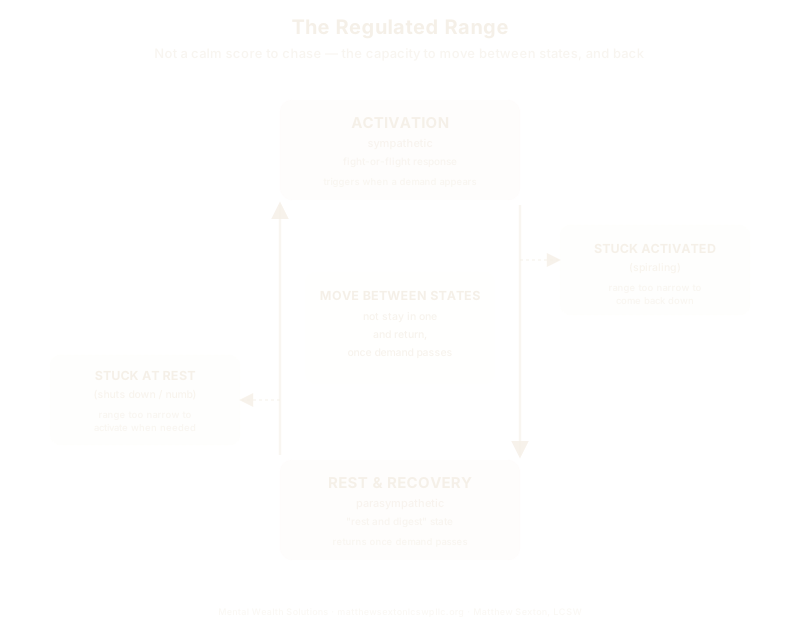
This distinction matters more than it sounds like it should. Clients who arrive already fluent in nervous-system vocabulary sometimes describe feeling like they're failing at regulation because they still get anxious, still get activated, still have bad days. That's not dysregulation. That's a nervous system doing its job.
Can tracking your nervous system actually make it worse?
Yes, and there's a well-documented precedent for exactly this pattern. Sleep researchers coined the term "orthosomnia" to describe an unhealthy preoccupation with achieving a "perfect" sleep score on a wearable, a preoccupation that can itself worsen sleep and increase anxiety (Baron et al., Journal of Clinical Sleep Medicine, 2017). The tracking behavior, meant to improve the thing it measures, ends up degrading it instead.
The same mechanic shows up with nervous-system tracking. Checking a heart-rate-variability score before bed, refreshing a "readiness" number, or treating a wearable's stress alert as a verdict on your day can turn a body signal into a performance metric. Watching your own vitals closely enough, and often enough, is itself a form of vigilance, and vigilance is a sympathetic-nervous-system activity. You can end up activating the exact system you're trying to calm, just by monitoring it too hard.
None of this means tracking tools are useless. It means treating a number as the goal, instead of a rough signal, is where the trend tends to go sideways. The Global Wellness Summit's own language for this, "meaning over measurement," is describing the same failure mode from the industry side.
Do cold plunges, breathwork, and vagus-nerve hacks actually regulate anything?
They do something real, just not what the marketing implies. Dr. Janna Dickenson, a licensed clinical psychologist at UC San Diego's Department of Psychology, explains that most viral nervous-system practices, cold plunges, breathwork, vagus-nerve stimulation, are really tools for helping people tolerate distress in the moment, not a cure-all that permanently resets your baseline (UC San Diego Today, June 9, 2026).
That's a meaningful, and more modest, claim than what shows up in most captions. A cold plunge can interrupt a panic spiral for ten minutes. It doesn't rewire a trauma response, resolve chronic hypervigilance, or replace the slower work of understanding why your baseline is set where it is. Used as a distress-tolerance tool alongside other work, these practices are genuinely useful. Used as the entire treatment plan, they're a lot of effort for a temporary effect that keeps needing to be repeated.
This is one of the more common gaps that shows up in practice: people arrive having built an elaborate toolkit of regulation techniques, and they're still dysregulated, because the toolkit was never designed to address what's underneath the activation in the first place.
What healthy nervous system regulation actually looks like in a therapy setting
It looks less like a routine and more like a widening window. Worry and stress are genuinely widespread right now, Gallup's most recent global data found 39% of adults worldwide reported "a lot of worry" the day before being surveyed, and 37% reported "a lot of stress," across 144 countries (Gallup, State of the World's Emotional Health, 2025). Regulation work doesn't aim to get that number to zero. It aims to widen the range of stress a person can move through without shutting down or spiraling.
In session, that usually means slower, less glamorous work than a breathing app: noticing activation earlier, building tolerance for discomfort without needing it to disappear immediately, and, often, co-regulation, the calming effect of a steady other person in the room, which no solo app or gadget can fully replicate. It also means treating rest as something you're allowed to have without earning it with a perfect score first.
The honest version of this work doesn't produce a number you can post. It produces a person who can feel activated on a Tuesday, notice it, and not organize the rest of their week around fixing it immediately. That's a quieter outcome than a screenshot, and it's also the one that actually holds up.
Is "nervous system regulation" a real clinical concept or just a wellness trend?
Both, which is part of the confusion. The underlying biology, sympathetic activation and parasympathetic recovery through the HPA axis, is well-established science. The trend is how that science got repackaged as a lifestyle metric to optimize, which the Global Wellness Summit itself flagged as a 2026 backlash point.
Can obsessively tracking my stress levels actually make me more anxious?
Yes, this is a documented pattern. Sleep researchers named "orthosomnia," anxiety created by chasing a perfect wearable sleep score, in 2017, and the same tracking-creates-the-problem-it-measures dynamic applies to nervous-system apps and HRV monitors.
Do cold plunges and breathwork actually fix nervous system dysregulation?
They help you tolerate distress in the moment, which is genuinely useful, but they're not a permanent reset on their own, according to UC San Diego clinical psychologist Dr. Janna Dickenson. They work best paired with deeper work on what's driving the activation.
How do I know if I need therapy instead of just more wellness tools?
If you've built out breathwork, cold plunges, supplements, and tracking apps and you're still dysregulated most days, that's a sign the toolkit is addressing symptoms rather than the pattern underneath them. Therapy targets the underlying pattern; wellness tools are generally built to manage a moment.
Is it normal to still feel anxious even when I'm "doing everything right" for my nervous system?
Very common, and not a sign you're failing. A regulated nervous system still activates, that's what it's supposed to do. Feeling stressed or worried is close to universal right now: Gallup found 39% of adults worldwide reported a lot of worry the day before being surveyed. The goal isn't zero activation, it's a wider capacity to move through it.
Sources
- Global Wellness Summit. "2026 Wellness Trends," including "The Rise of Neurowellness" and "The Over-Optimization Backlash." globalwellnesssummit.com, Jan 27, 2026.
- Harris, Meggen. "Why Nervous System Regulation Has Become Wellness's Latest Obsession." Forbes.com, June 21, 2026.
- Gallup. "State of the World's Emotional Health." news.gallup.com, 2025 report, 2024 fieldwork, 144 countries.
- Harvard Health Publishing. "Understanding the Stress Response." health.harvard.edu, 2026.
- UC San Diego Today. Interview with Dr. Janna Dickenson, Department of Psychology, on viral nervous-system regulation practices. today.ucsd.edu, June 9, 2026.
- Baron, K.G., et al. "Orthosomnia: Are Some Patients Taking the Quantified Self Too Far?" Journal of Clinical Sleep Medicine, 2017. jcsm.aasm.org
This article is for educational and informational purposes only. It does not constitute medical, clinical, legal, or therapeutic advice, and reading it does not create a therapist-client relationship with Matthew Sexton, LCSW or Matthew Sexton LCSW PLLC. Although the author is a licensed clinical social worker, the content in this article is not clinical assessment, diagnosis, or treatment.
The concepts described here reflect general research on stress physiology and clinical observation about how nervous-system regulation is discussed and practiced. Individual nervous systems, histories, and stress responses vary, and what helps one person regulate may not help another. If you're using tracking tools, breathwork, or cold exposure and finding that your anxiety is getting worse rather than better, that pattern is worth bringing to a licensed mental health professional who can assess your specific situation.
If you are in immediate emotional crisis, you can reach the 988 Suicide & Crisis Lifeline by calling or texting 988 (US). If you are experiencing domestic violence or are in physical danger, contact the National Domestic Violence Hotline at 1-800-799-7233 or visit thehotline.org. In a life-threatening emergency, call 911.