When a competent, accomplished person keeps stalling on the things that matter most while everything else gets done, that pattern usually is not laziness or a discipline problem. It is avoidance, and avoidance is driven by anxiety. Research treats behaviors like chronic procrastination as a way of regulating uncomfortable feelings in the moment, not a failure of time management (Sirois and Pychyl, Frontiers in Psychology, 2022; Steel, Psychological Bulletin, 2007). The relief you feel when you put the hard thing off is real, and that relief is exactly what teaches your brain to keep avoiding. The good news is the same mechanism that traps you can be worked in reverse, and it is a skill you can take back on purpose.
You are good at your job. You answer the emails, you hit the deadlines, people bring you the hard problems because you solve them. And there is a short list of things you have been not-doing for months. The big project you actually care about. The conversation you keep rehearsing and never having. The doctor's appointment, still unscheduled. The apology you owe, half-written in your Notes app since spring. You told yourself you would start "once work settles down." Work never settles down, and the list does not move.
Avoidance is easy to miss in high achievers because it hides behind productivity. Someone who cannot get off the couch is visibly stuck. Someone who reorganizes the inbox, ships four smaller deliverables, and books three meetings, all to keep from opening the one file that scares them, looks like they are crushing it. Sometimes you even work harder while avoiding: a less important project suddenly becomes urgent, or you wait for the perfect stretch of uninterrupted time. If you have ever finished a busy day and realized you touched everything except the thing that actually mattered, you know this from the inside. This is what I want to unpack: the mechanism, why it grips competent people especially hard, and how you get your agency back.
High-Achiever Avoidance Is Anxiety, Not Laziness
The difference matters because it changes what you do about it. Lazy is a character judgment, and it is almost always wrong when applied to someone who is otherwise reliable and driven. If you were lazy, the easy tasks would slide too. They do not. You reserve your stalling for specific things, which is a clue that something more targeted is going on.
That something is anxiety. Psychologists who study procrastination have moved away from calling it a time-management flaw and toward understanding it as a way of managing emotion. In their model, when a task stirs up something aversive, dread, self-doubt, the fear of doing it badly, we put the task down to relieve that feeling right now, prioritizing short-term mood over the long-term goal (Sirois and Pychyl, Frontiers in Psychology, 2022). Piers Steel's meta-analytic review, one of the largest of the procrastination literature, found that the single strongest pull toward procrastination is task aversiveness: how unpleasant or threatening the task feels, not how unimportant it is (Steel, Psychological Bulletin, 2007). The tasks you avoid are usually the ones you care about most, which is why they carry the most emotional charge.
Clinicians have a broader name for this: experiential avoidance, the habit of steering around unwanted internal experiences like anxiety, uncertainty, or the possibility of failing. A 2024 review describes it plainly: experiential avoidance works as an effective short-term strategy for shutting down an undesired emotional state, which is exactly why it is so hard to stop (Wang, Tian and Yang, Psychiatry and Clinical Psychopharmacology, 2024). You are not avoiding the project. You are avoiding how the project makes you feel.
High Achievers Get Caught in This Pattern More Than Most
Avoidance and competence can live in the same person without ever meeting. High-functioning anxiety describes exactly that: someone who, despite feeling anxious a lot of the time, manages the demands of daily life well enough that no one, sometimes including them, sees the strain (Cleveland Clinic, 2022). The organization, the detail-orientation, the getting-ahead-of-things, those look like professional strengths from the outside. Underneath, a lot of that drive is anxiety being converted into output.
For a high achiever, the stakes of the important thing are higher precisely because you care about it and because your identity is wrapped up in doing things well. A project you are indifferent to is easy to start, because a mediocre result would not mean anything. The project that matters carries the risk that you will try your hardest and it still will not be good enough. That is a genuinely frightening prospect for someone whose sense of self runs on competence. So the mind does something quietly protective: it keeps you busy with things you know you can win at, and it keeps the high-stakes thing at arm's length, where it cannot confirm your worst fear.
Perfectionism dresses this up as good judgment. "I will do it when I can do it right" sounds responsible, but functionally it often means "I will do it when I can be sure I will not feel exposed," and that day never quite comes. If you want a fuller picture of what this internal state actually feels like day to day, I wrote about it in what high-functioning anxiety actually feels like.
There is a particular version of this for the person everyone relies on. If you are the strong one, the capable person who absorbs everyone else's problems, your own hard thing gets to be last in line indefinitely, and helping others is a socially rewarded, genuinely useful way to never sit with your own discomfort. Admitting you are stuck can feel more vulnerable than doing twice the work. It does not read as avoidance. It reads as being generous. It can be both.
How Does the Avoidance Loop Actually Work?
It runs on relief, and relief is a powerful teacher. Here is the loop, step by step.
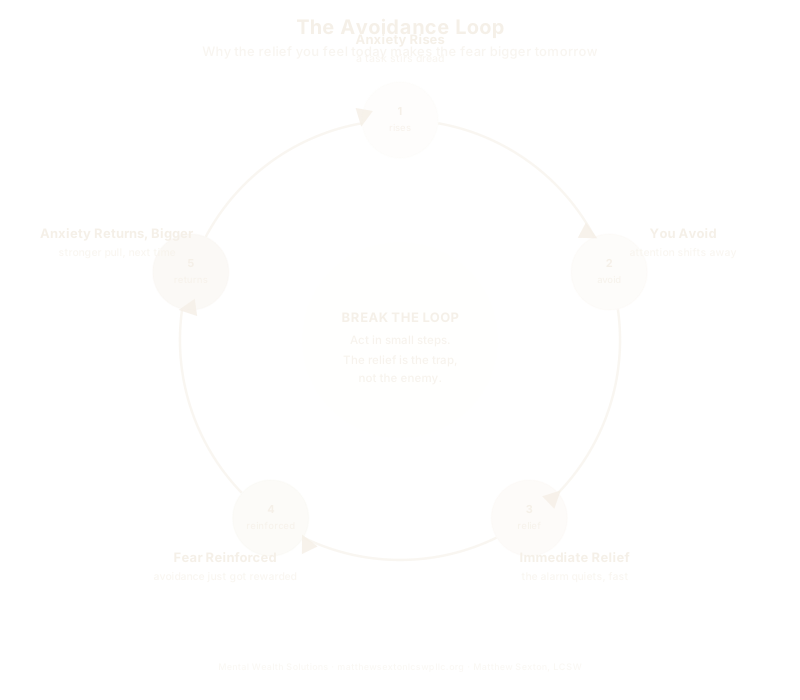
You think about the hard thing. Your body tenses, the dread rises, a small alarm goes off. You turn your attention to something else, an easier task, your phone, a snack, a suddenly urgent email. The alarm quiets. That drop in discomfort feels good, and it happens fast.
That fast drop is the problem. In behavioral terms, avoidance is negatively reinforced: the behavior gets stronger because it removes something unpleasant (Wang, Tian and Yang, 2024). Your brain files away a lesson it learned very efficiently, which is that avoiding the thing made the bad feeling go away. Next time the dread rises, the pull to avoid is a little stronger, because last time it worked.
Then comes the part that tightens the trap. Because you never actually approached the hard thing, you never got to find out whether it was as bad as your anxiety insisted. The fear goes unchallenged, so it stays intact, and often grows. The project you have been avoiding for three months is now scarier than it was on day one, not because the project changed but because avoidance let the fear compound in the dark. Avoidance buys you relief today and sells you a bigger version of the same fear tomorrow. NIMH puts the general principle simply: avoidance may bring temporary relief, but over time it tends to make anxiety worse, not better (NIMH, Anxiety Disorders).
This is why willpower and self-criticism rarely fix it. Telling yourself you are being lazy adds shame on top of the anxiety, and shame is itself an aversive feeling you will then want to avoid. That is how a bad morning of procrastination rolls into a bad week. If any of this is starting to sound like a slow leak rather than a dramatic collapse, you might recognize yourself in silent burnout, where "I'm fine" is the symptom.
Is This Actually Common, or Is It Just Me?
It is common, and the numbers are not small. Chronic procrastination, the kind that spreads across most areas of life rather than showing up on one bad Tuesday, has risen from an estimated 5 percent of adults in the 1970s to around 20 percent today, according to procrastination researcher Piers Steel (University Affairs, 2019). About one in five adults, in other words, is a chronic avoider of the things they mean to do.
Anxiety, the engine underneath, is more common still. An estimated 19.1 percent of U.S. adults had an anxiety disorder in the past year, and roughly 31 percent will meet criteria for one at some point in their lives, according to the National Institute of Mental Health's analysis of national survey data (NIMH, Any Anxiety Disorder). Among adults with an anxiety disorder, an estimated 22.8 percent had serious impairment in their daily functioning. None of that means you have a diagnosis, and reading a blog is no way to get one. It means the wiring behind the successful-avoider pattern is ordinary human wiring, running in a lot of capable people who look, from the outside, like they have it handled.
Is Avoidance the Same as Rest, or Am I Just Recovering?
A fair question, and worth taking seriously, because not every pause is avoidance. Rest restores your capacity. A boundary protects your time or your values. A thoughtful delay has a reason and a return point. If you have been running on empty, lying low is legitimate, and mistaking real depletion for avoidance just adds a layer of self-attack you do not need.
The difference tends to show up in what happens afterward. Healthy rest helps you re-enter your life; avoidance quietly removes options and leaves the decision running in the background, collecting mental interest. When you are not sure which one you are in, four plain questions usually sort it out:
- Did I choose this pause on purpose, or did I slide into it?
- Is there a specific time when I will come back to the thing?
- Does the delay actually improve the decision, or mainly lower my anxiety right now?
- Is my world getting wider or narrower because of this pattern?
If the honest answers point toward sliding, no return point, pure relief, and a shrinking world, you are probably looking at avoidance rather than recovery. This line matters most when you are spending long stretches horizontal after a hard week; I sorted through that specific tangle in bed rotting: self-care or avoidance.
How Do You Take Your Agency Back?
You reverse the loop. The loop works by giving you relief for retreating, so you build a new pattern that gives you a small win for approaching. This is not a matter of forcing yourself to white-knuckle the whole scary thing at once. It is a matter of shrinking the thing until the first step is small enough to be doable, then letting your own experience, rather than your anxiety's predictions, teach you what the thing is really like.
A few things that actually help, drawn from how this is worked in therapy:
Name the feeling, not just the task. Instead of "I have to finish the proposal," try "I'm avoiding the proposal because I'm scared it won't be good enough." Naming the emotion underneath does two things: it tells you this is an anxiety problem rather than a discipline problem, and it lowers the charge slightly just by making it explicit.
Make the first step embarrassingly small. Not "write the report" but "open the document and write one ugly sentence." Not "call the doctor" but "open the patient portal and draft the request." The goal of the first step is not progress, it is to approach the thing without your body sounding the alarm, so your nervous system gets new evidence that contact with this task is survivable. Give the first pass a deliberately small job, too: a draft exists to make the second draft possible, an appointment exists to gather information. Watch for the productive-looking safety behaviors, rewriting the same opening, over-researching, rehearsing every reaction, that lower anxiety without moving you forward, and cap them with a deadline: "I will review for twenty minutes, then send."
Put the hard thing in the hard slot, and protect it. High achievers tend to give their best energy to everyone else's priorities and leave the avoided task for "later," when willpower is already spent. Schedule the thing you are avoiding first, when you have the most capacity, even if the block is only fifteen minutes.
Let the discomfort be there without obeying it. The feeling that says "not now, later" is not a command. Expect the urge to escape and decide in advance how you will meet it: stay two more minutes, complete one micro-step, then reassess, rather than renegotiating the whole plan in the heat of the moment. Every time you do, you write a new lesson: the dread comes up, and I move toward the thing regardless, and nothing catastrophic happens.
Track the cost of delay as honestly as the cost of action. Avoidance sells itself as protection. Write down what the delay has already cost you, sleep, health data, creative momentum, a relationship going quietly stale, your own self-trust. Concrete costs make the short-term relief a lot less persuasive.
Drop the self-attack. Self-criticism feels productive and is the opposite. Treating your own avoidance with a little curiosity ("what am I afraid of here?") instead of contempt ("what is wrong with me?") keeps you from adding shame to the pile you are already trying not to feel.
One honest caveat about doing this alone. The mechanism is simple to describe and genuinely hard to run against a nervous system that has been rewarded for avoiding for years. That is not a personal weakness, it is how the wiring works. If the important things have been stalled for months, if the avoidance is quietly costing you at work or in your relationships or your health, that is a reasonable point to bring in help rather than keep grinding solo.
When Is It Worth Talking to a Therapist?
When the pattern is stable and it is costing you something. A useful, non-dramatic test: has some hard-but-important thing been stuck for weeks, not because you lack the skill to do it but because you keep flinching away from it, and is that stall now interfering with your work, your relationships, or your wellbeing? SAMHSA's guidance points to duration and impact as the real signal for seeking support: when changes in mood, thoughts, or behavior make it hard to manage work, home, or relationships over a sustained stretch, that is the marker (SAMHSA). NIMH describes anxiety the same way, judged not by whether you feel it but by whether it is interfering with your daily life (NIMH, Anxiety Disorders).
Therapy for this is not about being told to try harder. It is about learning to feel the anxiety and move toward the thing anyway, in small, repeatable steps, until approaching stops being an emergency. Part of the work, for people who have been the capable one for a long time, is letting others see you struggle in real time, which can feel more dangerous than the original task and is still worth practicing. Competence without contact becomes a cage. Therapy for high-functioning anxiety is built around exactly this pattern: the competent person whose competence has been quietly propped up by avoiding the few things that scare them most.
If you recognize yourself in the successful avoider, you are welcome to book the call to talk about whether this is a fit. The list of things you have been not-doing does not have to keep growing. You can take that back.
Is my procrastination a sign of anxiety or just poor discipline?
If you reliably get easy or low-stakes tasks done and only stall on specific high-stakes ones, that pattern points toward anxiety, not a general discipline problem. Researchers increasingly understand chronic procrastination as an emotion-regulation strategy: you put off a task to relieve the uncomfortable feeling it brings up, prioritizing short-term mood over the long-term goal (Sirois and Pychyl, 2022). Task aversiveness, how threatening a task feels, is one of the strongest predictors of avoiding it (Steel, 2007). The things you avoid tend to be the ones you care about most.
Why do I avoid the things I care about most while easy tasks get done?
Because the things you care about carry the most emotional risk. A task you are indifferent to cannot really hurt you if it goes badly. A high-stakes project you care about carries the fear that you will try your hardest and it still will not be good enough, which is threatening for anyone whose identity runs on competence. Staying busy with tasks you know you can win at protects you from ever testing that fear.
How do I know whether I am avoiding or genuinely too depleted to act?
Look at capacity and pattern. Depletion tends to affect many areas at once and often eases with real rest or practical support. Avoidance tends to cluster around particular feelings or outcomes and comes right back when the task comes back. Both can be true at the same time, and sorting out what needs recovery versus gradual approach is a large part of what therapy helps with.
What is the first step to breaking the pattern?
Make the first step so small it does not trigger the alarm. Not "write the report" but "open the document and write one ugly sentence." The point of the first step is not progress, it is approaching the task without your nervous system sounding the alarm, so you gather new evidence that contact with the task is survivable. Repeated small approaches gradually rewrite the lesson your brain learned from years of retreating.
When should I consider therapy for this?
When the pattern is stable and costing you something. If an important thing has been stalled for weeks because you keep flinching from it, and that stall is now interfering with your work, relationships, or wellbeing, that is a reasonable point to seek support. SAMHSA points to sustained duration and functional impact as the signal, not the presence of the feeling itself (SAMHSA; NIMH, Anxiety Disorders).
Sources
- Sirois, F. and Pychyl, T., work summarized in "'I'll Worry About It Tomorrow' – Fostering Emotion Regulation Skills to Overcome Procrastination," Frontiers in Psychology, 2022. pmc.ncbi.nlm.nih.gov
- Steel, P., "The Nature of Procrastination: A Meta-Analytic and Theoretical Review of Quintessential Self-Regulatory Failure," Psychological Bulletin, 2007. studypedia.au.dk
- Wang, Y., Tian, J. and Yang, Q., "Experiential Avoidance Process Model: A Review of the Mechanism for the Generation and Maintenance of Avoidance Behavior," Psychiatry and Clinical Psychopharmacology, 2024. pmc.ncbi.nlm.nih.gov
- Cleveland Clinic, "Signs You Have High-Functioning Anxiety," May 16, 2022. health.clevelandclinic.org
- "The Pull of Procrastination" (Dr. Piers Steel on the rise of chronic procrastination from ~5% to ~20% of adults), University Affairs, 2019. universityaffairs.ca
- National Institute of Mental Health, "Any Anxiety Disorder" (prevalence and impairment statistics). nimh.nih.gov
- National Institute of Mental Health, "Anxiety Disorders." nimh.nih.gov
- SAMHSA, "Signs You May Need Support." samhsa.gov
This article is for educational and informational purposes only. It does not constitute medical, clinical, legal, or therapeutic advice, and reading it does not create a therapist-client relationship with Matthew Sexton, LCSW or Matthew Sexton LCSW PLLC. Although the author is a licensed clinical social worker, the content in this article is not clinical assessment, diagnosis, or treatment.
The mechanisms and patterns described here reflect published research and general clinical observation about avoidance, anxiety, and procrastination, not an individualized assessment of your situation. Individual circumstances vary, and a pattern that fits one person may not fit another. If avoidance, anxiety, or low mood persists and interferes with your work, relationships, or daily life for two weeks or more, please consult a licensed mental health professional who can assess your specific circumstances.
If you are in immediate emotional crisis, you can reach the 988 Suicide & Crisis Lifeline by calling or texting 988 (US). If you are experiencing domestic violence or are in physical danger, contact the National Domestic Violence Hotline at 1-800-799-7233 or visit thehotline.org. In a life-threatening emergency, call 911.