More U.S. workers are taking job-protected leave for their mental health, using a therapist's certification rather than staying quiet and pushing through, according to Bloomberg's reporting on rising FMLA use tied to workplace stress and anxiety (Bloomberg, July 8, 2026). Under federal FMLA, an anxiety, depression, or dissociative disorder can qualify as a "serious health condition" if it involves inpatient care or ongoing treatment, and a licensed clinical social worker or clinical psychologist is explicitly named as someone who can certify it. No diagnosis has to appear on the form. In New York, your own condition falls under paid sick leave and disability benefits, not Paid Family Leave, which is a distinction worth knowing before you ask HR anything.
By Matthew Sexton, LCSW · July 16, 2026
Bloomberg reported on July 8, 2026 that a rising number of U.S. workers are taking job-protected mental health leave, often supported by a therapist's certification, as workplace stress and anxiety push people to use the leave laws already on the books. If that headline made you think "wait, could I do that," this post is for you. Taking time off for your mind is not a loophole. It is written into federal and New York law, and knowing which law applies to which situation is the confusing part. Let's walk through it plainly.
Is a mental health condition "serious" enough for FMLA?
Under federal law, an anxiety disorder, major depression, or a dissociative condition can meet the bar for a "serious health condition," the standard the Family and Medical Leave Act (FMLA) uses to decide who qualifies for protected leave (U.S. Department of Labor Fact Sheet #28O). You don't need a hospital stay to qualify. Continuing outpatient treatment can be enough on its own.
The DOL sets out two paths. The first is inpatient care, meaning an overnight stay in a hospital or treatment facility. The second, more common path is "continuing treatment," which covers two situations: being unable to function for three or more consecutive days while receiving ongoing care, or having a chronic condition, like an anxiety disorder or a dissociative disorder, that requires treatment at least twice a year over an extended period (DOL Fact Sheet #28).
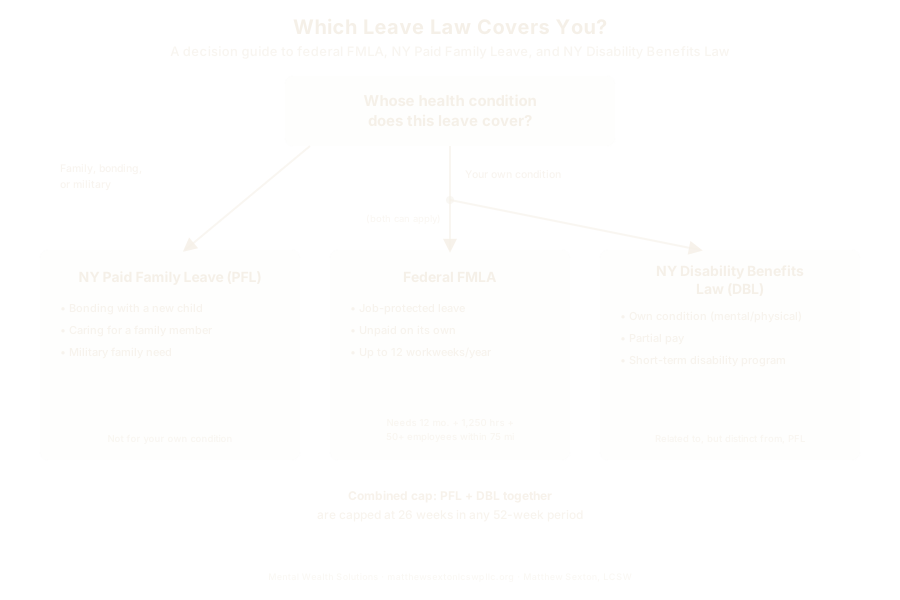
If you qualify, FMLA gives you up to 12 workweeks of leave in a year. That leave is job-protected, meaning your employer has to hold your position or an equivalent one for you. It is also unpaid on its own, which trips people up. FMLA protects your job. It does not guarantee a paycheck while you're out, which is where New York's own laws come in later in this post.
FMLA eligibility has its own checklist. You need 12 months with your employer, at least 1,250 hours worked in the past year, and a worksite with 50 or more employees within 75 miles. Covered employers are private companies with 50+ employees for at least 20 workweeks, plus all public agencies and schools regardless of size (DOL Fact Sheet #28). Smaller private employers sit outside FMLA entirely, though New York's state-level protections below still apply to them.
Who can actually sign off on the leave?
A licensed clinical social worker or clinical psychologist is named directly in federal FMLA regulation as someone who can certify your need for leave, alongside physicians, nurse practitioners, and physician assistants (DOL Fact Sheet #28O; DOL Fact Sheet #28G). This matters more than it sounds like it should, because a lot of people assume only a psychiatrist's word counts.
The certification form asks for enough detail to support the need for leave, not a diagnosis. Your provider describes the condition, the treatment plan, and the expected duration, in general clinical terms. Your employer is not entitled to your diagnosis, your session notes, or the specifics of what you're working through in therapy.
Practically, that means your therapist or prescriber fills out a form, and your employer's HR or leave-administration team reviews it. It is a paperwork process, not a hearing. One honest note: not every type of therapist sits in the same clear regulatory spot as a clinical social worker or psychologist. If your provider is a licensed professional counselor or marriage and family therapist, ask them directly whether they can certify, or loop in your prescriber.
Does New York Paid Family Leave cover my own mental health?
No. New York Paid Family Leave (PFL) is built for bonding with a new child, caring for a family member with a serious health condition, or a military family need, not for your own illness (Paid Family Leave, New York State). This is the single most common mix-up people run into when they start researching this topic, so it's worth saying plainly upfront.
If the leave is for your own condition, mental or physical, the relevant New York benefit is Disability Benefits Law (DBL), a separate short-term disability program that isn't specific to mental health (New York State Workers' Compensation Board). DBL and PFL are related but distinct. Combined, PFL and DBL benefits are capped at 26 weeks within any 52-week period.
It's a strange piece of the system. The program with "family" in the name is for family and bonding. The program that actually covers you runs on different rates and rules. If you're filing for your own mental health leave in New York, DBL, not PFL, is where the conversation with HR should start.
What does NY Paid Sick Leave actually cover?
New York's Paid Sick Leave law, in effect since January 1, 2021, explicitly covers your own mental or physical illness, including a condition that hasn't been formally diagnosed yet (NY Labor Law §196-b). This is the most immediately useful protection for a bad week or a rough stretch that doesn't rise to a full leave of absence.
You accrue one hour of sick leave for every 30 hours worked. Employers with 100 or more employees have to allow up to 56 hours a year; smaller employers, up to 40 hours a year. Employers with five or more employees, or with over $1 million in net income, have to pay for this leave. Smaller, lower-revenue employers can offer it unpaid instead (NY.gov Paid Sick Leave).
Here's the part worth underlining: your employer cannot require you to disclose the specific condition to use this leave. You don't have to say "anxiety" or "depression" out loud to your manager. You just have to say you're using sick leave. That privacy protection is written into the law itself, not something you have to negotiate for.
Is this leave surge actually real, or just a headline?
Bloomberg's July 2026 reporting on rising FMLA use for mental health lines up with a longer trend already visible in absence-management data. Mental-health-related leaves of absence rose 300% between 2017 and 2023, and 33% in 2023 alone, according to claims data from ComPsych, a national employee-assistance and absence-management firm (ComPsych, reported 2024).
That's older data, so treat it as the longer arc, not a fresh 2026 number. But the direction matches what Bloomberg is describing now: more workers using leave that already existed, not some brand-new law. Workplace stress hasn't been trending down, and therapists are more comfortable writing certifications than they might have been a decade ago. Neither is a legal change. Both are a culture shift, and culture shifts eventually show up in the data.
What do I do if I think I need this?
Start with your own provider, not with HR. A therapist who knows your history is the right person to help you figure out whether your situation fits the "serious health condition" standard, and whether a shorter break, a reduced schedule, or a full leave makes more sense for you. That conversation belongs in the therapy room first.
From there, HR or a leave-administration vendor walks you through the actual forms, since FMLA, DBL, and paid sick leave each carry their own paperwork and timelines. None of it requires explaining yourself to a manager.
If you're trying to figure out whether what you're feeling is a rough patch or something that needs real support, that's a conversation worth having before any paperwork gets involved. You're welcome to start with a call whenever you're ready, and we can sort out together what kind of support actually fits.
Can my therapist really sign my FMLA paperwork?
Yes, if your therapist is a licensed clinical social worker or clinical psychologist, federal FMLA regulation names both directly as certifiers, alongside physicians, nurse practitioners, and physician assistants (DOL Fact Sheet #28O). If your provider is an LPC or MFT, ask them directly, since some license types sit in a grayer spot in the federal text.
Do I have to tell my employer my diagnosis?
No. FMLA certification requires enough clinical detail to support the need for leave, not a diagnosis (DOL Fact Sheet #28G). Under New York Paid Sick Leave, your employer also cannot require you to disclose your specific condition to use the leave (NY Labor Law §196-b).
Does New York Paid Family Leave cover my own anxiety or depression?
No. PFL covers bonding with a new child, caring for a family member, or a military family need, not your own condition (Paid Family Leave, New York State). Your own mental health leave falls under New York Disability Benefits Law instead, a separate short-term disability program.
Is FMLA leave paid?
No, FMLA itself is unpaid. It protects your job for up to 12 workweeks, not that you'll be paid while out (DOL Fact Sheet #28). In New York, Disability Benefits Law can provide partial pay during your own serious health condition, separately from FMLA's job protection.
How much paid sick leave can I use for a mental health day in New York?
It depends on your employer's size. You accrue one hour per 30 hours worked, up to 56 hours a year at employers with 100+ employees, or 40 hours a year at smaller ones (NY.gov Paid Sick Leave). This leave has covered your own mental or physical illness, diagnosed or not, since January 1, 2021.
Sources
- Bloomberg. "Mental Health Leave Is Rising as More US Workers Take FMLA Time Off." July 8, 2026. https://www.bloomberg.com/news/articles/2026-07-08/mental-health-leave-is-rising-as-more-us-workers-take-fmla-time-off
- U.S. Department of Labor, Wage and Hour Division. "Fact Sheet #28: The Family and Medical Leave Act." https://www.dol.gov/agencies/whd/fact-sheets/28-fmla
- U.S. Department of Labor, Wage and Hour Division. "Fact Sheet #28O: Mental Health Conditions and the FMLA." https://www.dol.gov/agencies/whd/fact-sheets/28o-mental-health
- U.S. Department of Labor, Wage and Hour Division. "Fact Sheet #28G: Certification of a Serious Health Condition under the FMLA." https://www.dol.gov/agencies/whd/fact-sheets/28g-fmla-serious-health-condition
- New York State. "Paid Family Leave and Other Benefits." https://paidfamilyleave.ny.gov/paid-family-leave-and-other-benefits
- New York State Workers' Compensation Board. "Employee Eligibility / Benefits — Disability Benefits Law." https://www.wcb.ny.gov/content/main/DisabilityBenefits/employee-eligibility-benefits.jsp
- New York State Senate. Labor Law §196-b, New York Paid Sick Leave. https://www.nysenate.gov/legislation/laws/LAB/196-B
- New York State. "Paid Sick Leave" program page. https://www.ny.gov/programs/new-york-paid-sick-leave
- ComPsych. "Mental Health Leaves of Absence Surge, Increasing 33% Over Prior Year." February 29, 2024. https://www.compsych.com/press-release/mental-health-leaves-of-absence-surge-increasing-33-over-prior-year/
This article is for educational and informational purposes only. It does not constitute medical, clinical, legal, or therapeutic advice, and reading it does not create a therapist-client relationship with Matthew Sexton, LCSW or Matthew Sexton LCSW PLLC. Although the author is a licensed clinical social worker, the content in this article is not clinical assessment, diagnosis, or treatment.
Federal FMLA rules, New York Paid Family Leave, New York Disability Benefits Law, and New York Paid Sick Leave each have their own eligibility rules, forms, and deadlines, and these can change after this article is published or vary based on your specific employer and plan. Nothing in this article is legal advice. If you are weighing a mental health leave, please confirm your specific eligibility and paperwork with your employer's HR or leave-administration team, or consult an employment attorney, in addition to talking with a licensed mental health professional about your clinical needs.
If you are in immediate emotional crisis, you can reach the 988 Suicide & Crisis Lifeline by calling or texting 988 (US). If you are experiencing domestic violence or are in physical danger, contact the National Domestic Violence Hotline at 1-800-799-7233 or visit thehotline.org. In a life-threatening emergency, call 911.