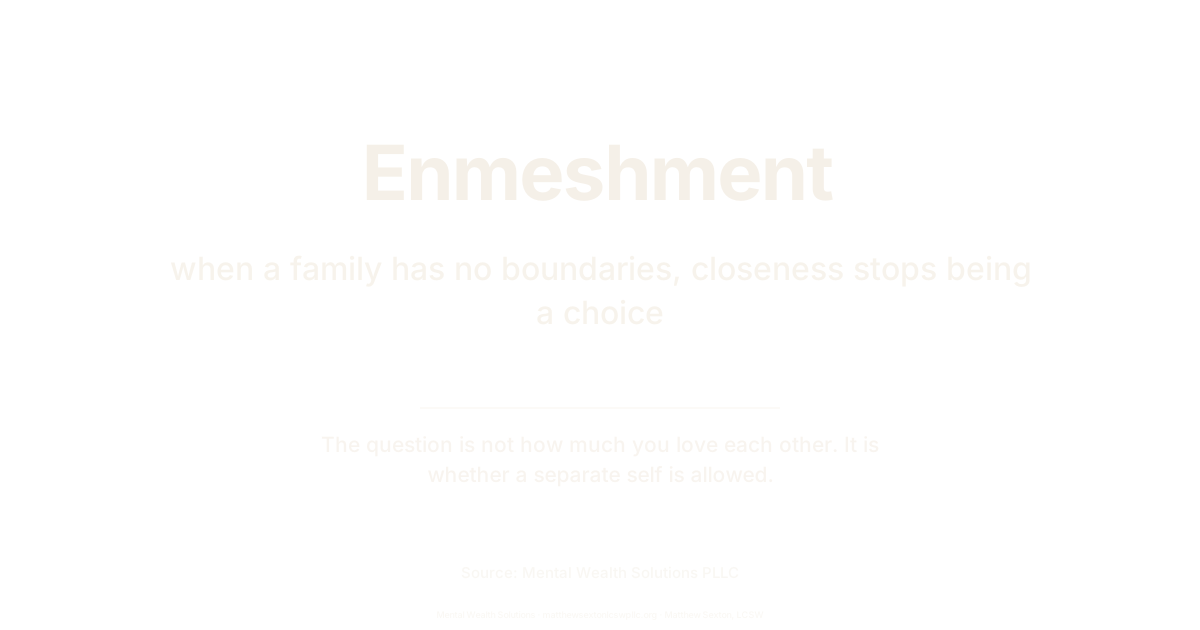
Enmeshment is not too much love. It is a missing boundary: a family system where individual edges are so blurred that people cannot easily tell whose feeling is whose. Murray Bowen called the capacity to hold onto a separate self while staying connected to family differentiation of self. In a 2021 study of 185 Spanish young adults (average age 22) in PLoS ONE, it correlated with trait anxiety at r = −.69 — roughly 48% of the variance. Family functioning and differentiation together predicted 50.3%. That study is cross-sectional and correlational, so it cannot prove enmeshment causes anxiety, but it locates something clinicians see constantly: adults with free-floating anxiety and no idea what they actually want. The sample was 185 Spanish young adults, average age 22 and mostly early-twenties, measured at a single moment, which is why the honest reading is that low differentiation and anxiety travel together rather than that one produces the other.
Matthew Sexton, LCSW, NATC — Licensed clinical social worker in private practice, providing telehealth psychotherapy to adults in New York.
The reason enmeshment is so hard to spot from the inside is that it does not feel like harm. It feels like closeness, and often like virtue. The family's own story about itself is usually flattering: we tell each other everything, we're each other's best friends, we don't do secrets.
Which is why nobody arrives in a therapy office saying they were enmeshed. They arrive saying they feel guilty all the time and cannot work out why.
What enmeshment actually means
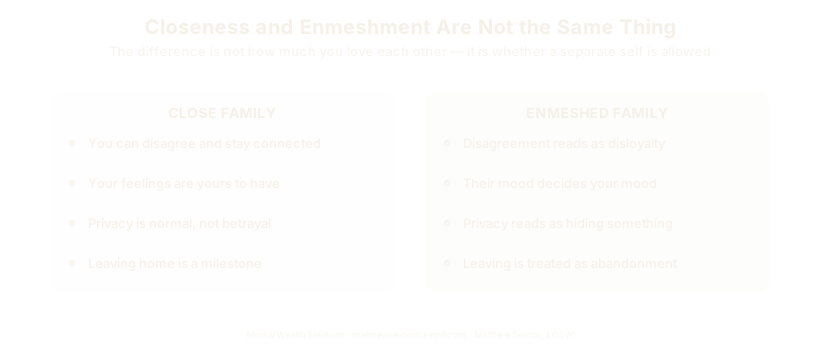
Enmeshment is a term from Salvador Minuchin's structural family therapy. It describes boundaries inside a family that have gone diffuse — so permeable that members cannot fully separate their own identity, emotions and needs from everyone else's. Its opposite extreme is disengagement, where the boundaries are so rigid that nobody reaches anybody. Both are failures of the same regulating function, which is how a family manages closeness and distance.
| A close family | An enmeshed family | |
|---|---|---|
| Disagreement | Tolerated; you can hold a different view and stay close | Read as betrayal or disloyalty |
| Feelings | Yours are yours; others' are theirs | One person's mood becomes everyone's mood |
| Privacy | Assumed, not negotiated | Read as rejection or as hiding something |
| Leaving home | A milestone the family supports | An injury the family absorbs |
Murray Bowen, working in parallel, named the individual capacity involved: Differentiation of self is the ability to hold onto your own thinking and emotional separateness while remaining in real contact with your family. Fusion is Bowen's word for low differentiation.
The practical translation is simple. In a differentiated family you can be close and still be a separate person. In an enmeshed one, closeness and separateness are treated as opposites, so wanting privacy reads as rejection and having a different opinion reads as betrayal.
Note what enmeshment is not. It is not a close family. It is not warmth, frequent contact, or a family that likes each other. Plenty of families talk daily and are perfectly differentiated. The distinguishing feature is not the volume of contact. It is whether a separate self is permitted inside it.
What the research actually found
The 2021 study by Dolz-del-Castellar and Oliver looked at 185 Spanish young adults — average age 22, range 18 to 56 — and measured three things: how the family functions, how differentiated the individual is, and trait anxiety. That age profile matters: this is early-adulthood data, and it is a fair question how far it stretches to someone renegotiating a family at 45. In plain terms: they asked how the family works, how separate a self each person has, and how anxious they tend to be — then looked at how those track together.
The results, in order of strength:
- Differentiation of self and trait anxiety: r = −.69. The less differentiated a person was, the higher their trait anxiety. This accounted for about 48% of the variance, an unusually strong relationship for this kind of research.
- Family functioning and trait anxiety: r = −.44.
- Family functioning and differentiation of self: r = .43. Family functioning predicted about 19% of the variance in differentiation.
- Together, family functioning and differentiation predicted 50.3% of trait-anxiety variance.
- Differentiation partially mediated the path from family functioning to anxiety.
That mediation finding is the interesting one. One reading is that the family environment is linked to anxiety less directly than it is linked to how separate a self a person builds. The design cannot confirm that order, but it is the pattern the numbers fit.
Two honest limits, because they matter. This was 185 people in Spain, and it was cross-sectional: everything measured at one time point. That design cannot tell you which came first. Highly anxious people may differentiate less, rather than low differentiation producing anxiety, and the study cannot separate those. What it establishes is a strong association, not a mechanism.
How enmeshment shows up in adults
The presentation is rarely dramatic. It tends to sound like this. None of this is a test, and matching a few of these does not tell you what your family was.
Not knowing what you want. Asked to pick a restaurant, a career, a place to live, you genuinely cannot locate a preference, not out of politeness, but because the machinery for having one independent of other people's reactions never got built.
Guilt with no offense attached. A background hum of having done something wrong, which intensifies around ordinary separateness: taking a trip, not answering a call, having a private thought.
Feeling other people's feelings as your own. A parent's disappointment lands in your body indistinguishably from your own. In an enmeshed system this is trained, because reading the emotional weather accurately was how you stayed safe and useful.
Anxiety without an object. This is the piece the research speaks to most directly. Not fear of something specific, just a persistent readiness with nothing to point at. If you have read about high-functioning anxiety, this is one of the family patterns it often shows up alongside.
Adult relationships that go too deep too fast, or stay carefully shallow. Both make sense as adaptations. If closeness has always meant losing your edges, you either merge immediately because that is what closeness means, or you keep everyone at a distance to protect a self you are not confident you can hold onto.
Being the family's emotional infrastructure. The confidant, the referee, the one who manages a parent's moods. Usually described with pride, and often the reason there was no room for a separate life.
The part that makes it hard to change
Enmeshment protects itself with a very effective move: it makes the first step look like cruelty.
In a differentiated family, saying I'd rather not talk about that is a normal sentence. In an enmeshed one, that sentence is an event. It gets read as coldness, as an accusation, as evidence that something is wrong with you or that someone has turned you against the family. So the cost of a boundary is not just the discomfort of setting it. It is being told, sincerely and often tearfully, that setting it makes you a bad person.
Most people I have worked with on this are usually not fighting the family. They are fighting their own guilt, which is doing the family's work on the inside. That is why boundaries and family guilt are really one problem rather than two.
I also want to be clear about something the internet gets wrong. A boundary is not estrangement. The loudest advice online treats going no-contact as the natural endpoint, and for the overwhelming majority of people it is neither necessary nor what they want. The clinical work almost always lives in the wide middle: staying in contact and becoming a separate person inside it. That is harder than leaving, and it is usually the actual goal.
It is also worth distinguishing enmeshment from families organized around a genuinely disordered parent. Diffuse boundaries can exist in a family where everyone means well. When there is an active pattern of triangulation and control, that is a different situation with different safety considerations, and the strategies are not interchangeable.
Therapy for enmeshment: what the work involves
Not confrontation. Mostly it is much quieter and slower than people expect.
Learning to notice whose feeling this is. The first genuinely useful skill is a pause long enough to ask whether the distress you are feeling originated in you. Early on the answer is often unclear, and noticing that it is unclear is already progress.
Practicing very small separateness. Not the confrontation about the holidays. Taking four hours to reply. Having an opinion about a film that differs from your mother's and saying it out loud. Differentiation is built in low-stakes reps, and starting with the hardest conversation is how people conclude it cannot work.
Tolerating the other person's reaction without managing it. This is the actual muscle. Someone you love is upset, you did nothing wrong, and you neither fix it nor collapse. Deeply uncomfortable, and the whole game.
Letting guilt be present without treating it as evidence. Guilt after a reasonable boundary is a conditioned response, not a verdict. It shows up on schedule and it does not mean you erred.
Building a self with content. Preferences, opinions, interests that are yours. This sounds soft next to the boundary work and it is at least as important. A boundary defends something, and it helps to know what.
Bowen's framing is worth keeping because it removes the false choice. The goal is not distance. It is being a person while staying in the room.
If you grew up in a family with no edges and you are trying to find yours, book a call. That is workable, and it is a lot of what I do.
Related reading
- Setting boundaries with family without drowning in guilt
- Triangulation in personality-disordered families
- Am I becoming my parent?
- High-functioning anxiety, from the inside
What's the difference between an enmeshed family and a close family?
Whether a separate self is allowed inside the closeness. Close, differentiated families talk often, like each other, and can tolerate a member having different opinions, private thoughts, and time apart without treating any of it as rejection. In an enmeshed family, closeness and separateness are experienced as opposites, so privacy reads as secrecy and disagreement reads as disloyalty. The test is not how much contact there is. It is what happens when someone wants a little less of it. If ordinary separateness reliably triggers a crisis, that is the distinguishing feature.
Does enmeshment cause anxiety?
The research cannot say that, and I would not claim it. The 2021 PLoS ONE study found a strong association: differentiation of self and trait anxiety correlated at r = −.69, roughly 48% of the variance, and found that differentiation partially mediated the relationship between family functioning and anxiety. But it was cross-sectional and correlational with 185 participants in Spain, which means it measured everything at one moment and cannot establish direction. It is equally consistent with anxious people differentiating less. The honest statement is that low differentiation and anxiety travel together strongly, and in my experience the family environment is part of that story.
Do I have to cut off my family to recover from enmeshment?
Almost never, and I want to push back on how common that advice has become online. Estrangement is a serious decision with real long-term costs, and it is not the natural endpoint of boundary work. The great majority of this work happens while staying in contact, becoming a differentiated person inside an ongoing relationship, which is harder than leaving and usually what people actually want. Cutting off contact is a safety decision that belongs in a small number of situations, most often involving abuse, and it should be made with support rather than as a first move.
Why do I feel so guilty for setting completely reasonable boundaries?
Because in an enmeshed system the guilt is doing a job. If separateness has historically been treated as betrayal, then your own guilt becomes the mechanism that keeps the boundaries diffuse without anyone having to enforce it from outside. The important reframe is that guilt is not evidence. It is a conditioned alarm that fires when you do something the old system prohibited, and it fires just as loudly for a completely reasonable request as for an actual wrong. The work is not eliminating the guilt. It is learning to act well while it is present, at which point it usually quiets down on its own.
Sources
- Dolz-del-Castellar, B., & Oliver, J. (2021). Relationship between family functioning, differentiation of self and anxiety in Spanish young adults. PLoS ONE, 16(3), e0246875. doi.org/10.1371/journal.pone.0246875 · full text: pmc.ncbi.nlm.nih.gov
- Minuchin, S. (1974). Families and Family Therapy. Harvard University Press. The structural-family-therapy account of enmeshment as diffuse boundaries.
- Bowen, M. (1978). Family Therapy in Clinical Practice. Jason Aronson. Differentiation of self and fusion.
This article is for educational and informational purposes only. It does not constitute medical, clinical, legal, or therapeutic advice, and reading it does not create a therapist-client relationship with Matthew Sexton, LCSW or Mental Wealth Solutions PLLC. Although the author is a licensed clinical social worker, the content in this article is not clinical assessment, diagnosis, or treatment.
The study described here is cross-sectional and correlational, conducted with 185 participants in Spain. Correlations describe patterns across a sample rather than predictions about any individual, and a cross-sectional design cannot establish that one thing caused another. Enmeshment is a clinical concept from family-systems theory, not a diagnosis. Individual experiences vary widely, and decisions about family relationships, including any decision about contact, deserve support from a licensed professional who knows your specific circumstances. This article is published by Matthew Sexton, LCSW, NATC, PLLC. Nothing here is a screening instrument, and nothing here can tell you what happened to you.
If you are in immediate emotional crisis, you can reach the 988 Suicide & Crisis Lifeline by calling or texting 988 (US). If you are experiencing domestic violence or are in physical danger, contact the National Domestic Violence Hotline at 1-800-799-7233 or visit thehotline.org. In a life-threatening emergency, call 911.