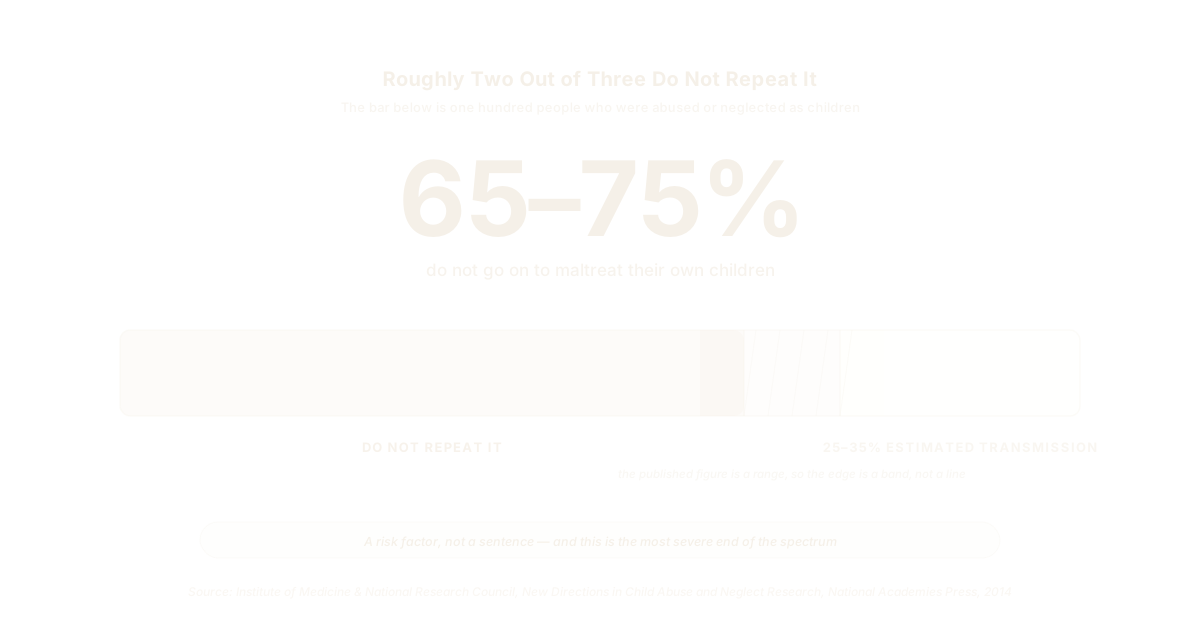
No, this is not destiny, and the evidence says so plainly. The U.S. National Academies' 2014 consensus report on child abuse and neglect research puts the intergenerational transmission rate at roughly one-third, with estimates ranging from 25 to 35 percent. Read it the other way, which is the way that matters if you are frightened right now: somewhere between 65 and 75 percent of people who were abused or neglected as children do not go on to do it to their own. The research on what separates those two groups keeps landing on the capacity to notice the pattern and think about it. That is the capacity you are using at this exact moment.
By Matthew Sexton, LCSW, NATC — a licensed clinical social worker in private practice in New York, working with adults by telehealth across New York, Maine, Delaware, and Florida.
Most people who find their way to a page like this got here after a specific ten seconds.
Something small happened. Juice went over the edge of the counter, or a jacket did not get picked up for the fourth time, or bedtime turned into a negotiation at 9:40 on a night when you had nothing left. And a voice came out of you. The tone was not yours. The words were not yours either. They were your mother's, or your father's, delivered with a precision you did not know you had memorized.
Then your kid's face changed, and the floor dropped out.
Am I becoming my parent, and is the "cycle" real?
Yes, and it is smaller than the phrase makes it sound.
The largest study on the question is a meta-analysis by Sheri Madigan and colleagues, published in Development and Psychopathology in February 2019. It pooled 142 studies covering 227,918 parent–child pairs. The association between a parent's own history of maltreatment and their child's was real, and the authors' own word for its size, used twice, was modest, an effect size of d = 0.45.
The second half of their finding almost never gets repeated. They reported that methodological quality significantly moderated the results for physical abuse, "with a weakening of effect sizes as methodological rigor increased." In plain language: the better the study design, the smaller the cycle looks. That is the opposite of what you would expect if it were as automatic as the folk wisdom suggests.
This is not a new argument. In April 1987, Joan Kaufman and Edward Zigler reviewed the literature behind the belief that abused children become abusive parents, in the American Journal of Orthopsychiatry, and concluded that its unqualified acceptance was unfounded. That was nearly forty years ago. The belief outlived the evidence for it.
Two honest limits, because you have probably been handed reassurance that fell apart when you looked at it. None of this says the cycle is a myth. Madigan's team explicitly wrote that their evidence confirms the transmission hypothesis, with modest effect sizes. A modest, real association is what the science supports, and overclaiming in the comforting direction is still overclaiming.
And nearly all of this research studies documented maltreatment, the severe end of a very wide spectrum. Many people reading this had a childhood that was painful, frightening, lonely, or emotionally starved without ever meeting that threshold. If your family ran on assigned roles and shifting favor, or on a parent who was physically present and emotionally out of reach, the maltreatment literature is describing something more severe than what happened to you. And even there, most people do not repeat it. That should make the reassurance land harder, not softer. If the gap between those two things is exactly where you get stuck, this piece on wondering whether it was bad enough sits with that question directly.
Why hearing your parent's voice is evidence in your favor
In the London Parent–Child Project, Peter Fonagy and colleagues rated mothers on reflective functioning: the capacity to make sense of behavior, their own and their child's, in terms of what is going on inside a person. The rating came from an interview about the mother's own childhood, before the baby's attachment was ever assessed.
Among mothers who reported significant childhood deprivation, every one of the ten who scored high on reflective functioning had a securely attached infant. Among mothers with the same kind of history who scored low, 6 percent did. The research team's summary was that reflective functioning matters most precisely where the mother had a hard childhood.
Those cells are tiny. Ten mothers and seventeen mothers, one London cohort, analysis published in the 1990s. Carry it as a striking finding from a single longitudinal study, not as a population statistic. But it points where everything else on this page points.
The Adult Attachment Interview literature says it from another angle. Glen Roisman and colleagues, writing in Child Development in 2002, described "earned-secure" adults: people who describe negative childhood experiences coherently. Those adults were observed to parent as effectively as "continuous-secures," the people describing positive childhoods. What they carried instead was a heavier load of depressive symptoms. The cost showed up in their own inner life rather than in their parenting. The authors add their own caution, which is worth passing on. That measure tracks how coherently a person can tell the story, not how bad the story was.
Put that next to your ten seconds in the kitchen. You heard it. You clocked the tone as belonging to someone else. You knew what it cost you when it was aimed at you, which is why your stomach dropped. Noticing, recognizing, connecting it to your own history, being disturbed by it. That whole sequence is the capacity these studies are measuring.
The alarm you are feeling is the brake.
— Matthew Sexton, LCSW, NATC
Good enough parenting is messy on purpose
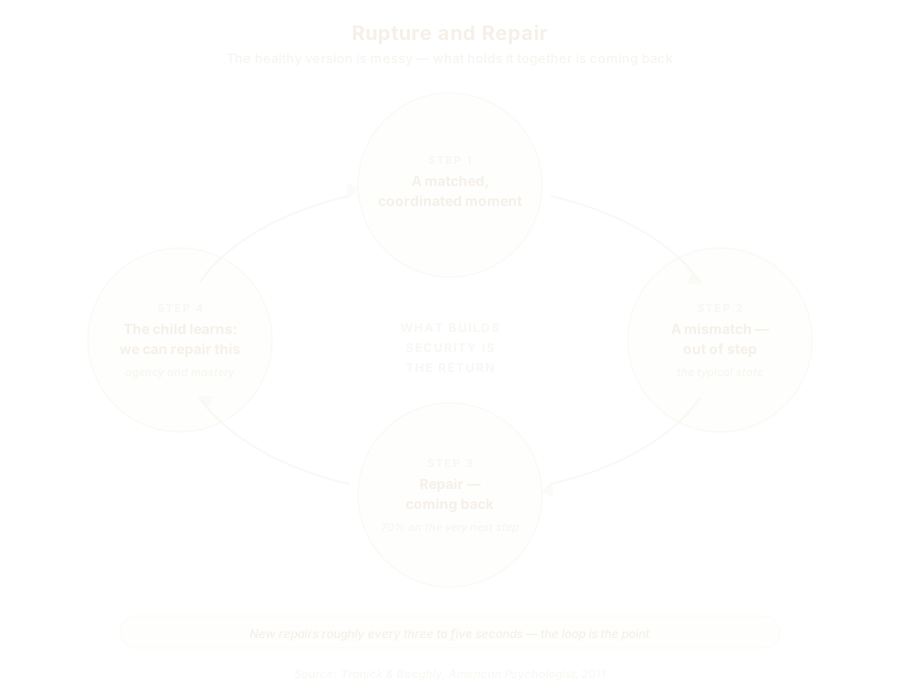
Ed Tronick and Marjorie Beeghly, writing in American Psychologist in 2011, described what ordinary face-to-face interaction between a mother and an infant looks like when you slow the tape down and code it frame by frame. Their word for the typical interaction is messy. It moves from coordinated states to miscoordinated ones and back again, constantly. The general lack of coordination, they wrote, suggests that infants and caregivers do not share similar intentions most of the time during face-to-face interaction.
That is the healthy version.
What holds it together is repair. In their observations, mismatches were repaired 70 percent of the time on the very next interactive step, with new repairs happening roughly every three to five seconds. Not once a day. Every few seconds, all day, in ordinary healthy pairs.
Repair does more than clean up after a bad moment. Tronick and Beeghly argue that a pair's ability to repair its interactive errors is what drives development, calling it "the fundament of new meanings." Through repeated cycles of rupture and repair, a baby arrives at an implicit knowing that we can repair mismatches, and that a bad feeling can turn back into a good one. The authors connect this to the child's emerging sense of agency and mastery.
The mechanism that builds security in a child is not a parent who never gets it wrong. It is a parent who comes back.
Nobody told most of us this. If you grew up in a house where nobody ever came back, where the sharp thing was said and the subject was closed, then you learned that a rupture is permanent by definition. If you grew up with a parent whose volume set the temperature of the house, that lesson got installed early and without words. So when you snap at your kid, your nervous system files it as permanent damage, because permanent is the only category you were given.
It is not the only category. Going back in is a skill, it is learnable in adulthood, and it is the one that does the work. In practice it is smaller than people expect: finding your kid twenty minutes later, saying that you were sharp, that it was not about them, and that you are glad they are here. No speech. No self-flagellation, which puts the child in the position of comforting you. Just the return.
What actually separates the families that break the pattern
Here the research stops being about your childhood and starts being about your current life. Sara Jaffee and colleagues followed 1,116 UK families for up to twelve years and published the results in the Journal of Adolescent Health in October 2013. They compared families where the mother had been maltreated but the child was not, against families where both generations were. Three things distinguished the first group: supportive and trusting relationships with intimate partners, high levels of maternal warmth toward the children, and low levels of violence between the adults.
The same paper reports something else. Families in which only the mother had been maltreated looked largely similar to families where neither generation had. Statistically, they were ordinary families. The one difference was that those mothers were more likely to carry a lifetime history of depression and low levels of social support. The damage was showing up inside the mother, and the children were doing fine. The authors note that more research is needed to establish whether these factors play a causal role, and I will hold that caution alongside them.
A meta-analysis by Thomas Schofield, Rosalyn Lee, and Melissa Merrick in the same 2013 issue found the same protective effect across prospective longitudinal studies, estimating that roughly 49 unpublished null studies would be needed to wipe it out. Only five studies met their inclusion criteria, so treat it as convergent evidence rather than a settled number.
Read across those findings and you get a short list of things sitting in front of you: the quality of your adult relationships, warmth toward your kid, and whether your own depression and isolation are being treated. Not one item on that list is about your parent. All of them are about now.
Here is the whole evidence base on this page in one place, with the limits attached to each line rather than buried under it.
| What was studied | What it found | Source | The limit that comes with it |
|---|---|---|---|
| How often maltreatment carries to the next generation | About one-third, with estimates ranging from 25 to 35 percent — so roughly two out of three do not | National Academies consensus report, 2014 | It is a range, not a single rate, and it describes documented maltreatment, not every hard childhood |
| How strong the link is | Real but modest, d = 0.45, across 142 studies and 227,918 parent–child pairs | Madigan et al., Development and Psychopathology, February 2019 | The authors' own word is "modest," and for physical abuse the effect got weaker as methodological rigor increased |
| Whether the capacity to reflect on your own history protects the next generation | Among mothers reporting significant childhood deprivation, every one of the ten who scored high on reflective functioning had a securely attached infant; 6 percent of those who scored low did | Fonagy et al., London Parent–Child Project, reported in the 1998 Reflective-Functioning Manual | Cells of ten and seventeen mothers, one London cohort, analysis published in the 1990s. A striking single-study finding, not a population statistic |
| Whether describing a painful childhood coherently matters | "Earned-secure" adults parent as effectively as adults describing positive childhoods; what they carry instead is more depressive symptoms | Roisman et al., Child Development, 2002 | The authors' own caution: the measure tracks how coherently a person tells the story, not how bad the story was |
| What separates families where the pattern stopped | Supportive and trusting relationships with intimate partners, high maternal warmth toward the children, and safety between the adults in the home | Jaffee et al., 1,116 UK families followed up to twelve years, Journal of Adolescent Health, October 2013 | The authors note more research is needed to establish whether these factors play a causal role |
| Whether that protective effect holds across studies | It does; roughly 49 unpublished null studies would be needed to wipe it out | Schofield, Lee & Merrick, Journal of Adolescent Health, October 2013 | Only five studies met the inclusion criteria — convergent evidence, not a settled number |
| Whether parenting can actually change | Randomized interventions shifted insensitive parenting (d = 0.33) and infant attachment insecurity (d = 0.20) across 70 studies; briefer and behaviorally focused worked best | Bakermans-Kranenburg, van IJzendoorn & Juffer, Psychological Bulletin, 2003 | 88 intervention effects on sensitivity (n = 7,636) and attachment (n = 1,503); effect sizes are modest, like everything else here |
| What happens to children when a parent's depression is treated | When mothers' depression remitted, children's diagnoses fell by 11 percent; where it did not remit, they rose by 8 percent | Weissman et al., JAMA, March 2006, 151 mother–child pairs across 19 clinics | That trial treated depression with antidepressant medication, not psychotherapy. It speaks to treating a parent's depression, not to any particular method |
Can parenting actually change, or is this fixed by now?
It changes, and the research on how is oddly encouraging.
Marian Bakermans-Kranenburg, Marinus van IJzendoorn, and Femmie Juffer reviewed 70 studies in Psychological Bulletin in 2003, producing 88 intervention effects on parental sensitivity (n = 7,636) and infant attachment (n = 1,503). Randomized interventions were effective at shifting insensitive parenting (d = 0.33) and infant attachment insecurity (d = 0.20). The paper is titled "Less Is More," and it earns the title. The most effective interventions used a moderate number of sessions and a clear behavioral focus, and they worked in families with multiple problems as well as in families without them. Fewer sessions, aimed at something specific, beat sprawling open-ended help.
One more piece of evidence is worth stating precisely, because it usually gets stated sloppily. A study published in JAMA in March 2006 followed 151 mother–child pairs across 19 clinics. When the mothers' depression went into remission after three months of treatment, their children's diagnoses fell by 11 percent; among children whose mothers' depression did not remit, diagnoses rose by 8 percent. Among children who already carried a diagnosis, 33 percent remitted when the mother responded to treatment, compared with 12 percent when she did not. The evaluators were blind to how the mothers had done.
The treatment in that trial was antidepressant medication, not psychotherapy. What it shows is that when a mother's depression lifted, her children's symptoms improved, and when it did not, they got worse. I am a licensed clinical social worker. I do not prescribe, and nothing here is a recommendation about medication. What the study establishes is the direction of the effect. A parent's depression reaches the child, and attending to it is one of the more direct things a parent can do for a child.
What to do with the fear tonight
If you are still holding those ten seconds in the kitchen, here is what I would actually say. Go back in. Not with a speech. Find your kid, name that you were sharp, say it was not their fault, and stay for a minute afterward. If they are already asleep, say it in the morning. The repair does not expire overnight. You are teaching the thing Tronick's research describes, which is that a bad moment can turn back into a good one.
Then look at the list from the Jaffee study, because it is the practical one. Do you have one adult relationship where you are actually supported? Is anyone treating your depression, if you have it? Has your social support gotten as thin as it quietly tends to get? Those are the levers the evidence points at, and none of them require you to resolve anything with your own parent first.
On that subject, what you do about contact with your parent is a personal decision with real consequences in both directions, and it is not something an article should decide for you. It belongs in a room with someone who knows your whole history. If the guilt around holding a line with your own family is the part that keeps you up, that is its own piece of work. What the research says is only that the protective factors live in your present relationships, not in your verdict about the past.
And notice what you have been doing while reading this. You have been thinking about your own mind and your child's mind at the same time, which is the capacity Fonagy's team was measuring. It is an uncomfortable skill to use, and it is the one that protects your kid.
If you are in New York and you want to work on this with someone, I would be glad to talk. A first call is a conversation about what actually happens in your house, what you grew up in, and whether the two of us working together makes sense. If I am not the right fit, I will say so and point you somewhere better.
Does a hard childhood mean I will repeat it with my own kids?
No. The National Academies' 2014 consensus report estimates that about one-third of people who were abused or neglected as children go on to abuse or neglect their own, with the range running from 25 to 35 percent, meaning roughly two out of three do not. The largest meta-analysis on the question, covering 142 studies and 227,918 parent–child pairs, found the association real but modest (d = 0.45), and found that it got weaker as study designs got more rigorous. It is a risk factor, not a sentence.
I heard my parent's voice come out of my mouth. Does that mean it is already happening?
It more likely means the opposite. The capacity to notice your own reaction, recognize where it came from, and be disturbed by it is what researchers call reflective functioning, and it is the strongest protective factor in this literature. In one London longitudinal study, every one of the ten mothers with a hard childhood who scored high on that capacity had a securely attached infant, compared with 6 percent of the seventeen who scored low. Small samples, one cohort, but it points where everything else points. Noticing is the mechanism, not the warning sign.
Do I have to fix things with my own parent to stop the pattern?
The evidence does not say so. In a twelve-year study of 1,116 UK families, what distinguished families where the pattern stopped was supportive and trusting relationships with intimate partners, high warmth toward the children, and safety between the adults in the home. Every item on that list describes a person's current household rather than their parent. Decisions about contact with a parent are personal and consequential, and they are worth working through with a clinician who knows your history rather than settling from an article.
Is there anything that actually changes how a person parents?
Yes, and briefer help appears to work better than sprawling help. A meta-analysis of 70 studies found randomized interventions effective at changing insensitive parenting (d = 0.33) and infant attachment insecurity (d = 0.20), with the most effective ones using a moderate number of sessions and a clear behavioral focus, in families with multiple problems as well as without. Separately, a 2006 JAMA study of 151 mother–child pairs found that when mothers' depression remitted, their children's diagnoses fell by 11 percent, while children of mothers whose depression did not remit saw an 8 percent increase. That trial treated depression with medication rather than psychotherapy, so it speaks to treating a parent's depression, not to any particular method.
Sources
- Institute of Medicine & National Research Council, New Directions in Child Abuse and Neglect Research, National Academies Press, 2014 — "Causality" chapter, 25–35% transmission estimate. https://www.ncbi.nlm.nih.gov/books/NBK195983/
- Madigan, S., Cyr, C., Eirich, R., et al. (13 February 2019). "Testing the cycle of maltreatment hypothesis: Meta-analytic evidence of the intergenerational transmission of child maltreatment." Development and Psychopathology, 31(1), 23–51. https://www.cambridge.org/core/services/aop-cambridge-core/content/view/C3D3168C2C8B5240075A48F3F074C1A8/S0954579418001700a.pdf/testing-the-cycle-of-maltreatment-hypothesis-meta-analytic-evidence-of-the-intergenerational-transmission-of-child-maltreatment.pdf
- Kaufman, J., & Zigler, E. (April 1987). "Do abused children become abusive parents?" American Journal of Orthopsychiatry, 57(2), 186–192. https://pubmed.ncbi.nlm.nih.gov/3296775/
- Tronick, E., & Beeghly, M. (2011). "Infants' Meaning-Making and the Development of Mental Health Problems." American Psychologist, 66(2), 107–119. https://pmc.ncbi.nlm.nih.gov/articles/PMC3135310/
- Roisman, G. I., Padrón, E., Sroufe, L. A., & Egeland, B. (July/August 2002). "Earned–Secure Attachment Status in Retrospect and Prospect." Child Development, 73(4), 1204–1219. https://srcd.onlinelibrary.wiley.com/doi/10.1111/1467-8624.00467
- Fonagy, P., Target, M., Steele, H., & Steele, M. (July 1998). Reflective-Functioning Manual, Version 5, for Application to Adult Attachment Interviews, University College London, p. 11 — reporting the 1994 London Parent–Child Project analysis. https://discovery.ucl.ac.uk/id/eprint/1461016/1/Reflective%20Functioning%20Manual%20v5%201998.pdf
- Jaffee, S., Bowes, L., Ouellet-Morin, I., et al. (October 2013). "Safe, Stable, Nurturing Relationships Break the Intergenerational Cycle of Abuse: A Prospective Nationally Representative Cohort of Children in the United Kingdom." Journal of Adolescent Health, 53(4, Suppl), S4–S10. https://kclpure.kcl.ac.uk/portal/en/publications/safe-stable-nurturing-relationships-break-the-intergenerational-c
- Schofield, T. J., Lee, R. D., & Merrick, M. T. (October 2013). "Safe, stable, nurturing relationships as a moderator of intergenerational continuity of child maltreatment: a meta-analysis." Journal of Adolescent Health, 53(4 Suppl), S32–S38. https://pubmed.ncbi.nlm.nih.gov/24059937/
- Bakermans-Kranenburg, M. J., van IJzendoorn, M. H., & Juffer, F. (2003). "Less Is More: Meta-Analyses of Sensitivity and Attachment Interventions in Early Childhood." Psychological Bulletin, 129(2), 195–215. https://vydavatelstvo-f.sk/sites/default/files/bakermans-kranenburg-van-ijzendoorn-juffer-2003-psychological-bulletin-meta-analyses-sensitivity-attachment-interventions-less-is-more-pdf.pdf
- Weissman, M. M., Pilowsky, D. J., Wickramaratne, P. J., et al. (22 March 2006). "Remissions in maternal depression and child psychopathology: a STARD-child report." JAMA*, 295(12), 1389–1398. https://pubmed.ncbi.nlm.nih.gov/16551710/
This article is for educational and informational purposes only. It does not constitute medical, clinical, legal, or therapeutic advice, and reading it does not create a therapist-client relationship with Matthew Sexton, LCSW or Mental Wealth Solutions PLLC. Although the author is a licensed clinical social worker, the content in this article is not clinical assessment, diagnosis, or treatment.
The research described here on intergenerational patterns, reflective functioning, and rupture and repair reflects group-level findings and general clinical observation, not an assessment of you, your child, or the parent who raised you. Studies of maltreatment describe the most severe end of a wide spectrum, and what is described here may not match your family or your situation. Nothing in this article should be used to diagnose yourself or anyone else, and decisions about your relationship with your own parent are personal ones best worked through with a licensed clinician who knows your full history. If you are worried about your own or your child's safety, or about how you are parenting, please consult a licensed mental health professional who can assess your specific circumstances.
If you are in immediate emotional crisis, you can reach the 988 Suicide & Crisis Lifeline by calling or texting 988 (US). If you are experiencing domestic violence or are in physical danger, contact the National Domestic Violence Hotline at 1-800-799-7233 or visit thehotline.org. In a life-threatening emergency, call 911.