You have probably never described yourself as anxious. Anxious people cannot get things done. They cancel plans and miss deadlines and fall apart at exactly the moments that require the opposite. That has never been you.
What you might have said, if pressed, is that you are a perfectionist. A worrier. Someone who just needs to be prepared. Someone who takes their responsibilities seriously. And the evidence supports you, at least on the surface — the output, the reliability, the reputation. You deliver. You always have.
What that story does not account for is what it costs to deliver. The hours of preparation that others do not need. The conversations you replay before they happen and after they are over. The inability to hand something off without checking it three times. The Sunday night that does not feel like rest because Monday is already running in your head. The sleep that breaks at 3 a.m. with a thought about something you may have forgotten to do. The exhaustion that does not match the explanation, because the explanation is that things are fine.
That is what high-functioning anxiety is. Not anxiety despite the competence. Anxiety expressed as competence.
— Section 01Why does high-functioning anxiety look like a character trait instead of a problem?
Anxiety disorders are the most common mental health concern in the United States, affecting roughly 40 million adults — about 18 percent of the population — in any given year, according to the Anxiety and Depression Association of America.1 The majority of those people do not receive treatment. That number is often cited to suggest stigma or access problems, which are real. But there is another explanation that gets less attention: a significant portion of people with anxiety have organized their entire lives around managing it, and the management works well enough that neither they nor the people around them recognize it as a problem at all.
The clinical picture of anxiety that most people carry — avoidance, paralysis, visible distress — describes what happens when anxiety wins. High-functioning anxiety is what happens when the person does not let it win. They override the avoidance impulse with over-preparation. They convert the paralysis into perfectionism. They manage the threat of disapproval by becoming indispensable. Every move is calculated, though not consciously, to neutralize the internal alarm before it becomes visible.
A pattern in which chronic anxiety is managed through achievement, over-preparation, and interpersonal performance rather than avoidance — producing external competence while sustaining a continuous internal threat-assessment loop. The coping mechanisms are not separate from the anxiety. They are the anxiety, expressed as behavior.
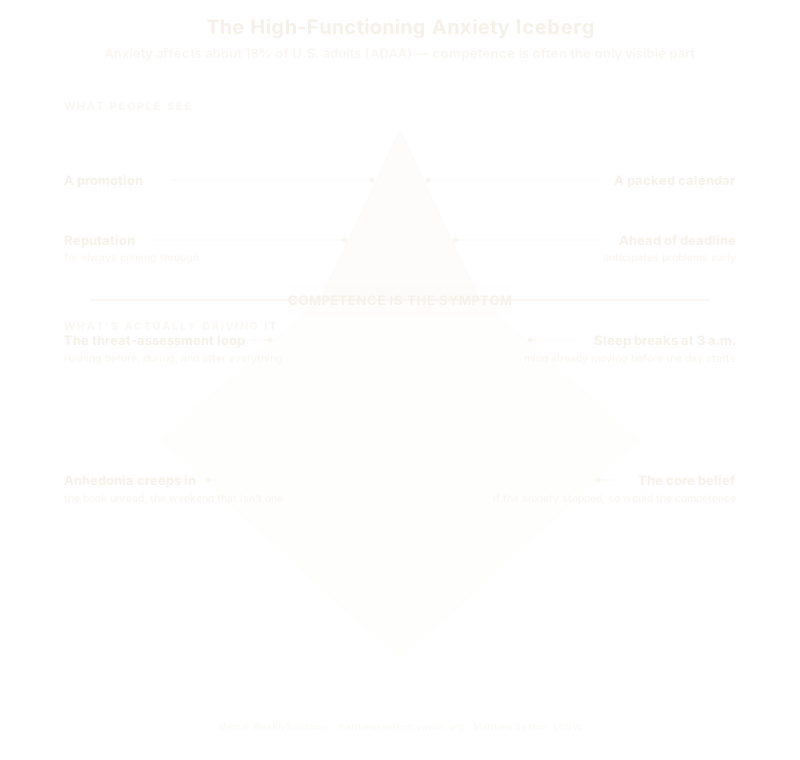
The problem is that this works until it does not. And the time frame is long. High-functioning anxiety can run for years, even decades, before the person hits the wall. By then, they have usually attributed the early signs — the fatigue, the irritability, the quiet loss of things that used to feel good — to something situational. Work stress. A difficult phase. Getting older. The idea that the anxiety itself is running the engine, and has been for twenty years, is not a frame most people arrive at without help.
— Section 02What the loop is actually doing inside
The internal experience of high-functioning anxiety is a continuous threat-assessment scan. Before the meeting, the brain is running simulations: what could go wrong, who might push back, what the worst version of this looks like, how to neutralize each scenario. During the meeting, there is a second track monitoring the room: facial expressions, tone of voice, the pause that lasted a beat too long. After the meeting, there is a review: what landed, what did not, what should have been said differently. Then there is the night, when the whole thing runs again without the social pressure of having to look calm.
Research on high-achieving populations and performance anxiety suggests that this kind of chronic vigilance has physiological costs that compound over time. A widely cited study in JAMA Internal Medicine found that anxiety disorders are associated with a 26 percent increase in the risk of incident coronary heart disease, a relationship that holds even when controlling for depression and other variables.2 The body running a threat-response loop continuously is not the same as a body at rest, regardless of what the performance metrics look like from the outside.
Sleep is usually the first thing to go, and the most telling. The threat-assessment loop does not have an off switch. It runs at 3 a.m. on a Tuesday with the same energy it brings to a high-stakes presentation. Most people with high-functioning anxiety have a complicated relationship with sleep — they can fall asleep from exhaustion, but they wake early, mind already moving, and they cannot recall the last time they woke feeling actually rested.
Pleasure follows. Anhedonia — the quiet dimming of enjoyment in things that used to matter — tends to precede full burnout by months.3 The book that sits unread. The weekend that does not feel like a weekend. The friendship that keeps getting deferred because there is no bandwidth for it. These losses accumulate slowly enough that most people do not notice them as a trend. They notice the absence of something specific — the walk they used to take, the music they used to play in the car — and attribute it to busyness rather than depletion.
— Section 03Why do the coping strategies feel impossible to give up?
Here is the clinical problem that makes high-functioning anxiety hard to treat: the coping mechanisms work. Not perfectly, not without cost — but well enough that the person has genuine evidence they are necessary.
Over-preparation reduces the number of times things go wrong. Perfectionism catches errors before they become visible. People-pleasing manages the social environment in ways that reduce friction and build relational safety. The inability to delegate prevents the disappointment of relying on someone who will not do it the right way. These are not irrational behaviors. In many environments, they produce real results. The anxiety is not crazy. It has a track record.
What makes this a clinical problem — rather than just a demanding personality style — is the belief that the behaviors are what make the person good. The belief, often not conscious, that if the anxiety stopped running, the competence would stop too. That the preparation is not just a response to anxiety but the source of the quality. That relaxing is actually the risk.
This is the part of high-functioning anxiety that is hardest to name in the consulting room, because the person sitting across from me has genuine evidence for it. They have caught errors that others missed. They have been promoted because they over-delivered. The anxiety has, in a real sense, made them successful. Asking them to consider that it has also been costing them requires a different kind of accounting than the one they are used to running.
— Section 04What treatment actually looks like
Treating high-functioning anxiety is not about becoming less capable. That is usually the first fear, stated or not, when someone begins to acknowledge the pattern. They are worried that if the anxiety goes away, so does the edge. That therapy is going to sand down the thing that makes them effective.
That is not what happens. What happens, when treatment works, is a separation: the person begins to locate where their behavior is driven by genuine values — thoroughness, care, commitment — versus where it is driven by the chronic threat response. Those two things are fused in high-functioning anxiety, and they look identical from the outside. From the inside, one feels like I want to do this well and the other feels like something will go wrong if I do not do this perfectly. The difference in quality of life between those two drivers is significant, even when the output is the same.
In practice, this means slowing down the threat-assessment loop enough to examine it. Not eliminating preparation — examining what the preparation is for, and what the person believes will happen if they prepare slightly less. It means building tolerance for the discomfort that arrives when someone stops using over-delivery to manage their internal state. It means identifying the specific beliefs — often installed early, often in environments where the threat was real — that are still running the show long after the original environment is gone.
Cognitive-behavioral approaches to anxiety have a strong evidence base, with meta-analyses showing meaningful reduction in anxiety symptoms across a range of presentations.4 But for high-functioning anxiety specifically, the work often requires going deeper than symptom management — into the architecture of the belief system that makes the anxiety feel not just tolerable but necessary. That is slower work. It is also more durable.
- High-functioning anxiety is anxiety organized around achievement rather than avoidance. The coping mechanisms — perfectionism, over-preparation, people-pleasing — are not character traits. They are behaviors in service of a chronic threat response.
- The internal experience is a continuous loop of threat assessment that runs before, during, and after everything. Sleep breaks. Pleasure dims. The exhaustion does not match the explanation, because the explanation is "I'm fine."
- The coping strategies work, which is the problem. The person has real evidence that the anxiety is what makes them effective. Disentangling the anxiety from the capability is the actual clinical work.
- Anxiety disorders affect roughly 18 percent of the U.S. adult population, with fewer than half receiving treatment. High-functioning anxiety is one reason: the presentation does not look like what people expect anxiety to look like.
- Treatment is not about becoming less capable. It is about locating where the behavior is driven by values versus threat response — and building a life where those are not the same thing.
— Section 05When is it time to talk to someone?
Most people with high-functioning anxiety wait a long time before they come to therapy. The performance is holding. The explanation they have always used — thoroughness, conscientiousness, just how my brain works — still explains enough. The signal that finally moves the needle is usually one of a few things.
Sometimes it is the wall. The year where the performance finally catches up to the depletion, and the person finds they cannot make themselves care the way they used to. Sometimes it is a relationship — a partner who says, with some precision, that they cannot reach the person behind the performance. Sometimes it is a physical thing: the sleep that has been broken for so long it no longer registers as broken, until a doctor mentions it, or a week of rest somewhere shows them what rested actually feels like.
Sometimes, honestly, it is just the accumulation of small losses. The morning coffee that used to be a pleasure and is now just a task. The friendship that used to be nourishing and now feels like one more thing to manage. The quiet, persistent sense that the life they have built is operating at full capacity and does not have room for them inside it.
If you recognize any of that, the question is not whether you are anxious enough to need help. The question is whether the way you have been managing things for twenty years is still working, or whether it is working on borrowed time.
What is high-functioning anxiety?
High-functioning anxiety is a pattern in which anxiety does not produce visible dysfunction — it produces visible competence. The person over-prepares, over-delivers, and anticipates every possible failure before it arrives. From the outside, this looks like conscientiousness or talent. From the inside, it is a continuous threat-assessment loop running underneath everything else. The coping mechanisms — perfectionism, over-preparation, people-pleasing, inability to delegate — are not separate from the anxiety. They are the anxiety, expressed as behavior.
Is high-functioning anxiety a real diagnosis?
High-functioning anxiety is a clinical descriptor, not a formal DSM-5-TR category. Most people who identify with the pattern meet criteria for generalized anxiety disorder (GAD), which affects roughly 6.8 million American adults — though fewer than half receive treatment. The "high-functioning" distinction matters because it identifies the specific way the anxiety is being managed: through achievement rather than avoidance, which makes it both harder to recognize and harder to treat.
Why does high-functioning anxiety get missed?
Because the conventional picture of anxiety — paralysis, avoidance, visible distress — is absent. The person with high-functioning anxiety shows up on time, delivers ahead of deadline, and anticipates problems before they arrive. Every symptom looks like a strength until the adrenaline that has been running the engine for twenty years starts to run out. The clinical problem is that the pattern reinforces itself: anxiety produces competence, competence is rewarded, so the anxiety feels necessary. By the time someone comes to therapy, they have often spent years wondering if the anxiety is actually their secret weapon.
What does high-functioning anxiety feel like on the inside?
The internal experience is a continuous loop of threat assessment — scanning for what could go wrong, rehearsing conversations before they happen, replaying the ones that already did. Most people with high-functioning anxiety do not describe this as anxiety. They describe it as "being thorough" or "just how my brain works." Sleep is often the first casualty: the loop does not stop when the day ends. Irritability follows, then the quiet loss of things that used to feel good — the book they used to read, the morning they used to enjoy, the friendship they keep meaning to tend.
What does therapy for high-functioning anxiety actually involve?
Treatment for high-functioning anxiety is less about reducing productivity and more about disentangling the person from the belief that the anxiety is what makes them good at things. The goal is not to remove the conscientiousness — it is to locate where the behavior is driven by genuine values versus chronic threat response. Most people discover the two are not as fused as they thought. Sessions typically involve slowing down the threat-assessment loop, examining the beliefs that keep it running, and building tolerance for the discomfort that comes when the person stops using preparation and over-delivery to manage internal states.
Citations
- Anxiety and Depression Association of America (ADAA). (2023). Facts & Statistics: Anxiety Disorders. Retrieved from adaa.org/understanding-anxiety/facts-statistics. GAD affects an estimated 6.8 million American adults; anxiety disorders overall affect approximately 40 million adults annually. Fewer than 37 percent of those affected receive treatment. ↩
- Roest, A. M., Martens, E. J., de Jonge, P., & Denollet, J. (2010). Anxiety and risk of incident coronary heart disease: A meta-analysis. Journal of the American College of Cardiology, 56(1), 38–46. doi:10.1016/j.jacc.2010.03.034. A meta-analysis of 20 prospective cohort studies found that anxiety was associated with a 26 percent increased risk of coronary heart disease, independent of depression. ↩
- Pizzagalli, D. A. (2014). Depression, stress, and anhedonia: Toward a synthesis and integrated model. Annual Review of Clinical Psychology, 10, 393–423. doi:10.1146/annurev-clinpsy-050212-185606. Anhedonia is a robust early marker of stress-related affective dysregulation, typically preceding full-syndrome presentation under chronic stress. ↩
- Hofmann, S. G., Asnaani, A., Vonk, I. J. J., Sawyer, A. T., & Fang, A. (2012). The efficacy of cognitive behavioral therapy: A review of meta-analyses. Cognitive Therapy and Research, 36(5), 427–440. doi:10.1007/s10608-012-9476-1. A broad review of CBT meta-analyses demonstrating strong evidence of efficacy across anxiety disorders, with consistent reduction in symptom severity relative to control conditions. ↩