Antagonistic personality styles at work are best understood through repeated behavior, not amateur diagnosis. Watch for entitlement, exploitation, contempt, chronic blame-shifting, status protection, retaliation after disagreement, and a willingness to sacrifice accuracy or other people to preserve an image. One confident interview or one rude meeting proves very little. A pattern across time, power differences, and witnesses tells you much more.
By Matthew Sexton, LCSW, NATC
People with strongly self-promoting styles can have a real early advantage at work, but that advantage does not reliably predict good leadership. A 2015 meta-analysis found that narcissism was associated with emerging as a leader, but not with being an effective one; much of the emergence effect was explained by extraversion (Grijalva et al., 2015). That gap between being selected and being effective helps explain why a person can glow in an interview, win over a board, or impress a client, then become corrosive once the relationship has a history.
This pattern can appear in a coworker who takes credit, a manager who punishes dissent, a rainmaker whose numbers excuse everything, or an owner who makes the institution an extension of personal loyalty. The costs move outward. First, people close to the behavior spend time managing it. Then information stops moving. Eventually clients, patients, customers, and the public can pay for decisions nobody felt safe challenging.
I use the words style, traits, and behavior deliberately here. Narcissistic personality disorder is a clinical diagnosis. You cannot determine it from a polished interview, an arrogant email, a lawsuit, a news story, or a list on the internet. You do not need a diagnosis to decide that a repeated workplace pattern is harmful or that you need protection from it.
Defining Antagonistic Behavior Without Diagnosing Anyone
In personality research, antagonism generally refers to ways of relating that can include entitlement, exploitation, deceitfulness, grandiosity, hostility, callousness, or disregard for other people's needs. Those features exist on dimensions. A person may show some of them in one environment and not meet criteria for any disorder. Context, stress, incentives, power, and organizational culture all matter.
One useful research model separates narcissistic self-presentation into admiration and rivalry. Admiration is the assertive, agentic side: striving for uniqueness, projecting confidence, and promoting oneself. Rivalry is the antagonistic, defensive side: devaluing other people, trying to establish superiority, and reacting aggressively when status feels threatened (Back et al., 2013). The distinction explains an experience many workers struggle to put into words. The person you met was not necessarily “fake.” You may have met the socially effective side before disagreement, accountability, or competition activated the rivalrous side.
That still does not mean every charismatic person is dangerous. Confidence can be earned. Ambition can serve a team. A strong leader can be direct, tolerate correction, share credit, and create room for expertise they do not possess. The concern is the combination of self-enhancement with low accountability and repeated antagonism.
Useful questions are behavioral:
- What happens when this person is wrong?
- Can someone lower in rank disagree without paying for it later?
- Do standards remain stable, or move according to who is favored?
- Does information improve a decision, or threaten the decision-maker?
- Are clients treated as people with interests, or as sources of money, admiration, or leverage?
- Does the institution investigate patterns, or protect the person who brings status and revenue?
These questions keep you grounded in what can be observed.
If the standard changes every time you meet it, the separate guide to moving goalposts and antagonistic manipulation explains how to stop treating an unwinnable contest as a performance problem.
The Interview Glow and the First 90 Days
Most interviews are short performances built around impressions. Applicants are invited to describe their strengths, leadership, impact, and vision. Those are reasonable questions, but they reward fluent self-presentation. The hiring team usually cannot yet verify how a candidate behaves after a mistake, under a tedious deadline, or when a junior colleague has the better idea.
In a simulated employment study, Paulhus and colleagues found that frequent self-praise helped chronically narcissistic applicants receive more positive interview evaluations (Paulhus et al., 2013). A later workplace review described the same practical problem: confidence, assertiveness, charm, and overclaiming can influence raters before claims become verifiable, while impressions may become less favorable as coworkers gain experience with the person (Hirschi & Jaensch, 2021).
Longitudinal research shows this is not merely a hiring problem. In a field study that followed 126 people entering a new social group, narcissistic admiration supported popularity early, while rivalry predicted the later decline in popularity (Leckelt et al., 2020). Earlier research found that narcissistic people often made positive first impressions, followed by a decline as self-centered and antagonistic behaviors became visible (Leckelt et al., 2015).
This helps explain the office whiplash:
- Selection rewards presentation. The candidate speaks in outcomes, radiates certainty, mirrors the interviewer's priorities, and takes up leadership space.
- Early ambiguity protects the image. New employees inherit incomplete projects and unclear relationships. Success can be claimed; failures can be attributed to the predecessor or the system.
- Verification arrives. Deadlines repeat. Colleagues compare accounts. Predictions can be checked. The person must share credit, absorb correction, and perform unglamorous maintenance.
- Status becomes contestable. A peer succeeds, a client complains, or a junior employee names a risk. If the person protects identity by devaluing others, the workplace starts reorganizing around that defense.
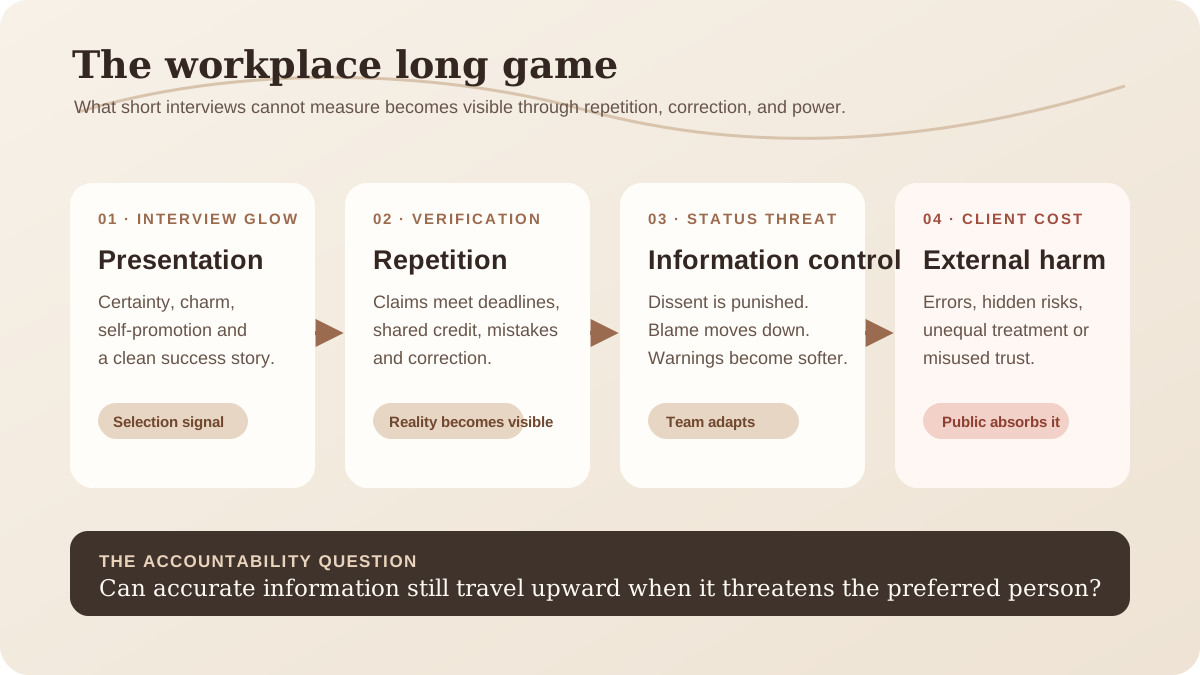
A 2011 experiment adds an important twist. Teams led by more narcissistic leaders rated those leaders as effective, even while the leaders inhibited information exchange and the groups performed worse (Nevicka et al., 2011). The danger is not only that a difficult person “fools” everyone. People can sincerely experience confidence and authority as competence while the team's decision process deteriorates underneath.
Insecurity, Grandiosity, and Status Threat
The popular explanation is that grandiosity always covers secret low self-esteem. Research is more complicated. Grandiose narcissistic traits can coexist with relatively high explicit self-esteem, social boldness, and genuine positive affect. Vulnerable narcissistic traits are more consistently associated with shame, hypersensitivity, negative affect, and insecurity. A person can also move between grandiose and vulnerable states (Krizan & Herlache, 2018; Di Sarno et al., 2020).
So “deep down they hate themselves” is not a conclusion you can safely make about a coworker. A more defensible frame is status-contingent self-regulation. The person may depend heavily on admiration, rank, exceptional treatment, or control to maintain a preferred view of self. Feedback then lands as humiliation, and another person's competence can feel like displacement rather than help.
That distinction matters because it predicts what you may see:
- neutral questions treated as disrespect;
- corrections reframed as disloyalty;
- credit flowing upward while blame flows downward;
- a need to control the story before facts are settled;
- contempt toward people who no longer provide admiration;
- sudden victimhood when consequences arrive.
A 2021 meta-analysis covering 437 studies and 123,043 participants found a reliable association between narcissism and aggression. The relationship was stronger under provocation, although it was also present without provocation (Kjærvik & Bushman, 2021). This is a population-level finding, not a prediction that a particular boss will become aggressive. It does support taking status-threat reactions seriously when they form a repeated pattern.
Status Rewards in Professional and Leadership Roles
It is easy to overstate this section, so the limits matter. There is no sound basis for saying that lawyers, physicians, real estate professionals, executives, or founders are generally narcissistic. Most people in those fields do difficult work with integrity. A job title is not a personality test.
Some research does find associations between narcissistic traits and interests involving leadership, business, law, finance, professional advising, visibility, or prestige (Jonason et al., 2022). Career studies have also found links between narcissism and salary or leadership emergence in some samples (Spurk et al., 2016). Those findings do not establish that people with these traits “become professionals,” nor do they tell us the personality of any individual professional.
The useful observation is about fit between motives and rewards. Professions that offer status, influence, high-stakes competition, public credibility, access to vulnerable people, or control over large decisions can reward confidence and self-promotion. They can also provide ethical codes, peer review, supervision, courts, licensing boards, credentialing committees, and compliance systems that constrain abuse. The outcome depends partly on which side the institution rewards.
If revenue, fame, or fear grants one person practical immunity, professional status can become camouflage. Clients tend to assume that a title, license, partnership, board seat, or prestigious firm reflects continuing oversight. Sometimes it does. Sometimes the institution has seen the warning signs and found reasons not to act.
The Pattern Changes as Power Increases
At the coworker level, the pattern may be irritating but containable: credit-taking, selective gossip, withholding information, public correction, private charm, or small acts that force you to defend your competence. The person has influence but cannot single-handedly rewrite the rules.
At the manager level, ordinary defenses acquire machinery. A manager controls assignments, access, ratings, schedules, visibility, and often the first account HR hears. Moving goalposts can become performance management. Triangulation can become succession planning. A favored employee may be encouraged to carry the manager's version of events without realizing they are participating in someone else's isolation.
At the executive, partner, or owner level, the pattern can become institutional:
- governance is treated as an insult rather than a safeguard;
- independent oversight is weakened or populated with loyalists;
- exceptions accumulate for the high performer;
- complaints are evaluated by the revenue or embarrassment they threaten;
- departures are used as proof that critics were unstable or “not a fit”;
- client harm is reframed as a public-relations problem.
Research on chief executives cannot diagnose any leader, and many studies rely on indirect measures. With that limitation, archival work has associated higher proxy measures of CEO narcissism with bolder, more fluctuating strategic outcomes and more acquisition activity (Chatterjee & Hambrick, 2007). Another study associated CEO narcissism with firms being named as defendants and with higher-risk decisions around litigation (O'Reilly et al., 2018). These are correlations across samples. They are reasons for stronger governance, not labels for a chief executive.
WeWork offers a public governance example without requiring a personality conclusion. Its 2019 securities filings disclosed extensive founder voting control and related-party transactions. The company's amended filings and later reporting documented investor concerns and governance changes during its failed initial public offering process (The We Company, 2019; WeWork, 2021). The lesson is structural: when a compelling founder story is paired with weak checks, stakeholders can discover late that charisma and governance are different assets.
The Workplace Cost Is Real, but the Client Cost Matters More
Antagonistic workplaces consume attention. People rehearse how to phrase a basic question, copy witnesses on routine emails, withhold early concerns, and spend meetings tracking rank instead of solving the problem. Over time, that changes what the institution knows.
Meta-analytic research has linked workplace bullying with later mental-health and somatic symptoms, although the relationship can run in both directions and no study can determine what caused one person's symptoms (Verkuil et al., 2015; Nielsen & Einarsen, 2012). The worker may experience dread, sleep disruption, rumination, irritability, self-doubt, or physical stress. The organization sees turnover, silence, rework, and lost expertise.
Clients can be harmed through a different pathway:
Antagonism changes information flow. People stop giving bad news to the person who punishes it. Risks are softened. Documentation becomes defensive. The most experienced staff may leave, while agreeable or dependent employees remain.
Image can outrank accuracy. Admitting uncertainty threatens the expert identity. A professional may overpromise, conceal an error, attack the messenger, or escalate a weak position rather than correct course.
People become instruments. A patient, legal client, buyer, seller, investor, or junior professional may be valued while they supply money, status, gratitude, or access. Their interests become secondary when they conflict with the professional's self-protection.
Institutions normalize exceptions. Each exception seems manageable. Together, they create a system in which the “star” is no longer meaningfully supervised.
Health-care research shows how quickly interpersonal behavior can reach the patient. In a randomized simulation, neonatal intensive-care teams exposed to rude comments performed worse on diagnostic and procedural tasks than control teams (Riskin et al., 2015). The Joint Commission warns that intimidation and disruptive conduct can suppress speaking up and contribute to errors, adverse outcomes, burnout, and turnover (Joint Commission, 2024). This is why “they're brilliant, just difficult” is not an adequate patient-safety strategy.
Real-World Case: Law, Client Money, and Institutional Deference
The Girardi matter is a stark example of client harm and institutional failure. It is not evidence of anyone's diagnosis.
In 2023, the State Bar of California released reports describing the handling of complaints about attorney Thomas Girardi as a “persistent institutional failure.” The reports said employees and officials received numerous reports over decades while the system repeatedly failed to investigate and discipline appropriately (State Bar of California, 2023). In 2025, the U.S. Department of Justice announced that Girardi received an 87-month federal prison sentence after wire-fraud convictions for stealing settlement funds from clients (U.S. Attorney's Office, Central District of California, 2025).
The client lesson is not that every charismatic attorney is suspect. It is that prestige and relationships can distort oversight. When colleagues, regulators, and institutions treat a powerful professional as too successful to question, the public protection attached to professional status weakens.
I cover the connection between professional status, oversight failures, and financial misconduct more directly in why professional success does not rule out exploitation. Here the important point is narrower: the long game depends on whether the institution can tolerate evidence that contradicts its preferred person.
Real-World Case: Health Care, Credentialing, and the Cost of Quiet Exits
Christopher Duntsch, the Texas surgeon commonly covered as “Dr. Death,” was convicted of intentionally or knowingly causing serious bodily injury to an elderly patient; a Texas appellate court affirmed the conviction in 2018 (Duntsch v. State, 2018). ProPublica's investigation described how hospitals removed or restricted him while reporting and credentialing gaps allowed him to continue practicing elsewhere (ProPublica, 2018).
Again, a criminal case and reporting about conduct cannot establish a personality diagnosis. The workplace lesson is about systems. Quietly moving a dangerous professional out of one institution can transfer risk to the next set of coworkers and patients. Hospitals have specified duties to query and report certain information through the National Practitioner Data Bank, including queries when practitioners apply for privileges and every two years thereafter (Health Resources and Services Administration, current guidance).
Patient safety depends on people being able to speak before certainty arrives. If a department punishes doubt, protects a high-status biller, or interprets concern as jealousy, it creates the conditions in which weak signals remain separated. The pattern becomes visible only after someone connects them, often after preventable harm.
Real-World Case: Real Estate, Unequal Treatment, and Culture
Real estate shows how client harm can emerge from everyday discretion rather than one dramatic act. Newsday conducted a three-year paired-testing investigation on Long Island in which similarly qualified testers of different races or ethnicities approached the same agents. The project reported evidence suggesting unequal treatment in 21 of 86 tests, including steering and differences in service (Newsday, 2019). The New York Attorney General later announced 2022 settlements totaling more than $115,000 with three brokerages following investigations prompted by Newsday's reporting (Office of the New York State Attorney General, 2022).
This example is about documented conduct and institutional practice, not narcissism. It belongs here because antagonistic systems often rely on the same protective habits: private discretion, deniable differences, loyalty to insiders, and confidence that the client cannot compare what happened behind another door.
A brokerage can have charismatic top producers and still build a culture that tests decisions, audits patterns, trains agents, and responds to complaints. It can also decide that revenue excuses behavior. The second choice makes the organization, not merely one personality, part of the problem.
Practical Engagement Without Feeding the Contest
If you have to keep working with the person, your aim is not to expose their psychology. It is to reduce ambiguity, protect the work, and preserve your nervous system.
Stay close to the task. Ask for the deliverable, owner, deadline, and decision. When the conversation turns into motives or character, return to the work: “What specifically needs to change in the document, and by when?”
If the person repeatedly provokes a reaction and then makes your reaction the entire story, use the response sequence in baiting and blame-shifting at work.
Confirm important decisions in writing. A short recap is often enough: “My understanding is that option B was approved today, I own the revised draft, and it is due Friday at 2 p.m. Please correct anything I missed.” This is useful project management even when nobody is difficult.
Offer bounded options. A person who experiences every limit as defiance may respond better to concrete tradeoffs: “I can finish the client memo today or the analysis tomorrow morning. Which is the priority?” You are making capacity visible without entering a dominance contest.
Use low-emotion language. Neutral does not mean submissive. Avoid diagnosing, moral verdicts, sarcasm, and long defenses. Correct the record once with evidence. Repetition rarely persuades someone who needs the story to remain unchanged.
Limit personal information. Do not hand a manipulative coworker material that has no reason to be in the workplace. Warm, professional, and private can coexist.
Choose witnesses for consequential conversations. A project channel, scheduled meeting with an agenda, or appropriate third person can reduce later confusion. Do not create a spectacle. Create a reliable process.
These tools overlap with gray rock or yellow rock, but the workplace version must remain functional. For day-to-day scripts, read how to deal with a manipulative coworker when you cannot quit.
Documentation HR Can Evaluate
Good documentation is boring. It records conduct and impact without trying to win the diagnosis.
For each significant event, note:
- date, time, location, and communication channel;
- who was present;
- the closest accurate wording you can recall, with direct quotes clearly marked;
- the policy, assignment, client obligation, or prior direction involved;
- what you did in response;
- measurable effect on work, safety, service, schedule, or client;
- where a contemporaneous email, message, or work record already exists.
Separate fact from inference. “The director said, ‘People who question me do not last here,’ during the July 22 staff meeting” is a factual allegation. “The director is a malignant narcissist” is a clinical-sounding conclusion HR cannot verify and may use to dismiss the rest.
Keep your record accurate. Do not edit old entries to make them sound stronger. Do not collect irrelevant personal material. Do not secretly record conversations or move privileged, proprietary, patient, client, or confidential information to a personal account without first getting advice about law and policy. Health-care workers must be especially careful not to copy protected health information into a personal log. Lawyers and staff must protect privilege and client confidentiality.
A Focused HR Conversation
HR is an organizational function. A good HR professional may investigate fairly and take real action, but you should not assume the conversation is therapy, confidential in the clinical sense, or free of institutional interests.
Prepare a short summary:
- Pattern: two or three representative, dated examples.
- Impact: work, safety, turnover, compliance, client service, or protected rights.
- Prior effort: what you already tried and the result.
- Request: what you want the organization to do.
The request might be written priorities, a reporting-line change, review of a policy, preservation of records, an investigation, protection against retaliation, or a safety plan. Ask what process follows, who will receive the information, what can be kept confidential, how updates will be communicated, and where retaliation concerns should be reported.
Use legal words carefully. The U.S. Equal Employment Opportunity Commission states that petty slights, annoyances, personality conflicts, and general rudeness are not automatically illegal harassment. Federal harassment law generally requires unwelcome conduct tied to a protected characteristic and sufficient severity or pervasiveness under the applicable standard (EEOC, current guidance). New York law protects workers against discrimination and harassment tied to protected characteristics, with standards and remedies that can differ from federal law (New York State Division of Human Rights; New York Attorney General).
That does not make ordinary bullying acceptable. It means toxic and illegal are not synonyms.
Other protections may matter. Employees covered by the National Labor Relations Act can have rights to act together about working conditions, and in some circumstances one worker is protected when bringing a group concern (NLRB, current guidance). New York Labor Law §§ 740 and 741 address certain whistleblower and health-care retaliation situations, and § 215 addresses retaliation connected to specified labor-law complaints. Each has definitions, exceptions, procedural requirements, and fact-specific limits. If retaliation, discrimination, safety, licensing, patient care, client funds, or major financial risk is involved, get advice from a qualified employment attorney, union representative, professional board, or compliance professional before assuming a statute protects your next step.
Signs the Institution Has Become Part of the Pattern
One difficult person and an antagonistic institution are different problems. In a healthier system, evidence can still travel. A complaint may be uncomfortable, but the process has some independence. Rules apply to high performers. Corrective action is possible.
The institution may be part of the pattern when:
- multiple people report similar conduct and are isolated one by one;
- the person controls the complaint pathway or chooses the investigator;
- turnover is blamed entirely on departing workers without pattern review;
- records disappear, standards change retroactively, or witnesses are coached;
- client or safety concerns are reframed as insubordination;
- status and revenue repeatedly override policy;
- retaliation is deniable in each instance but consistent across reporters;
- leadership demands loyalty to a person over accuracy, ethics, or the client.
At that point, better wording may not fix the problem. The institution may be functioning exactly as its leaders intend. If loyalty tests, information control, and punishment for dissent have become normal, the workplace-cult framework can help you evaluate the system without forcing a literal label.
Planning a Safe, Professional Exit
Leaving can be an act of agency, but it is not always immediately safe or financially possible. You do not owe anyone a dramatic exit.
Start with a private plan. Review finances, insurance, licensing needs, immigration consequences if relevant, references, and the timing of bonuses or benefits. Consider which colleagues can speak to your work without being pulled into the conflict. Use personal time and personal devices for a job search, consistent with policy.
Keep your exit explanation brief and future-facing. You can say you are looking for clearer governance, a more collaborative culture, a different scope, or stronger alignment with your professional goals. You do not have to convince the next interviewer that your former boss was harmful. A detailed attack can make a stranger focus on conflict instead of your judgment.
If you hold regulated responsibilities, leaving does not erase them. Get field-specific advice about patient continuity, client files, trust money, mandatory reporting, supervision, record retention, or notice obligations. Do not take evidence that belongs to clients or the institution simply because you fear it will disappear.
Expect your body to lag behind your resignation. People often leave the building and keep bracing for the email, the changed rule, or the public correction. Sleep, attention, and confidence may take time to settle. Therapy can help you reality-test what happened, grieve the version of the job you thought you accepted, and decide what healthy authority should feel like next time.
The question is not whether you can prove another person's diagnosis. The useful questions are whether the behavior is repeated, whether power makes it harder to challenge, whether clients are absorbing the consequences, and whether the system can correct itself. Those answers are enough to guide your next move.
If workplace antagonism has left you second-guessing yourself, Matthew Sexton, LCSW works with adults rebuilding agency after manipulative and coercive dynamics. You can book a call to discuss whether therapy is a fit.
Can someone with narcissistic traits make a strong first impression at work?
Yes. Research has found that self-promotion can improve simulated interview evaluations and that narcissistic admiration can support early popularity. That does not mean every confident candidate has narcissistic traits. The better predictor of the long game is how the person handles verification, shared credit, limits, and correction.
How can I tell confidence from an antagonistic personality style?
Do not judge one performance. Watch the pattern after disappointment or disagreement. Healthy confidence can tolerate correction, recognize expertise, share credit, and maintain stable standards. Antagonistic patterns more often include contempt, exploitation, blame-shifting, devaluation, retaliation, or controlling the story when status is threatened.
What should I document before speaking to HR?
Record dates, participants, close-to-verbatim statements, the work or policy involved, your response, and the measurable impact. Preserve existing work records through lawful, policy-compliant means. Avoid diagnoses, exaggerated language, secret recordings, and moving confidential or client information to personal storage without qualified advice.
Is a toxic workplace automatically a hostile work environment under the law?
No. “Toxic” is an everyday description, while unlawful harassment and discrimination have specific legal elements. General rudeness or a personality conflict may be harmful without violating federal or New York discrimination law. An employment attorney can assess the facts and any other retaliation, whistleblower, wage, safety, leave, or labor protections that may apply.
When is leaving a toxic workplace the healthiest option?
Consider leaving when the pattern is sustained, your health or ethics are deteriorating, client harm is being ignored, retaliation follows good-faith concerns, or the institution repeatedly protects the behavior. Timing still depends on finances, benefits, safety, licensing, and legal obligations. A quiet, supported exit is often safer than a final confrontation.
Sources
- Grijalva, E., Harms, P. D., Newman, D. A., Gaddis, B. H., & Fraley, R. C., “Narcissism and Leadership: A Meta-Analytic Review of Linear and Nonlinear Relationships,” Personnel Psychology, 2015.
- Paulhus, D. L., Westlake, B. G., Calvez, S. S., & Harms, P. D., “Self-Presentation Style in Job Interviews: The Role of Personality and Culture,” Journal of Applied Social Psychology, 2013.
- Leckelt, M. et al., “Longitudinal Field Investigation of Narcissism and Popularity Over Time,” Personality and Social Psychology Bulletin, 2020.
- Leckelt, M., Küfner, A. C. P., Nestler, S., & Back, M. D., “Behavioral Processes Underlying the Decline of Narcissists' Popularity Over Time,” Journal of Personality and Social Psychology, 2015.
- Nevicka, B., Ten Velden, F. S., De Hoogh, A. H. B., & Van Vianen, A. E. M., “Reality at Odds With Perceptions: Narcissistic Leaders and Group Performance,” Psychological Science, 2011.
- Back, M. D. et al., “Narcissistic Admiration and Rivalry: Disentangling the Bright and Dark Sides of Narcissism,” Journal of Personality and Social Psychology, 2013.
- Kjærvik, S. L., & Bushman, B. J., “The Link Between Narcissism and Aggression: A Meta-Analytic Review,” Psychological Bulletin, 2021.
- Hirschi, A., & Jaensch, V. K., “Narcissism and Perceived Employability: The Role of Job Search Self-Efficacy and Career Engagement,” 2021.
- Spurk, D., Keller, A. C., & Hirschi, A., “Do Bad Guys Get Ahead or Fall Behind? Relationships of the Dark Triad and Career Success,” Social Psychological and Personality Science, 2016.
- Jonason, P. K. et al., “Dark Triad Traits and Vocational Interests,” Personality and Individual Differences, 2022.
- Chatterjee, A., & Hambrick, D. C., “It's All About Me: Narcissistic Chief Executive Officers and Their Effects on Company Strategy and Performance,” Administrative Science Quarterly, 2007.
- O'Reilly, C. A. III, Doerr, B., & Chatman, J. A., “See You in Court: How CEO Narcissism Increases Firms' Vulnerability to Lawsuits,” The Leadership Quarterly, 2018.
- Di Sarno, M. et al., “The Winding Path of Narcissism: A Systematic Review,” 2023.
- Verkuil, B., Atasayi, S., & Molendijk, M. L., “Workplace Bullying and Mental Health: A Meta-Analysis on Cross-Sectional and Longitudinal Data,” PLOS ONE, 2015.
- Nielsen, M. B., & Einarsen, S., “Outcomes of Exposure to Workplace Bullying: A Meta-Analytic Review,” Work & Stress, 2012.
- Riskin, A. et al., “The Impact of Rudeness on Medical Team Performance: A Randomized Trial,” Pediatrics, 2015.
- The Joint Commission, “Culture of Safety,” National Performance Goals, current 2026.
- The Joint Commission, “Behaviors That Undermine a Culture of Safety,” Sentinel Event Alert 40, updated resource.
- State Bar of California, “Reports Detailing Past Handling of Girardi Complaints,” March 2023.
- U.S. Attorney's Office, Central District of California, “Former Plaintiffs Lawyer Tom Girardi Sentenced to More Than 7 Years in Prison,” June 2025.
- Duntsch v. State, “Texas Fifth Court of Appeals Opinion,” 2018.
- ProPublica, “Dr. Death: A Surgeon So Bad It Was Criminal,” 2018.
- Health Resources and Services Administration, “Information for Hospitals,” National Practitioner Data Bank, current 2026.
- Newsday, “Long Island Divided,” 2019.
- Office of the New York State Attorney General, “Attorney General James and Governor Hochul Tackle Discriminatory Practices in Long Island Real Estate,” August 2022.
- The We Company, “Amendment No. 1 to Form S-1 Registration Statement,” U.S. Securities and Exchange Commission, September 2019.
- WeWork Inc., “Form S-1 Registration Statement,” U.S. Securities and Exchange Commission, November 2021.
- U.S. Equal Employment Opportunity Commission, “Questions and Answers for Employees: Harassment at Work,” current 2026.
- New York State Division of Human Rights, “Employment Discrimination,” current 2026.
- National Labor Relations Board, “Concerted Activity,” current 2026.
- New York State Senate, “Labor Law § 740: Retaliatory Personnel Action by Employers,” current 2026.
- New York State Senate, “Labor Law Article 20-C: Retaliatory Action by Employers of Health Care Employees,” current 2026.
This article is for educational and informational purposes only. It does not constitute medical, clinical, legal, or therapeutic advice, and reading it does not create a therapist-client relationship with Matthew Sexton, LCSW or Mental Wealth Solutions PLLC. Although the author is a licensed clinical social worker, the content in this article is not clinical assessment, diagnosis, or treatment.
The personality research, workplace patterns, public cases, and general response strategies described here cannot diagnose any person or determine whether conduct is illegal, reportable, or covered by an employment protection. Individual circumstances, professional duties, workplace policies, and state and federal laws vary. Consult a licensed mental health professional about your health, and a qualified employment attorney, union representative, compliance professional, or licensing authority about your specific rights and obligations before acting.
If you are in immediate emotional crisis, you can reach the 988 Suicide & Crisis Lifeline by calling or texting 988 (US). If you are experiencing domestic violence or are in physical danger, contact the National Domestic Violence Hotline at 1-800-799-7233 or visit thehotline.org. In a life-threatening emergency, call 911.