When you can't afford to quit, the goal shifts from fixing the person to protecting yourself while you stay. That means recognizing the behavior for what it is, reducing the emotional payoff they get from you, documenting facts in writing, and holding small boundaries you can actually enforce. It also means knowing the line between a difficult coworker and genuine harassment, because those two situations call for very different moves.
If you spend part of every workday managing one specific person, you are not imagining how much it costs you. In the 2024 Workplace Bullying Institute national survey, 32.3% of U.S. adults reported being directly bullied at work, and 55% of that behavior came from someone higher up the org chart, with another 29% coming from a peer of equal rank (Workplace Bullying Institute, 2024). So the person making your job harder is very often someone with power over your review, your schedule, or your standing — which is exactly why "just leave" is not the answer it sounds like.
You may need the paycheck, the insurance, the visa timeline, or six more months of stability for family reasons. Wanting out and being free to leave are different problems. You don't have to like this person, understand them, or win them over. You have to get through the workday with your nervous system and your job intact — a smaller, more achievable goal, and everything below is built around it.
What a Manipulative or Antagonistic Coworker Actually Does
Naming the behavior matters, because manipulation works best when you can't quite point to what happened. It often arrives dressed as "directness," "high standards," or "just joking," and the pattern matters far more than any single rude email. The most common workplace incivility behaviors people report are addressing others disrespectfully, interrupting or silencing people mid-sentence, and excessive monitoring or micromanaging, according to SHRM's Civility Index research (SHRM, 2024). None of those leaves a bruise. All of them wear you down.
A few patterns tend to cluster together:
- Undermining. Small, deniable moves that make you look less competent: leaving you off an email, volunteering "help" that reframes your work as a mess, questioning your judgment in front of the people you most want to impress.
- Credit-taking. Your idea, their name on it. Your late night, their update to the boss.
- Triangulation. They recruit allies by selectively sharing half-stories about you, sometimes before you even know there is a story.
- Gaslighting at work. Cleveland Clinic describes gaslighting as a pattern where the other person denies things you clearly remember, tells you you're too sensitive, and leaves you second-guessing your own read on events (Cleveland Clinic, "Gaslighting"). At work it sounds like "I never said that," "you're reading into it," or "everyone else is fine with it."
- Contempt. The eye-roll, the sigh, the tone that treats every question you ask as proof you're a problem. With a boss, layer power on top: unpredictable praise and punishment, moving goalposts, public warmth and private sabotage.
You don't need a clinical label for any of this, and reaching for one usually backfires. "She's a narcissist" is an interpretation that rarely helps an HR conversation; observable behavior does. "On four occasions she changed the deadline verbally, then told our manager I had missed the original date" is a pattern someone else can see. And if you find yourself over-documenting just to feel sane or wondering whether you're the difficult one, that confusion is often the intended result, not a character flaw.
Some of these dynamics tip into something closer to a coercive group culture. If loyalty tests, information control, and punishment for dissent feel like the water everyone swims in, the problem may be bigger than one person, and it's worth reading is my workplace a cult to sort out where ordinary dysfunction ends and control begins.
Why Can't I Just Leave or Report Them?
Because the math is real, and pretending otherwise helps no one. A lot of people stay because the paycheck is load-bearing, the insurance is attached to it, or the person causing the harm is also the person who decides their future. When most workplace bullying comes from a supervisor (Workplace Bullying Institute, 2024), "go to your boss" and "the problem is your boss" are frequently the same sentence.
There's also the quieter cost that keeps people stuck: control over your own workday. NIOSH reports that roughly a quarter of workers feel they have no real decision-making power over their jobs, and that low control is one of the psychosocial hazards most strongly linked to poor health outcomes (NIOSH/CDC, 2024). When you can't change the situation and can't leave it, your body registers that as chronic stress — the kind that eventually shows up as the exhaustion, dread, and flatness people call burnout. So no, this article won't tell you to quit or to file a complaint you're not ready to file. It will help you take back the parts of this you can actually control.
How Do You Deal With a Manipulative Coworker Day to Day?
The single most useful shift is to stop feeding the dynamic: people who thrive on friction are running on your reaction.
Use gray rock at work
The gray rock method means becoming as boring and low-reward to engage with as possible. Cleveland Clinic describes it as responding to goading with a blank expression and a calm, neutral tone, keeping answers brief and unemotional, so that provoking you stops being satisfying (Cleveland Clinic, "Grey Rock Method"). At work it should still sound competent. Answer the task, not the bait.
- If they write, "Once again I'm cleaning up your mess," try: "Please point me to the item that needs correcting and the deadline."
- If they fish for gossip: "I haven't discussed that with them."
- If they bait you in a meeting: return to the project status. "Got it. I'll follow up by email."
- Keep personal disclosure low; vacation drama and "I can't stand so-and-so either" bonding tend to get collected and reused.
Two honest cautions. Gray rock is a survival tool, not a personality, and Cleveland Clinic notes it takes a genuine mental toll when you run it constantly. And it isn't the same as being a doormat: a softer version, sometimes called yellow rock, keeps things warm rather than stone-cold, which matters when you still have to collaborate or when pure gray would read as insubordinate with a boss. I walk through when to use each in gray rock and yellow rock survival strategies.
Document, in writing, without drama
Documentation is not revenge. It is memory with timestamps. When someone rewrites history, your calm record becomes the counterweight, and it quietly counters gaslighting by letting you check your memory against something real.
Keep it simple and unemotional. After a relevant interaction, note the date, the channel, who was present, what was said in as close to quote form as you can manage, and any impact on your work. Confirm verbal agreements by email, and separate direct quotes from impressions — "He said, 'You won't last here,' in front of Ana and Malik" travels better than "he was abusive again." Save the record somewhere you control, not only on a work device you could lose access to.
One caution: don't secretly record conversations or forward confidential material to a personal account without understanding your company's rules and your local law; if you're weighing a formal complaint, ask HR or employment counsel how to preserve evidence safely. You're not building a case out of spite — you're making sure that if someone later says "that never happened," you're not left arguing against your own doubt.
Hold boundaries you can actually enforce
The reason most workplace boundaries collapse is that people set ones they can't back up. "You need to stop being condescending" depends entirely on the other person cooperating, which they won't. A workable boundary describes what you will do, and it carries a low enforcement cost:
- "I'll respond to work requests over email so we both have a record."
- "I can take that on. Which current deadline should move?" (useful with a boss)
- "Please route changes through the project channel." (useful with a peer)
- "I'm not able to get into that right now." Then you end the conversation. You can do this.
You're allowed to disengage from a conversation going in circles. When someone gaslights, Cleveland Clinic suggests responses that decline the debate rather than trying to win it, such as "I'm not going to continue this conversation right now" (Cleveland Clinic, "Gaslighting"). That's not rude; that's a limit.
If you do escalate, lead with business impact and a specific request rather than a verdict on who's the bad person. "Deadlines have shifted verbally three times, then been attributed to a missed target; here are the dated recaps, and I'm asking that ownership be confirmed in the tracker" is something a manager can act on, where "she's impossible to work with" is not.
How Do I Protect My Nervous System When I Can't Escape the Stress?
This is the part people skip, and it often determines whether you make it a year in this job or three months. Repeated contempt and unpredictability train your body to scan for the next hit, so you replay conversations, dread notifications, and wake at 3 a.m. Your body is keeping score whether or not you are.
The APA's 2024 Work in America survey found that 43% of workers typically feel tense or stressed during the workday, and that figure jumps to 61% among people who report low psychological safety at work (APA, 2024). If you're near that 61%, your baseline is already elevated before you've even seen the person. Protecting yourself means lowering that baseline on purpose.
A few things that genuinely help:
- Complete the stress cycle after contact. A walk around the block, cold water on your wrists, an exhale longer than your inhale. You're not winning a mindfulness contest; you're giving your body the signal that the threat has passed.
- Contain the rumination window and mark the shift home. Ten minutes of notes, then a firm stop, so endless replay doesn't train the threat system that the danger is still live at 11 p.m. Then change clothes, walk, or use a playlist that only plays after logout — corny works if it cues your body that the day is done.
- Have somewhere for the feeling to go. Cleveland Clinic notes that gray rocking doesn't mean you aren't feeling the hit, only that you're not showing it — which is exactly why you need a place to process it later. A trusted friend outside work, a journal, or a therapist all count.
- Watch for the "I'm fine" mask. The competent, reliable people are the ones most likely to absorb this quietly until they crash. If you're holding it together all day and running on empty by evening, that's worth taking seriously — I wrote about that pattern in silent burnout, when "I'm fine" is the symptom, and burnout therapy can help you recover without forcing a sudden career decision.
If the antagonist is a peer executive or board member and the pressure comes bundled with real stakes, that's its own particular grind; therapy built for executives and high-responsibility roles is designed for exactly that combination of no-easy-exit and high-visibility stress.
Difficult Coworker vs. Genuinely Unsafe: Where the Line Is
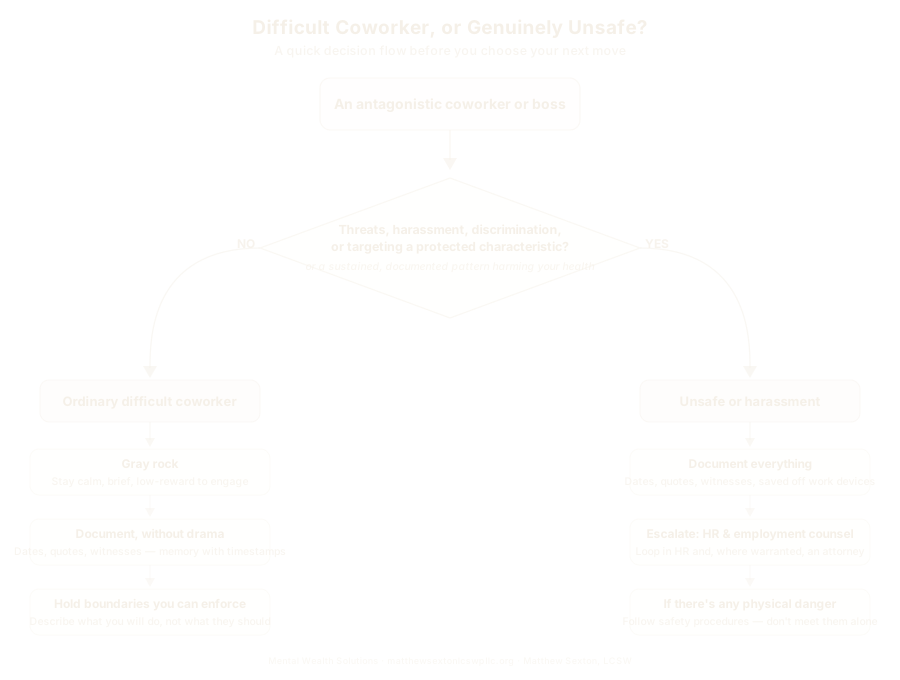
"Difficult" is unpleasant and draining: rudeness, politics, uneven credit. "Unsafe" or "harassing" is a different category, and it changes what you should do.
Some markers that you've crossed into harassment or a genuinely unsafe situation:
- The behavior targets a protected characteristic (race, sex, religion, disability, age, and others).
- There are threats, intimidation, stalking, or any hint of physical danger.
- It's a sustained, documented pattern rather than a bad week, and retaliation follows after you report in good faith.
- Your health is escalating with it: panic before work, severe insomnia, new hopelessness tied tightly to that relationship.
If you're in that territory, general survival tactics stop being enough. That's the point to loop in your HR department and, where warranted, an employment attorney. I'm a therapist, not a lawyer, so I won't advise you on the legal specifics, but I'll say plainly: legitimate workplace harassment is not something you're obligated to gray-rock your way through indefinitely. And if you believe violence may happen, that's a safety situation, not a documentation one — follow emergency procedures and don't meet the person alone.
On the mental health side, SAMHSA's guidance uses a simple duration-and-impact test: if changes in your mood, thoughts, or functioning are making it hard to manage work, relationships, or daily life for two weeks or more, that's the signal to bring in a professional (SAMHSA). The test isn't "is my coworker bad enough to justify this," it's "is this getting in the way of my life" — and only the second question is really yours to answer.
What Does Taking Back Your Agency Look Like Here?
It looks smaller and more real than "confront them" or "quit tomorrow." You very likely can't change this person. But you can stop being the reliable source of the reaction they're fishing for, build a record that protects you, quietly prepare a slow exit if you want one, and keep your evenings from being colonized by someone who doesn't deserve that much of your life. On the days that feels like nothing, that's usually the exhaustion talking — which is its own reason to get some support.
If you're worn down from managing someone you can't get away from, that's a completely reasonable thing to bring to therapy. Book a call and we'll figure out how to get your footing back — whether that's building better protection at this job or getting clear on what you want your next move to be.
How do I deal with a manipulative coworker without making things worse?
Reduce the emotional payoff instead of confronting them head-on. The gray rock method, keeping your responses brief, calm, and factual, tends to de-escalate because it makes provoking you unrewarding (Cleveland Clinic, "Grey Rock Method"). Pair that with documenting interactions in writing and moving key conversations to email, so you're building protection rather than escalating conflict.
What is workplace gaslighting and how do I respond to it?
Gaslighting at work is a pattern where someone denies things you clearly remember, calls you too sensitive or overreacting, and leaves you doubting your own judgment (Cleveland Clinic, "Gaslighting"). You don't have to win the argument. Effective responses decline the debate: "I hear you see it differently, this is my experience," or "I'm not going to continue this right now." Keeping written records also helps you trust your own memory.
Should I report a manipulative boss or coworker to HR?
It depends. If the behavior targets a protected characteristic, involves threats, or is a sustained documented pattern harming your work and health, that's harassment territory, and HR (and possibly an employment attorney) is appropriate. For garden-variety antagonism, documentation and self-protection often serve you better first. A therapist can help you think it through, though legal specifics belong to legal counsel.
How do I protect my mental health when I can't quit a toxic job?
Lower your baseline stress on purpose, because the situation itself won't. Build real separation between hard interactions and the rest of your day, give the feelings somewhere to go instead of swallowing them, and watch for the "I'm fine" mask competent people wear right up until they burn out. If it's interfering with your life for two weeks or more, that's the marker to get professional support (SAMHSA).
Sources
- Workplace Bullying Institute, "2024 WBI U.S. Workplace Bullying Survey," 2024. workplacebullying.org
- American Psychological Association, "2024 Work in America Survey: Psychological Safety in the Changing Workplace," 2024. apa.org
- SHRM, "Workplace Incivility Is More Common Than You Think" (Civility Index research), 2024. shrm.org
- NIOSH / CDC, "An Urgent Call to Address Work-related Psychosocial Hazards and Improve Worker Well-being," 2024. cdc.gov
- Cleveland Clinic, "How the Grey Rock Method Can Protect You From Abusive People and Toxic Interactions." health.clevelandclinic.org
- Cleveland Clinic, "Gaslighting: Definition & How To Spot It." health.clevelandclinic.org
- SAMHSA, "Signs You May Need Support." samhsa.gov
This article is for educational and informational purposes only. It does not constitute medical, clinical, legal, or therapeutic advice, and reading it does not create a therapist-client relationship with Matthew Sexton, LCSW or Matthew Sexton LCSW PLLC. Although the author is a licensed clinical social worker, the content in this article is not clinical assessment, diagnosis, or treatment.
Workplace dynamics, employment protections, and individual health circumstances vary widely. The strategies described are general patterns, not an individualized plan for your situation, and a tactic that helps one person may not fit another. For questions about workplace harassment, discrimination, or your legal rights, consult your organization's human resources department and, where appropriate, a qualified employment attorney. If stress related to work is interfering with your mood, sleep, relationships, or daily functioning for two weeks or more, please consult a licensed mental health professional who can assess your specific circumstances.
If you are in immediate emotional crisis, you can reach the 988 Suicide & Crisis Lifeline by calling or texting 988 (US). If you are experiencing domestic violence or are in physical danger, contact the National Domestic Violence Hotline at 1-800-799-7233 or visit thehotline.org. In a life-threatening emergency, call 911.