In two 2020 experiments with 316 and 360 university students reading fictional violence or assault scenarios, a DARVO response shifted judgments against the person reporting harm; brief education reduced some of those effects. The study did not test moving the goalposts. It is adjacent evidence showing how blame reversal can alter judgment. When standards keep changing, more proof may fail because the standard itself is unstable.
If you meet a requirement only to learn that it no longer counts, you may be caught in a shifting-standard pattern. You explain and answer the next objection. Then your timing, tone, or motives become the problem. “Moving the goalposts” is plain language, not a diagnosis or recognized clinical form of narcissistic abuse. The useful question is what the behavior does over time, not which label fits the other person.
What moving the goalposts looks like
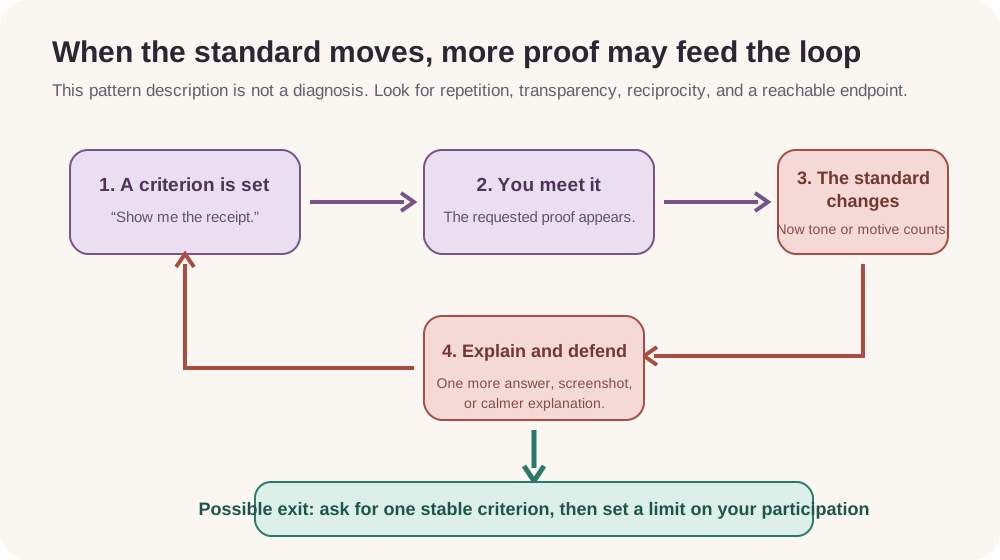
A person states or implies a criterion. Once you meet it, a condition appears, the original is reinterpreted, or the discussion moves elsewhere. Only one person holds the pencil that redraws the line.
The American Psychiatric Association’s adult PID-5 places manipulativeness, deceitfulness, and grandiosity within an Antagonism trait domain, but antagonism is not a diagnosis. The APA says the measure cannot be the sole basis for diagnosis. A few exchanges cannot support a third-party diagnosis.
A stable disagreement has an identifiable subject. People may weigh evidence differently without manipulation. Goalpost-shifting becomes more plausible when a criterion changes after it is met, no new information explains why, and the pattern repeats.
Why the explain-prove-defend loop is so exhausting
Supplying facts is sensible when an issue seems factual. With a moving standard, each answer becomes material for the next dispute. Your explanation is inspected, your proof is declared incomplete, and defending your motives becomes suspicious. The original question goes unanswered.
That is the explain-prove-defend loop. Goalpost-moving can overlap with DARVO, which stands for Deny, Attack, and Reverse Victim and Offender, but the concepts are not interchangeable.
The adjacent DARVO research offers a narrow view of role reversal. In the first 2020 experiment, students exposed to DARVO rated the person reporting harm as less believable, more responsible, and more abusive, while rating the accused person as less responsible and less abusive. Prior education reduced some effects in the second experiment. This does not show that every topic change is DARVO or that DARVO proves guilt.
In a 2017 study of 138 undergraduates, greater recalled DARVO exposure correlated with greater self-blame. The incidents were mainly social transgressions, wrongdoing was not verified, and the design cannot establish causation.
Self-audit can sound responsible: Maybe one more screenshot will help. Maybe I need to be calmer. With unstable criteria, that search can keep you engaged after progress stops.
A changed standard is not always manipulation
People revise expectations for legitimate reasons. Good-faith revision allows transparency: the person names what changed, acknowledges that the earlier standard was incomplete, states an attainable endpoint, and accepts that you may reconsider.
When you are unsure, ask:
- What was the original criterion?
- What new information appeared after it was set?
- Can the other person state the current endpoint in one sentence?
- Would the same rule apply to both of you?
- Does the discussion return to the issue or turn to your character or motives?
- Is this one badly handled exchange or a repeated pattern?
These are questions for clarity, not a clinical test. Ordinary disagreement can remain frustrating while still being reciprocal.
Gaslighting is distinct from goalpost-moving. A 2024 study validated an 11-item relationship-gaslighting measure in romantic-partner samples of 509 adults in Israel and 395 in the United States. Exposure was associated with greater depression and lower relationship quality after other measured forms of intimate-partner violence were considered. The associations do not prove causation or apply automatically outside romantic relationships.
Practical ways to step out of the loop
Find out whether a workable agreement exists and decide how much you will spend looking for it.
Ask for the criterion before offering more proof. Try: “What specific information would resolve this question?” Repeat a clear answer back.
Return to the original agreement once. “We agreed that the receipt would answer this. What new information changed that?”
Set a limit on your contribution. “I’ve answered the original question, and I’m not going to keep debating my motives” governs your participation without requiring an admission.
Pause when the subject becomes your character. You can say: “I’m willing to discuss the original decision. I’m not going to debate my character.” The broader guide on responding to antagonistic behavior offers more ways to slow an exchange without turning it into a diagnosis.
Keep a private contemporaneous note only if it is safe. A brief record can support your clarity, but it does not guarantee persuasion and is not legal guidance. If notes could increase danger, speak with an advocate instead.
Use lower-contact approaches cautiously. The gray rock and yellow rock guide describes two ways to reduce emotional material. Neither is a cure or universal safety strategy. The guide to weaponized honesty separates useful candor from a recurring tactic.
When this belongs in a safety conversation
Moving goalposts alone does not establish coercive control or domestic violence. In intimate-partner violence research, behavior can mean something different inside an enduring pattern of domination, isolation, and control.
A systematic review identified 68 coercive-control studies, with 45 in meta-analyses. Exposure was moderately associated with PTSD symptoms and depression. The evidence was correlational and specific to intimate-partner violence.
New York’s Office for the Prevention of Domestic Violence describes domestic violence as a pattern used to maintain power and control over an intimate partner. Its 2025 training resource notes that coercive-control tactics may change. Neither source turns one shifting expectation into an assessment or legal conclusion.
If the wider picture includes fear, threats, monitoring, isolation, financial control, stalking, or danger, do not treat a boundary script as a safety plan. New York offers confidential statewide support at 800-942-6906 or by text at 844-997-2121. A qualified advocate can consider your specific circumstances.
Reclaiming agency without solving the other person
Goalpost-moving fixes attention on the next demand. Agency returns when you ask: What do I know? What decision belongs to me? What would I choose if agreement never arrives?
That final question is not a command to confront, leave, or cut contact. It keeps your life from depending on a verdict the other person may never give. An unresolved accusation does not require unlimited access to your time.
Therapy can help map the demands, their impact, your values, and your choices. For New York therapy clients, the work may include rebuilding trust in your observations and practicing workable limits. It cannot diagnose an absent person or promise change.
Is moving the goalposts a form of narcissistic abuse?
It is not a diagnosis, syndrome, DSM term, or recognized clinical form of narcissistic abuse. It describes a shifting-standard pattern but does not prove a personality disorder, gaslighting, coercive control, domestic violence, or abuse.
How can I tell moving goalposts from an ordinary disagreement?
Look for repetition, transparency, reciprocity, and a reachable endpoint. Good-faith revision names new information and states the new standard. In a shifting pattern, meeting one criterion produces another while the original issue remains unresolved.
Why do I keep explaining myself?
Because the dispute appears solvable through accuracy. Explaining is a reasonable effort to repair misunderstanding. The loop becomes costly when each explanation creates a new allegation or standard. Asking for one stable criterion may tell you more than another page of proof.
What can I say when the subject changes to my character?
Try: “I’m willing to discuss the original question. I’m not going to debate my character.” You can also pause. A script can protect your participation but cannot guarantee agreement, de-escalation, or safety.
Can therapy help if the other person will not participate?
Therapy can help you examine the pattern, its impact, your choices, your values, and your safety without diagnosing someone who is not present. It cannot guarantee that another person will change or confirm one interpretation of the relationship.
Sources
- Harsey, S. J., & Freyd, J. J. (2020). “Deny, Attack, and Reverse Victim and Offender (DARVO): What Is the Influence on Perceived Perpetrator and Victim Credibility?”, Journal of Aggression, Maltreatment & Trauma. Published June 8, 2020.
- Harsey, S. J., Zurbriggen, E. L., & Freyd, J. J. (2017). “Perpetrator Responses to Victim Confrontation: DARVO and Victim Self-Blame”, Journal of Aggression, Maltreatment & Trauma. Published June 2017.
- Tager-Shafrir, T., Szepsenwol, O., Dvir, M., & Zamir, O. (2024). “The Gaslighting Relationship Exposure Inventory: Reliability and Validity in Two Cultures”, Journal of Social and Personal Relationships. Published online July 24, 2024; October 2024 issue.
- American Psychiatric Association. The Personality Inventory for DSM-5, Adult. Copyright 2013; file published August 11, 2015.
- Lohmann, S. et al. (2023). “The Trauma and Mental Health Impacts of Coercive Control: A Systematic Review and Meta-Analysis”, Trauma, Violence, & Abuse. Published online April 13, 2023; 2024 issue.
- New York State Office for the Prevention of Domestic Violence and New York State Coalition Against Domestic Violence. Understanding Coercive Control: Addressing Safety & Accountability in the Court System. Published June 12, 2025.
- New York State Office for the Prevention of Domestic Violence. “About Domestic Violence”. Undated living page; accessed July 28, 2026.
This article is for educational and informational purposes only. It does not constitute medical, clinical, legal, or therapeutic advice, and reading it does not create a therapist-client relationship with Matthew Sexton, LCSW or Mental Wealth Solutions PLLC. Although the author is a licensed clinical social worker, the content in this article is not clinical assessment, diagnosis, or treatment.
The patterns and response options described here reflect published research and general education about shifting standards, antagonistic behavior, and related interpersonal dynamics, not an individualized assessment of your situation or anyone else’s. Individual circumstances vary, and these descriptions may not fit your relationship, workplace, or family. If you are trying to understand a specific pattern, its impact, or possible safety concerns, consult a licensed mental health professional or qualified advocate who can consider your circumstances directly.
If you are in immediate emotional crisis, you can reach the 988 Suicide & Crisis Lifeline by calling or texting 988 (US). If you are experiencing domestic violence or are in physical danger, contact the National Domestic Violence Hotline at 1-800-799-7233 or visit thehotline.org. In a life-threatening emergency, call 911.