First, the practical thing. If you think your devices may be monitored, read this on a device the other person cannot access — a library computer, a friend's phone. Browser and search history can be visible, and clearing it can itself be noticed, so a different device is safer than a cleaned-up one. The National Domestic Violence Hotline is 1-800-799-7233, and thehotline.org has a chat option if a call is not safe to make. Now the substance. Tech-facilitated abuse — location tracking, shared accounts, monitoring dressed as care — rarely announces itself as abuse. In the CDC's National Intimate Partner and Sexual Violence Survey (2016/2017), 13.5% of women and 5.2% of men in the US reported having been stalked by an intimate partner. What technology changes is not the tactics but the reach: a 2025 study in the Journal of Interpersonal Violence found that surveillance gave perpetrators what the researchers call "omnipresence": control extending into spaces where the person was physically absent. That is why the fear does not stop when you are alone. It is not supposed to.
Matthew Sexton, LCSW, NATC — Licensed clinical social worker in private practice, providing telehealth psychotherapy to adults in New York.
Most people who end up living inside this do not describe it as surveillance. They describe a phone that has become stressful to look at.
What "omnipresence" means, and why it explains the exhaustion
The most useful idea I have read on this comes from a 2025 study by Kassing and Collins in the Journal of Interpersonal Violence, a qualitative study of semi-structured questionnaire responses from 15 Australian women who had experienced coercive control. Five of the fifteen described technology-facilitated control specifically, which the authors summarize as micro-management, harassment, and technological stalking.
Their conclusion about what technology contributes is the part worth carrying: it enabled the perpetrator's omnipresence, extending control into spaces where the abuser was physically absent, and intensifying the sense of entrapment throughout ordinary daily life.
Read that against your own experience if it applies. The reason you check your phone before you do something unremarkable, the reason arriving somewhere involves a calculation, the reason being alone in your own home does not feel like being alone. None of that requires the other person to be present or even to be actively looking. The monitoring replaced the need for them to be there. That is not you being paranoid. That is the mechanism working exactly as designed.
It also explains something clients often apologize for: the fatigue is disproportionate to any single incident. Nothing happened today. Nothing has to. Sustained readiness is expensive, and a system that runs all day costs more than an event that happens occasionally.
The researchers also identified three broader things coercive control attacks: autonomy and independence, degraded through monitoring and economic manipulation; identity and self-worth, degraded through humiliation and accusation; and an environment of terror and helplessness produced by unpredictability and isolation. Monitoring serves the first and feeds the third.
One important framing note: those authors propose "coercive control trauma" as a conceptual framework, explicitly not a diagnostic category. It is a way of describing a pattern of harm, not a diagnosis anyone can be given, including by this article.
The numbers, and their honest limits
The best population figure available in the US comes from the CDC's National Intimate Partner and Sexual Violence Survey, 2016/2017 report, which surveyed 15,152 women and 12,419 men. It found that 13.5% of women and 5.2% of men had been stalked by an intimate partner. More broadly, about 2 in 5 women and 1 in 4 men reported contact sexual violence, physical violence, and/or stalking by an intimate partner.
Now the caveat, which cuts in a specific direction: that data was collected between September 2016 and May 2017 and published in 2022. It predates the current generation of always-on location sharing, shared family accounts, smart-home devices and cheap tracking hardware. I am not going to inflate the number to compensate. I do not have a better one. But when you see 13.5%, understand that it describes a world with meaningfully less surveillance infrastructure than the one you are in.
Note also that these figures cover women and men. This is not a one-directional problem, and men experiencing it face an additional obstacle in being taken seriously.
The tactics of tech-facilitated abuse are ordinary, which is the problem
There is no exotic technology in most of these accounts. Advocacy groups that track this describe a range spanning the overt: location sharing that was framed as safety or convenience, tagging on social media, shared accounts, "just checking", and the covert, including software installed without knowledge.
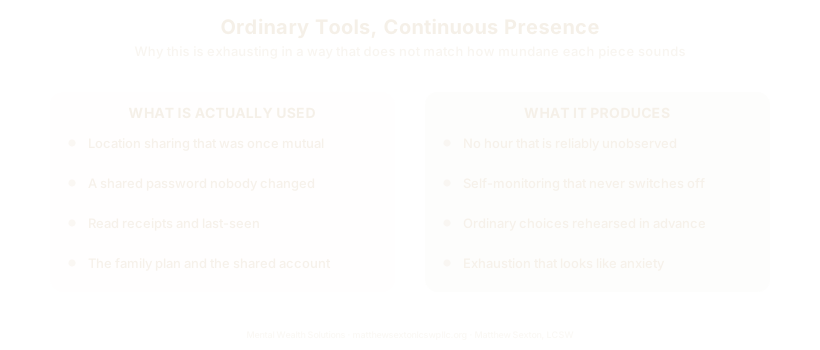
That column is not a checklist. Every item on it appears in healthy relationships too. It is here to show how ordinary the toolkit is, not to help you audit your own phone.
One line from the 2025 study gives the texture better than a list. One participant described a partner who "adopted technological surveillance through apps and demanded to know my passwords." The study also records a participant whose partner logged into her accounts to keep tabs on her, and who used them to talk to people online while pretending to be her.
The second one matters because it shows the reach. Access to accounts is not only about watching. It is the ability to be you, to send things in your name, to shape what other people believe about you. That is why the isolation deepens without anyone being visibly cut off.
What makes this hard to name is that almost every tool involved has a legitimate use. Couples share locations. Families share accounts. The feature is not the abuse. The absence of a real choice about it is. The question that separates the two is not what is enabled. It is what you believe would happen if you turned it off — and that is a question to answer in your head, not by trying it. The next section is about why.
Why I am not going to tell you how to check or remove it
I want to be direct about this, because it is the most common request and the advice is genuinely dangerous.
Do not start disabling monitoring, deleting apps, or turning off location sharing based on an article. If someone is monitoring you, the monitoring stopping is itself information. It tells them you know. For some people that is fine. For others it removes the predictability they have been surviving on, and advocates treat the period right after a controlling person realizes they have lost visibility as a point of elevated risk. Advocates who do this work full time treat the sequencing as the central problem, and they sequence it around a safety plan rather than around the technology.
So instead of instructions, one recommendation: talk to the National Domestic Violence Hotline at 1-800-799-7233 or thehotline.org, ideally from a device the other person cannot access. They do safety planning, they are current on the technology in a way no article stays, and they will help you work out the order of operations. This is the one situation where I would rather you close this page and call someone than read to the end.
What location tracking and monitoring do to a person, clinically
Set the technology aside and look at what living under surveillance produces, because this is the part therapy can address.
Chronic hypervigilance. A nervous system that does not stand down, because there is no reliable moment when it is safe to. This is the same physiology as walking on eggshells, running continuously instead of in episodes.
Erosion of an internal reference point. When someone else has more information about your day than you can recall unaided, you slowly stop being the authority on your own life. People start double-checking their own memory of where they were.
Anticipatory self-editing. Decisions made in advance to avoid a conversation later: routes, timing, who you see. Over months this is how a life quietly narrows, and most people cannot say when it started.
Guilt about wanting privacy. This one is nearly universal and worth naming clearly. Wanting privacy from a partner is not a betrayal, and needing to justify ordinary movement is not what closeness looks like.
The relief that does not come. Something many people are unprepared for: leaving does not necessarily end it, because the infrastructure can persist. What continues after you leave is its own distinct experience, and expecting it to stop at the door makes the continuation feel like personal failure rather than a predictable feature.
What therapy can and cannot do here
It cannot secure your devices, and it is not a substitute for safety planning with an advocate. Those are specific jobs for people trained in them.
What it can do is treat what the surveillance built. Rebuilding trust in your own account of events. Getting the nervous system to stand down in the places that are actually safe, which takes time and does not respond to being told the danger has passed. Restoring the small choices that got optimized away. Working on the guilt that attaches to wanting a private life. And separating what happened to you from what you concluded about yourself while it was happening, which is usually where the lasting damage sits.
Recovery from tech-facilitated abuse follows safety rather than replacing it. If you are still inside the situation, the advocates come first.
If you are past the acute stage, or working through what it left behind, book a call . Getting your own agency back is slow and it is genuinely possible.
Related reading
- Narcissistic abuse and stalking after you leave
- After the eggshells: taking back your agency
- Walking on eggshells: anxiety or an unsafe relationship?
- Setting boundaries with family without drowning in guilt
Is it abuse if I agreed to share my location?
Consent given under pressure, or given because refusing would have caused a problem, is not the same as a free choice, and consent to one thing is not permanent consent to everything it grew into. The clarifying question is not whether you agreed. It is what would happen if you changed your mind. If turning it off would trigger interrogation, punishment, or an accusation of hiding something, then the arrangement is being maintained by something other than your agreement. Many people in this situation did technically agree at the start, which is a large part of why it takes so long to name.
Should I check my phone for tracking apps or remove them?
Not based on an article, and please read that as caution rather than evasiveness. If someone is monitoring you, the monitoring going dark tells them you know, and advocates treat the period after a controlling person loses visibility as a point of elevated risk. Contact the National Domestic Violence Hotline at 1-800-799-7233 or thehotline.org from a device the other person cannot access — the section above explains why the sequencing matters more than the technical steps.
Does tech-facilitated abuse count as "real" abuse if nothing physical happened?
Yes, and the research treats it that way. Coercive control is studied as a pattern of harm in its own right, and the 2025 study discussed here describes surveillance as attacking autonomy and independence directly while feeding an environment of helplessness, with no physical violence required for those effects. This is also the most common reason people delay getting help: nothing happened that sounds serious enough to report. The absence of an incident is a feature of how control works, not evidence that it was mild.
Why do I still feel watched after leaving?
For two reasons, and they need different responses. Practically, the infrastructure can persist: accounts, devices, and shared services often outlast the relationship, which is why post-separation safety planning with an advocate is a distinct piece of work. Psychologically, a nervous system that spent years unable to stand down does not reset because the circumstances changed. Hypervigilance outlasts the threat that trained it, and it responds to gradual relearning in genuinely safe conditions rather than to reassurance. Feeling watched after leaving is not a sign you are failing to move on.
Sources
- Kassing, K., & Collins, A. (2025). "Slowly, over time, you completely lose yourself": Conceptualizing coercive control trauma in intimate partner relationships. Journal of Interpersonal Violence, 41(3–4), 662–684. doi:10.1177/08862605251320998. pmc.ncbi.nlm.nih.gov
- Centers for Disease Control and Prevention. The National Intimate Partner and Sexual Violence Survey: 2016/2017 Report on Intimate Partner Violence. cdc.gov
- National Domestic Violence Hotline: 1-800-799-7233, thehotline.org
This article is for educational and informational purposes only. It does not constitute medical, clinical, legal, or therapeutic advice, and reading it does not create a therapist-client relationship with Matthew Sexton, LCSW or Mental Wealth Solutions PLLC. Although the author is a licensed clinical social worker, the content in this article is not clinical assessment, diagnosis, or treatment.
The 2025 study described here is qualitative, based on accounts from 15 women in Australia, and cannot establish how common these experiences are. "Coercive control trauma" is a conceptual framework proposed by those researchers, explicitly not a diagnostic category. The CDC survey figures were collected in 2016 and 2017 and published in 2022, and describe patterns across a national sample rather than any individual situation. Individual circumstances vary enormously, and safety decisions should be made with a trained advocate who knows your specific situation. This article is published by Matthew Sexton, LCSW, NATC, PLLC. Nothing here is a screening instrument, and nothing here can tell you what happened to you.
If you are in immediate emotional crisis, you can reach the 988 Suicide & Crisis Lifeline by calling or texting 988 (US). If you are experiencing domestic violence or are in physical danger, contact the National Domestic Violence Hotline at 1-800-799-7233 or visit thehotline.org. In a life-threatening emergency, call 911.