After leaving a narcissistic or coercively controlling relationship, many people feel numb, indecisive, and still braced for danger rather than relieved. Sustained control trains the nervous system toward helplessness, hypervigilance, decision-paralysis, and self-erasure, and those adaptations do not switch off the day contact stops. Reclaiming agency after narcissistic abuse is a skill you regrow through small, repeated moves: reclaiming tiny preferences, making low-stakes decisions and letting them stand, and slowly rebuilding trust in your own perception. Modern neuroscience supports this directly: helplessness is the default state that adversity produces, and control is the thing the brain actively learns and detects (Maier and Seligman, 2016).
If the relationship is over and you expected to feel free, but instead you feel numb, frozen, and strangely unsure of who you are, nothing has gone wrong with you. This is one of the most common and least-discussed parts of recovery. The fear finally lifts, and the person underneath it turns out to be someone who cannot decide what to eat, who braces at a raised voice that is no longer in the room, who has quietly forgotten what they actually like. Agency, your sense of being the author of your own life, erodes under coercive control. And the encouraging news from the research is that agency is not a fixed trait you either have or lost. It is closer to a muscle, and muscles regrow.
Coercive control is far more common than most people leaving these relationships realize, which matters because isolation is part of the injury. The CDC's National Intimate Partner and Sexual Violence Survey found that more than 1 in 4 women (27.2%) and nearly 1 in 5 men (19.5%) have experienced coercive control and entrapment by an intimate partner in their lifetime (CDC NISVS). You are not the only person who walked out of a relationship and discovered they had misplaced their own preferences somewhere along the way.
The Numbness Is Protection, Not Failure
You spent months or years running a threat-detection system at full power. Under coercive control, safety depended on reading the other person's mood, predicting the next shift, and adjusting yourself before anything blew up. The National Domestic Violence Hotline describes this as a pattern in which one partner uses a range of tactics to intimidate, isolate, and dominate the other, stripping away the target's sense of self along the way (National Domestic Violence Hotline). That system does not power down the moment you leave. It kept you safe for a long time, and it does not yet trust that the danger is really gone.
So the bracing continues into an empty apartment. A door closing too hard, a certain tone in an email, a phone lighting up at the wrong hour, and your body responds as if the old rules still apply. Part of what keeps this running is a cruel feature of many of these relationships: intermittent reinforcement. If stretches of warmth, apology, and good days were mixed in with the control, your nervous system learned that calm can reverse without warning. No-contact and closed doors change your real circumstances while the body keeps running predictions off the old pattern. Sometimes the bracing even feels like loyalty to the old job, as if relaxing your guard would mean you are not taking it seriously. That belief updates slowly, with repeated safe days, not with a single pep talk.
The numbness is the other side of the same coin. A nervous system that has been on high alert for years will, when it finally gets a break, sometimes drop into flat, foggy shutdown. That is protection, not failure. Complex PTSD, the pattern that often follows prolonged relational trauma, includes exactly this kind of hypervigilance, or as Cleveland Clinic puts it, "excessive attention to the possibility of danger" (Cleveland Clinic). If you are having trouble telling ordinary anxiety apart from the real alarm your body learned, this piece on eggshell anxiety versus genuine danger walks through the difference.
Why Can't You Make Even Small Decisions Anymore?
Decision-paralysis after coercive control has a clear origin. When you lived with someone who could turn any choice into a problem, deciding stopped being safe. Pick the wrong restaurant, the wrong words, the wrong outfit, and there was a cost. The efficient adaptation was to stop choosing and start deferring. Over time, deferring becomes automatic, and the machinery you would use to know what you want goes quiet from disuse.
This is where the science gets genuinely hopeful. Martin Seligman and Steven Maier originally described "learned helplessness" in the 1960s: after enough uncontrollable stress, animals and people stop trying to escape even when escape becomes possible (Positive Psychology Center, University of Pennsylvania). For decades that was the story, and it was a grim one. But in 2016, Maier and Seligman published a reversal of their own theory based on fifty years of neuroscience. Passivity in the face of prolonged adversity, they found, is not learned at all. It is the default, unlearned response. What the brain actually learns and detects is control (Maier and Seligman, 2016).
Read that again, because it changes everything about recovery. Your indecision is not proof that you are broken or that helplessness is your true nature. It is the baseline state any nervous system drops into under sustained, uncontrollable stress. The thing that was missing was the experienced presence of control, and that is the thing you can rebuild through repetition. Every small choice you make and follow through on is your brain gathering fresh evidence that control is available again.
Agency Is a Skill You Regrow
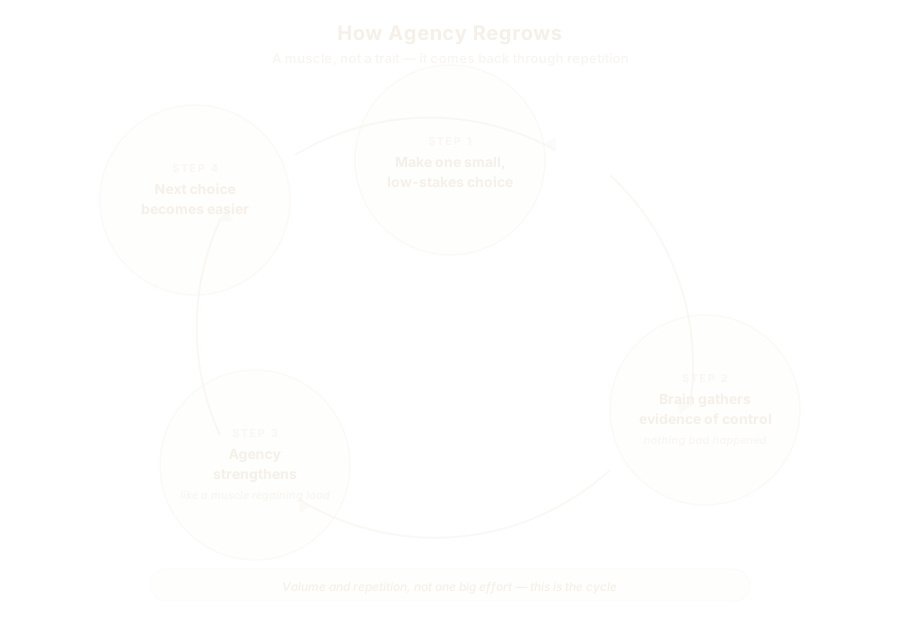
Think of it the way physical therapy treats a limb that has been in a cast. The muscle did not vanish. It weakened because it was not being used, and it comes back through graded, repeated load, not through a single heroic effort. Self-authorship works the same way. You do not reclaim your whole identity in a weekend of journaling. You reclaim it in hundreds of small, boring, deliberate moves that each say: I noticed what I wanted, I acted on it, and nothing bad happened.
The order matters, and most people get it backwards. They wait to feel confident before making choices. But confidence is downstream of the choices, not upstream. Maier and Seligman's finding points the same direction: control is something the brain detects through experience, which means you have to give it experiences of control to detect. You act first, in low stakes, and the feeling of agency follows the evidence. This is slow and unglamorous, and it works.
How Do You Start Reclaiming Your Own Preferences?
Start smaller than feels serious. A preference is a small act of self-definition, and in a controlling environment even small acts drew scrutiny, so it makes sense that "what do you want for dinner?" can feel bigger than the question deserves. A few concrete first moves:
- Run a micro-preference inventory. Work up from the body outward. Warm or cool shower, lights up or dim, the window seat or away from it. Then sensory: which texture of clothing feels better today, music or quiet. Then social: text back now or after lunch. The content barely matters. The point is reinstalling the habit of asking yourself and recording the answer instead of outsourcing it to someone else's mood.
- Separate the preference from the justification. Practice saying, out loud or on paper, "I want the blue one." Full stop, no essay about why blue is rational. Under coercive control, many people learned they were only allowed a want if they could defend it in court. You do not need a brief for soup.
- Expect fake preferences first. Some answers will sound like your former partner, a parent, or an old friend group. That is useful information, not a setback. Thank the borrowed voice and ask again: if no one would ever know or comment, what would I pick?
- Make one low-stakes decision a day and let it stand. Choose the dinner without polling anyone, pick the movie, take the route. Give reversible choices a short time box so you do not reopen the case for an hour. A wave of anxiety often follows a choice. That wave is usually the old threat tag firing, not evidence the choice was wrong. Name it and let the decision stand unless real new information arrives.
None of these will feel momentous. That is the point. Agency regrows through volume, not intensity, and small wins are the only kind available at the start. If the second-guessing is loud, this article on self-doubt after a narcissistic relationship goes deeper on rebuilding that inner trust.
What Do Boundaries Look Like When You Are Finding Your Voice?
Boundaries are simply decisions about your own participation, and early on they can be modest. You might wait before replying, decline a topic, leave when shouting starts, or keep something private. Because the old dynamic taught you that another person's disappointment was dangerous and yours to fix, even a small boundary can bring guilt or a panic to over-explain. Keep the wording short enough to hold onto under stress:
- "I won't discuss that."
- "I'll let you know tomorrow."
- "I'm going to end this conversation now."
- "No, that doesn't work for me."
You cannot control whether the other person approves. You can decide what access, time, and attention you offer. If contact has to continue because of children, work, housing, or a legal matter, generic advice about confrontation or going no-contact will not fit every situation, and personalized safety and legal guidance matters more than any script.
What If You Feel Guilty for Wanting Your Life Back?
Guilt shows up for almost everyone here: guilt for leaving, for staying as long as you did, for not fixing it, for feeling relief, or for not feeling relief. After coercive control, guilt is not a reliable moral compass. It is often just a trained response to putting yourself first.
One practical move is to sort it. Repair-worthy guilt points to a specific harm you could actually address with a living person who is safe to reach. Residual guilt is the fog that shows up whenever you choose rest, pleasure, a boundary, or no-contact. Residual guilt does not shrink by being obeyed. It shrinks by being named while you make the life-serving choice anyway and let the feeling tag along without handing it the gavel. You are allowed to want a life that is quiet, ordinary, and yours. Wanting that does not make you cruel.
When Should You Bring in a Therapist?
There is a practical marker for this, and it is about function, not toughness. NIMH's guidance on coping with traumatic events points to seeking professional support when symptoms do not improve over time or begin to interfere with daily life (NIMH). If the numbness, the bracing, the paralysis, or the sense of being a stranger to yourself is still running the show weeks and months after the danger ended, and it is getting in the way of work, sleep, or relationships, that is the signal. It is not a verdict on how well you are coping. It is information about what the injury needs.
Recovery from this kind of harm is also not meant to be done in isolation, which is a cruel irony given that isolation was part of how the control worked. NIMH names social support as one of the central resilience factors in trauma recovery (NIMH). A therapist is one deliberate form of that support, someone whose whole job is to help you rebuild the machinery of self-authorship in a setting where choosing is finally safe. Working with someone who understands narcissistic and coercive dynamics specifically matters, because the deformations of self that happen under sustained control get misread as personality flaws by people who do not know what they are looking at. Therapy built for narcissistic abuse recovery starts from the correct premise: your reactions made sense given what you survived. When the pattern runs deep enough to show up as the hypervigilance, negative self-concept, and difficulty trusting that mark complex trauma, complex PTSD-informed therapy addresses the whole shape of it rather than one symptom at a time, and a broader map of healing from narcissistic abuse covers the grief and boundary work alongside it.
Progress here can look wonderfully ordinary: choosing dinner without a debate in your head, disagreeing without disappearing, resting without waiting for punishment, believing yourself a little sooner. If you want support taking those steps, you are welcome to book the call. We can talk about what has been happening, what you want back, and whether working together feels like a fit. You do not need a polished explanation before you reach out.
The through-line is worth holding onto. The fear lifting and leaving numbness behind is not the recovery failing to start. It is the recovery starting, at the only place it can, with a nervous system that finally has room to notice how tired it is. Agency comes back the way it left, one small move at a time, except this time the moves are yours.
Why do I feel worse after leaving instead of relieved?
Your threat-detection system does not switch off just because the danger left the room. Under coercive control you stayed safe by bracing, scanning, and self-editing, and that system keeps running afterward, often alongside a numb, foggy shutdown as your nervous system finally lets its guard down. Grief and relief can also arrive together. This is a well-recognized part of post-separation recovery, not a sign that leaving was wrong or that you are broken.
Is it normal to not know what I want anymore after an abusive relationship?
Yes, and it has a specific cause. When choosing came with a cost, deferring became the safe habit, and the internal machinery you use to register your own preferences went quiet from disuse. It comes back through practice with small, low-stakes choices. Knowing what you want is a skill that regrows, not a fixed trait you permanently lost.
Can you actually rebuild agency after narcissistic abuse, or is the damage permanent?
You can rebuild it. Maier and Seligman's 2016 neuroscience review found that helplessness is the default response to prolonged adversity and that control is what the brain actively learns and detects (Maier and Seligman, 2016). That means agency is regrowable by design. Every small choice you make and follow through on gives your brain fresh evidence that control is available again.
How is reclaiming agency different from just being more confident?
Confidence is often a mood or a story you tell about yourself. Agency is closer to a set of practiced capacities: noticing a signal, choosing, tolerating the after-feeling, and updating from what actually happens. You can build agency on days your confidence is low, which is exactly why treating it as a skill works better than waiting to feel ready.
When should I see a therapist for this?
When the numbness, bracing, paralysis, or sense of being a stranger to yourself is not improving over time and is interfering with daily life, work, sleep, or relationships (NIMH). If there is any ongoing contact that involves stalking, threats, or violence, contact the National Domestic Violence Hotline for confidential safety planning first. A therapist who understands coercive control can help rebuild self-trust in a setting where choosing is finally safe.
Sources
- Centers for Disease Control and Prevention, "The National Intimate Partner and Sexual Violence Survey (NISVS): Intimate Partner Violence." cdc.gov
- Maier, S.F., and Seligman, M.E.P., "Learned Helplessness at Fifty: Insights from Neuroscience," Psychological Review, 2016. pmc.ncbi.nlm.nih.gov
- Positive Psychology Center, University of Pennsylvania, "Learned Helplessness" (Seligman and Maier research). ppc.sas.upenn.edu
- Cleveland Clinic, "CPTSD (Complex PTSD): What It Is, Symptoms & Treatment." my.clevelandclinic.org
- National Institute of Mental Health, "Coping With Traumatic Events." nimh.nih.gov
- The National Domestic Violence Hotline, "Power and Control." thehotline.org
This article is for educational and informational purposes only. It does not constitute medical, clinical, legal, or therapeutic advice, and reading it does not create a therapist-client relationship with Matthew Sexton, LCSW or Matthew Sexton LCSW PLLC. Although the author is a licensed clinical social worker, the content in this article is not clinical assessment, diagnosis, or treatment.
The patterns and recovery practices described here reflect published research and general clinical observation about coercive control and post-separation recovery, not an individualized assessment of your situation. Every person's history, safety needs, and nervous system are different, and what helps one person may not fit another. If you are concerned about stalking, threats, escalating control, or violence, consider confidential safety planning with a qualified domestic-violence advocate before changing contact or confronting the other person. If numbness, fear, or difficulty functioning persists after an abusive relationship ends, please consult a licensed mental health professional who can assess your specific circumstances. Matthew Sexton is licensed to provide telehealth therapy to residents of New York, Maine, Delaware, and Florida.
If you are in immediate emotional crisis, you can reach the 988 Suicide & Crisis Lifeline by calling or texting 988 (US). If you are experiencing domestic violence or are in physical danger, contact the National Domestic Violence Hotline at 1-800-799-7233 or visit thehotline.org. In a life-threatening emergency, call 911.