Yes, it counts, and the primary sources already say so. Of the fifty items in Hassan's BITE model, only nine require another person to be physically present with you, and all nine describe physical violence or confinement. The other three categories, Information Control, Thought Control, and Emotional Control, don't contain a single item that needs a shared room. Hassan's own handout names the internet four separate times. Lifton defines Milieu Control, the first of his eight criteria for thought reform, as "the control of all communication within a given environment," not as physical isolation; geography is one way that control gets delivered, not the definition of it. If a Discord server, a Telegram channel, a livestreamed service, or a paid coaching container controlled your information, your relationships, and your sense of reality, the frameworks that define coercive control already cover you. You never needed a building to have been in one.
Matthew Sexton, LCSW, NATC — Licensed clinical social worker in private practice, providing telehealth psychotherapy to adults in New York. Cult recovery, coercive control, and spiritual abuse.
The Audit Nobody Ran
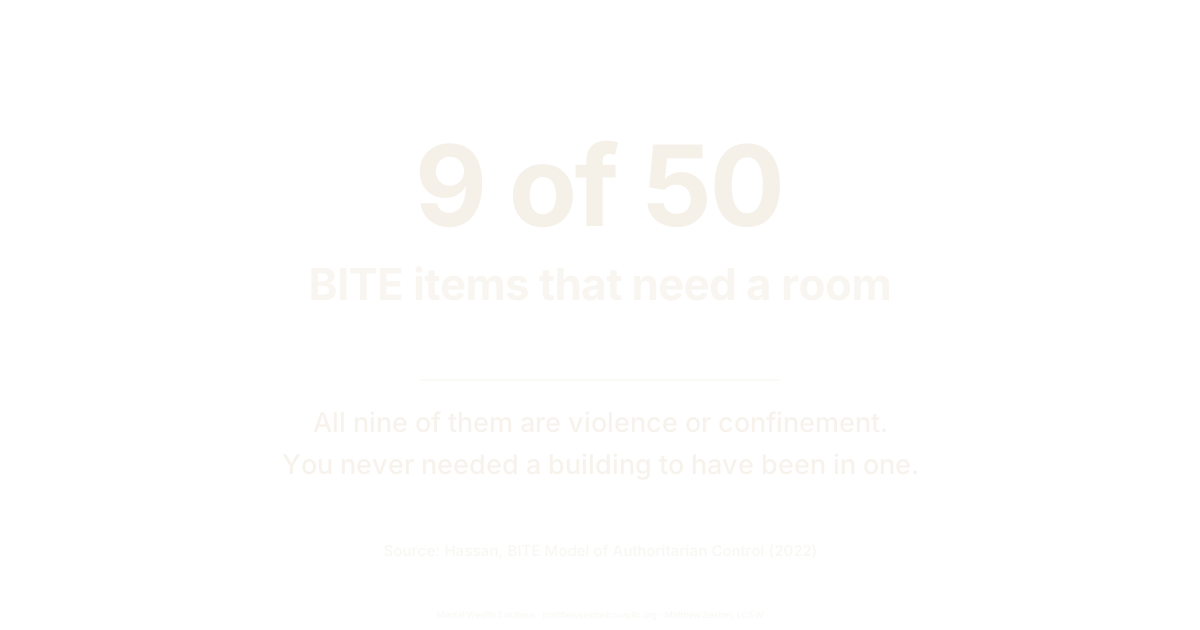
Hassan's BITE model has fifty items spread across four categories: Behavior Control, Information Control, Thought Control, and Emotional Control. Count how many of those fifty require someone to be physically near you, in a room, a compound, a building, anywhere your body could be watched by their eyes instead of tracked by their software. The number is nine. All nine sit inside Behavior Control, items 14, 16, 17, 19, 20, 21, 22, 24, and 25, and every one of them is physical violence or physical confinement.
That leaves forty-one items with no physical requirement at all. Three of the four categories, Information, Thought, and Emotional, contain zero. Not mostly none. Zero. A group can control what you're allowed to read, what you're allowed to conclude, and what you're allowed to feel without ever occupying the same time zone you do, and the model that defines coercive control was built to say exactly that. If the model itself is new to you, the machinery of control walks through what it names and why.
Hassan Already Named the Internet
This isn't an inference stretched across an old document written before anyone had a smartphone. Hassan's handout, revised in June 2022, names the internet directly, four times. Behavior item 9 covers "major time spent with group indoctrination and rituals and/or self indoctrination including the Internet." Information item 2a lists the internet among the outside sources members are discouraged from consulting. Information item 2e names "control through cell phone with texting, calls, internet tracking." Information item 5a lists YouTube among the channels a group can use to spread propaganda. The model was already written with your screen inside it.
And on page one, before any of the fifty items, Hassan writes the sentence that answers the reader's actual objection. People under undue influence "can live in their own homes, have 9-to-5 jobs, be married with children, and still be unable to think for themselves and act independently." He wrote that about people who never left their houses. It was never about the room. The same reasoning is what makes it possible to ask whether a workplace qualifies, where nobody is confined either.
What "Milieu Control" Actually Controls
Lifton's eight criteria for thought reform open with Milieu Control, and the definition is worth reading slowly, because it gets flattened into "isolation" so often that people stop checking the source. In Lifton's own language, Milieu Control is "the control of all communication within a given environment." Communication. Not geography.
The physical language, isolation by distance, no transportation, physical restraint, appears later in his description as one method a group can use to achieve that control. It's an example of delivery, not the requirement itself. A group chat where every message passes through a moderator, every dissenting comment disappears, and every member's picture of the outside world runs through the same handful of accounts is controlling communication within an environment just as completely as a compound behind a locked gate. The other seven criteria Lifton names, Mystical Manipulation, Demand for Purity, Cult of Confession, Sacred Science, Loading the Language, Doctrine Over Person, and Dispensing of Existence, carry no physical requirement in his model at all.
A Second Study, a Different Method, the Same Pattern
The audit above comes from two clinical frameworks that have been in use for roughly thirty and sixty years respectively. A newer, independent piece of research reaches the same shape of answer from a different angle entirely. Sarah Feliciano's 2023 master's thesis at CUNY John Jay College interviewed 52 former members of high-control groups, 1.5 to 3 hour phone interviews, coded by multiple researchers with 89.66% intercoder reliability. Coercive control tactics showed up in all 52 narratives. Every one.
The three most frequent tactics she identified were manipulation, intimidation, and microregulation, none of which require the person doing them to be standing in front of you. The least frequent were sexual coercion and abuse, deprivation, and degradation, the tactics that do require physical presence. Feliciano's thesis didn't set out to compare online and in-person groups specifically, and it would overstate her finding to claim it did. But the pattern it turns up independently is the same one sitting inside Hassan's and Lifton's definitions: the tactics that do the most damage are also the ones that travel through a screen without any trouble at all.
The Question Under the Question
None of this makes the question easier to sit with, and it's worth naming why. A cult that meets in a building leaves something behind you can point to: a compound, a sign, a room full of people who remember the same meetings you do. An online-only group leaves you with a browser history. Nobody else saw the messages arrive at 2 a.m. Nobody else watched you cancel plans to be available for a call. There's no photograph of the thing that happened to you, because the thing that happened to you was a pattern of messages, not a place.
That absence gets read, by the person who lived it, as evidence that it wasn't real enough to name. The accusation underneath "can that even count" is rarely about the frameworks. It's I could have just logged off. Nobody who was held behind a locked compound gate has to answer for that sentence. You do, because the door was always technically unlocked. But undue influence was never about a locked door. Hassan's own definition describes people who could walk out of their front doors any time they wanted and still could not think for themselves. The mechanism was never the door. It was the control of your information, your thinking, and your feeling, running through a channel you carried around in your pocket.
Why Belonging Matters More Than the Device
That pull toward a group in the first place is rarely about how many hours someone spends on a screen. RMIT's Digital Ethnography Research Centre published a qualitative brief in August 2025 describing groups like this as mirroring traditional cult behavior while adapting it to digital spaces, and it locates the draw toward them in loneliness and isolation, not in screen exposure itself. That brief carries no numbers, no method, and no sample, so it should be read as one research centre's attributed assessment rather than a measured finding. But it names something the audit above doesn't: what made you vulnerable to it was not the device. It was needing somewhere to belong.
The Same Dismissal, a Different Population
This isn't unique to cult recovery, and it's worth saying plainly that the next study is not about cults. Woodlock, Salter, Dragiewicz, and Harris published a 2023 peer-reviewed study in Violence Against Women on technology-facilitated coercive control, based on interviews with 20 Australian women, all of it intimate partner violence, not cult involvement of any kind. The mechanism, coercive control delivered and sustained through technology, transfers to this conversation. The population studied does not. Their finding: the harms were significant, and survivors' experiences were, in their own words, "often minimized and dismissed by justice institutions," compounding a loss survivors had already absorbed. The authors describe the result as a form of disenfranchised grief.
That's a different harm, a different population, and a different set of institutions than the ones a former group member deals with. But the shape of the dismissal, real harm delivered through a screen, treated as less real because a screen delivered it, is the same shape the reader fears facing when they finally ask whether an online-only group counts.
What the Absences Tell You
The Missing Checkbox
Here's what's honestly missing, stated plainly, because pretending otherwise wouldn't survive contact with the reader it's written for. The Parliament of Victoria's inquiry into cults and organised fringe groups surveyed 317 people and asked how they were recruited. Five categories were offered: friend or family, 38.2%; born into it, 22.1%; during personal hardship, 11.7%; through school, university, or a workplace, 10.7%; at a religious or spiritual event, 10.1%; everything left over fell into "other," 16.7%. Not one of the five named categories is online. The committee's own working definition of a cult is a group "defined not by its beliefs, but by its behaviour," a definition built wide enough to include what happened to you. The checkbox describing how you got in simply wasn't printed. The inquiry's final report hasn't been delivered yet; it's due no later than 30 September 2026.
No prevalence estimate exists for online-only groups. Not from the International Cultic Studies Association, not from anyone. And at the University of Victoria, Dr. Colette Smart is currently recruiting participants for a study on the mental health needs of people exiting high-demand groups that operated fully online or in hybrid form for one to ten years. No findings have been published yet. Researchers are only now beginning to study this population.
For someone who has spent months wondering whether what happened to them was real enough to name, "the survey didn't have a box for you" lands harder than a statistic would. It isn't proof the thing didn't happen. It's proof the research hasn't caught up to it yet. That lag has consequences after you leave too, which is its own subject in what recovery actually involves.
One Group, Investigated, Not Yet Proven
One current case shows what this looks like in practice, and it has to be read carefully, because it's an open investigation and every claim inside it is an allegation. On July 1, 2025, Michigan Attorney General Dana Nessel announced an investigation into Twin Flames Universe, reported by Interlochen Public Radio and the Glen Arbor Sun as an online spiritual organization based in Leelanau County, Michigan, led by Jeff and Shaleia Divine. The group operates primarily online while bringing some members to Michigan in person. Search warrants were executed the same day by the Michigan Attorney General's office, the U.S. Department of Labor's Office of Inspector General, Michigan State Police, and two county sheriff's offices.
Reporting on the investigation describes members being charged thousands of dollars and pressured to sever ties with their families. None of that has been proven in court, and the organization's own description of itself, operating primarily online, is the point worth sitting with: the alleged harm, financial and relational, was never described as needing a compound to land.
What to Do With an Answer You Already Have
None of this is a case for panic, and it isn't a case that online groups are more dangerous or spread faster than groups that meet in person. Nothing in the research above supports that claim, and reaching for it would undercut everything that came before it. What the audit supports is narrower, and for the reader carrying this question, more useful: the primary frameworks that define coercive control never required a shared room, and now you have the specific numbers that show it.
If you're sitting with this and trying to figure out what to do with the answer, start small. Write down what actually happened, in plain language, without deciding in advance whether it "counts." Check whether the account matches what Hassan's items or Lifton's criteria describe, not because you need a framework's permission, but because naming it accurately is what makes it usable in therapy. If the first thing you notice is that ordinary choices have become difficult, that has a name as well: decision paralysis after leaving . If you want to talk through what you're seeing and whether working together may be a fit, book a call.
Can a group be a cult if I never met any members in person?
Yes. The frameworks used to define coercive control, including Hassan's BITE model and Lifton's eight criteria for thought reform, describe control of behavior, information, thought, and emotion, not physical proximity. Of BITE's fifty items, only nine require someone to be physically present, and all nine describe violence or confinement. The other forty-one, including everything in the Information, Thought, and Emotional categories, can happen entirely through a screen.
Does Lifton's "Milieu Control" require physical isolation?
No. Lifton defines Milieu Control as "the control of all communication within a given environment." Physical isolation, distance, lack of transportation, restraint, is described as one way a group can achieve that control, not as the definition of the term itself. A group that controls every channel of information a member receives is exercising Milieu Control whether or not anyone involved is ever in the same room.
Is there research specifically on people who were in online-only high-control groups?
Not yet, and it's worth saying so plainly rather than papering over it. No prevalence estimate exists for online-only groups anywhere. The Parliament of Victoria's inquiry into cults surveyed 317 people but didn't offer an online recruitment category among its five options. A University of Victoria study on people exiting fully-online or hybrid high-demand groups is currently recruiting participants; no findings have been published. Researchers are only now beginning to study this population specifically.
If the harm was real but nobody else saw it happen, how do I know it counts?
Look at what the group actually controlled, not at whether anyone witnessed it happening. In a 2023 study of 52 former high-control group members, coercive control tactics appeared in every single narrative, and the most frequent tactics, manipulation, intimidation, and microregulation, don't require physical presence to work. The absence of a witness is not the same as the absence of harm, and the primary frameworks that define this kind of control were built to include exactly what you experienced.
Sources
- Hassan, S. BITE Model of Authoritarian Control handout, revised June 29, 2022. https://freedomofmind.com/wp-content/uploads/2022/08/BITE-Model-of-Authoritarian-Control-Handout-June-29th-2022.pdf
- Lifton, R.J. "Eight Criteria for Thought Reform in Cults," Cultic Studies Journal 1991, 8(1):1-6, reprinted by the International Cultic Studies Association. https://internationalculticstudies.org/icsa-insights/eight-criteria-for-thought-reform-in-cults/
- Feliciano, S.E. (2023). Master's thesis, CUNY John Jay College of Criminal Justice. https://academicworks.cuny.edu/jj_etds/300/
- Parliament of Victoria, Inquiry into Cults and Organised Fringe Groups. https://www.parliament.vic.gov.au/cofg and https://www.parliament.vic.gov.au/cofg-questionnaire-insights
- International Cultic Studies Association, Prevalence topic page. https://www.icsahome.com/elibrary/topics/articles/prevalence
- University of Victoria, faculty profile, Dr. Colette M. Smart. https://www.uvic.ca/socialsciences/psychology/faculty-staff/faculty-profiles/smart-colette.php
- Woodlock, D., Salter, M., Dragiewicz, M., & Harris, B. (2023). "Living in the Darkness: Technology-Facilitated Coercive Control." Violence Against Women, 29(5), 987-1004. https://research.monash.edu/en/publications/living-in-the-darkness-technology-facilitated-coercive-control-di/
- RMIT Digital Ethnography Research Centre, policy brief, "Online Cults and Fringe Groups," August 2025. https://www.rmit.edu.au/content/dam/rmit/rmit-images/research/institutes-centres-and-groups/digital-ethnography-research-centre/derc-policy-brief-online-cults-and-fringe-groups.pdf
- Michigan Attorney General, press release, July 1, 2025. https://www.michigan.gov/ag/news/press-releases/2025/07/01/ag-nessel-announces-twin-flames-universe-investigation
- Interlochen Public Radio, July 2, 2025. https://www.interlochenpublicradio.org/2025-07-02/ags-raid-puts-twin-flames-in-another-uncomfortable-spotlight
This article is for educational and informational purposes only. It does not constitute medical, clinical, legal, or therapeutic advice, and reading it does not create a therapist-client relationship with Matthew Sexton, LCSW or Mental Wealth Solutions PLLC. Although the author is a licensed clinical social worker, the content in this article is not clinical assessment, diagnosis, or treatment.
The coercive-control frameworks, research findings, and public reporting described here cannot determine whether any specific group is a cult or diagnose any person involved. Individual experiences vary, online-group dynamics may not match every pattern discussed, and the Twin Flames Universe investigation remains ongoing; allegations are not findings of fact. If you are recovering from a high-control group or questioning an online community's influence, consult a licensed mental health professional who can assess your circumstances. Consult qualified counsel about legal rights, reporting, records, or safety obligations.
If you are in immediate emotional crisis, you can reach the 988 Suicide & Crisis Lifeline by calling or texting 988 (US). If you are experiencing domestic violence or are in physical danger, contact the National Domestic Violence Hotline at 1-800-799-7233 or visit thehotline.org. In a life-threatening emergency, call 911.