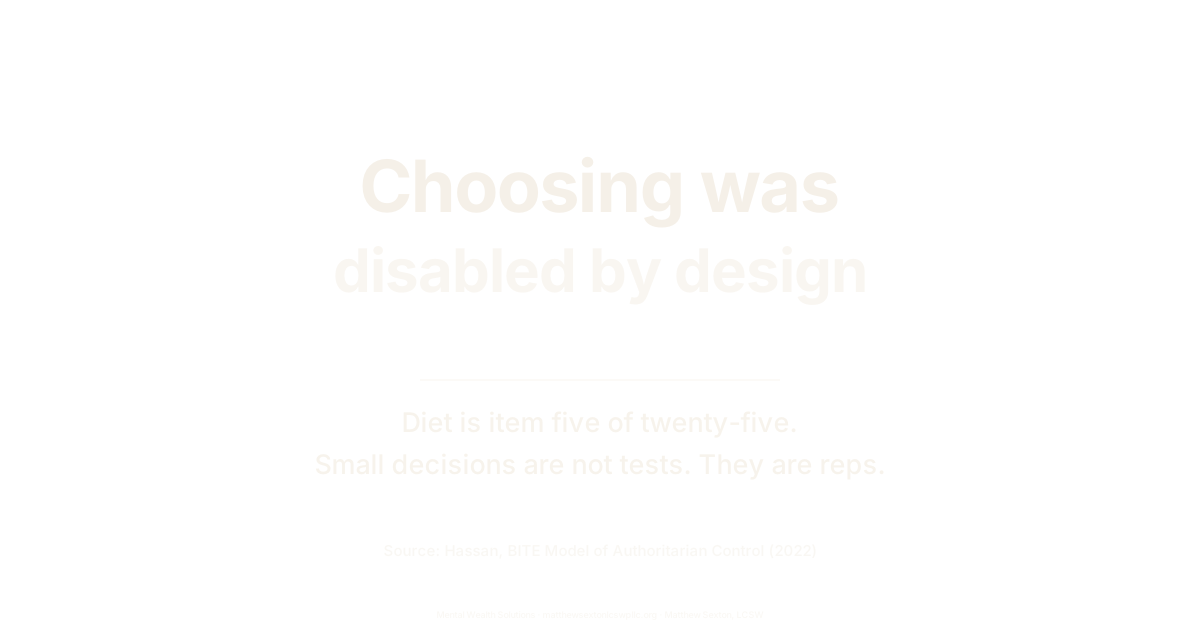
Choosing what to eat for dinner feels impossible right now because choosing itself was disabled by design, not because something is wrong with you. In 1979 the psychologist Margaret Singer catalogued "Indecisiveness" as its own named category of post-exit adjustment, built from her direct work with roughly 100 former members over two years and interviews with some 300 more. One woman she described could not decide whether to "clean the place, make the bed, cook, sleep, or what." Hassan's BITE model lists regulating a member's diet as item five of twenty-five behavior controls and requiring permission for major decisions as item ten: food and choice were named control surfaces inside the group, not accidents of group life. What ended when you left was the environment that suppressed choosing. The skill of choosing did not come back automatically the day you walked out. It comes back through small, repeated, low-stakes decisions, not through insight and not through willpower.
Matthew Sexton, LCSW, NATC — Licensed clinical social worker in private practice, providing telehealth psychotherapy to adults in New York. Cult recovery, coercive control, and spiritual abuse.
This Has a Name, and It Is Forty-Seven Years Old
The word for what you're describing already existed before you left. Margaret Singer spent two years running discussion groups with roughly 100 former members and, across four years, interviewed some 300 more. Out of that clinical work, writing in Psychology Today in 1979, she catalogued thirteen recurring categories of post-exit difficulty, in this order: Depression, Loneliness, Indecisiveness, Slipping into Altered States, Blurring of Mental Acuity, Uncritical Passivity, Fear of the Cult, The Fishbowl Effect, The Agonies of Explaining, Guilt, Perplexities about Altruism, Money, and Elite No More.
Indecisiveness sits third on that list, not as a footnote. Singer noted that some groups dictated nearly every activity a member did: what to eat, what to wear, what to do, at what hour, day and night. Her example was a single woman describing herself, unable to decide whether to clean the place, make the bed, cook, sleep, or what. That sentence was written and published decades before you had your own version of it. This is not a personality flaw showing up on a hard week. It is a named clinical pattern with a paper trail that predates most readers of this page. This article stays with that one symptom and its mechanism; the wider terrain of post-exit recovery, identity, and why people try to do it alone is covered separately in the recovery no one prepares you for. If you are still deciding what to call the place you left, that question gets its own treatment in is my workplace a cult.
It is worth being precise about what kind of evidence this is. Singer was not running a controlled trial. She was describing what she saw directly, across hundreds of former members, over years of clinical work. That is a real and useful kind of knowledge, and it is also not the same claim as a controlled finding. Nobody has since run the study that would upgrade her observation into a statistic, and nothing in this article will pretend otherwise.
Food and Choice Were Named Control Surfaces
Hassan's BITE model is a practitioner's taxonomy of control tactics, organized into Behavior Control, Information Control, Thought Control, and Emotional Control, with twenty-five items under Behavior Control alone. Two of those items describe exactly what happened to you. Item five concerns regulating a member's diet: food, drink, hunger, and fasting. Item ten concerns requiring permission before any major decision. Nearby, item twelve concerns discouraging individual thinking in favor of group conformity, and item eighteen concerns instilling dependency and obedience. Under Thought Control, item eight concerns the rejection of rational analysis and critical thinking as a matter of practice.
Read those in order and the shape becomes obvious. Diet was not overlooked as a control target inside the group, it was fifth on a list of twenty-five. Choosing for yourself was not a blind spot in the system, it was named twice: once for food, once for anything larger. Hassan's model names a design, not a coincidence. The wider machinery those items belong to is laid out in the machinery of control.
The BITE model is a framework, built from Hassan's own clinical and organizational experience, not a data set. The one place it has been tested quantitatively is Hassan's own doctoral research, which surveyed 1,044 people and found the items clustered together into a single reliable factor he named Authoritarian Control. That is a meaningful finding about how the tactics hang together as one construct. It is not a claim about how common any of this is in the general population, and it should not be read as one.
The same pattern shows up in current research on coercive control outside of formal cults. A 2025 study of survivors of coercive relationships included a participant describing her fear of choosing wrong as the reason she struggled to decide anything for herself, and another describing a slow loss of independence and, eventually, of any desire to choose at all. The reader who cannot choose lunch tonight is not failing at an easy task. It is a task that was targeted, by name, in more than one kind of relationship and more than one decade of research.
Your Preferences Were Disqualified as Evidence Before You Left
Lifton interviewed 40 people about their experience of Chinese thought reform in the 1950s, and from that work he described eight criteria of what he called ideological totalism: Milieu Control, Mystical Manipulation, Demand for Purity, Confession, Sacred Science, Loading the Language, Doctrine Over Person, and Dispensing of Existence.
Doctrine Over Person is the one that explains why your own sense of what you want stopped functioning as usable information. Lifton describes the underlying assumption of this criterion as treating doctrine and ideology as more valid, more true, and more real than any part of a person's actual character or lived experience, with the person expected to bend their own experience to fit that doctrine. A preference is not an abstraction sitting outside of you. It is a piece of personal experience, in exactly Lifton's sense of the term, and personal experience is precisely what doctrine was built to outrank. Your preference for pasta over salad was disqualified as evidence long before you noticed it happening, because the entire structure was built to disqualify it.
Lifton's eight criteria are a description of a psychological structure, drawn from a specific set of historical interviews. They are not a diagnostic checklist and not a finding you can cite as proof of anything about your particular group. What they offer is a name for a mechanism, and having the name is what lets you stop treating your own blank-mindedness at the refrigerator as evidence that you are broken. Readers who keep concluding their experience was not serious enough to count may recognise themselves in was it bad enough.
You Are Attempting the Hardest Version of an Ordinary Task
There is a popular idea that too many options overwhelm anyone, the supermarket jam-display story people cite constantly. It does not hold up as a general law. Scheibehenne and colleagues reviewed 50 experiments covering more than 5,000 participants and found the average effect across all of them was essentially zero. More options, by themselves, do not reliably make choosing harder.
What the same body of research does support is a conditional version of that claim. Chernev and colleagues analyzed 99 observations across more than 7,000 participants and found that choice overload is real, but only once specific moderators are accounted for: how complex the choice set is, how difficult the decision task is, the decision goal, and, centrally, how uncertain the person is about their own preferences going in.
Preference uncertainty is the hinge. A high-control group that regulates diet as item five of its behavior controls, and disqualifies personal experience as evidence at the level of doctrine, is not incidentally producing preference uncertainty. It is manufacturing that uncertainty as a matter of policy, over years, on purpose. That means you are not attempting an ordinary version of an ordinary task. You are attempting the specific version the research identifies as hardest, under the exact condition that makes it hardest, having spent years being trained directly into that condition. The task did not get harder because you are weaker now. It got harder because the group built the one condition that reliably makes it hard, and then handed it to you on your way out.
The Correction: You Did Not Learn to Be Helpless
There is a shorthand people reach for here, learned helplessness, as if passivity were a skill someone picked up along the way. That phrase is backward, and it is backward according to the two researchers whose names are on the original theory. In a 2016 correction, Maier and Seligman revised their own model. Passivity, they concluded, is the nervous system's unlearned default, mediated by a brain structure called the dorsal raphe nucleus. Control is the thing that gets learned, through a circuit involving the medial prefrontal cortex, and it only gets learned by being exercised, repeatedly, in practice.
This changes what happened to you, and what has to happen next. You did not absorb helplessness as a lesson. The group withheld the practice that would have built the opposite circuit: the repeated, low-stakes experience of choosing something and having that choice hold. Every meal decided for you, every major decision requiring someone else's permission, was a rep you did not get to take. The circuit that detects "I have control here" simply never got trained, and the default it was supposed to override stayed switched on.
That reframes recovery. If this were a matter of insight, understanding the mechanism would be enough on its own, and it is not. What builds the control-detection circuit is repetition: an actual choice, made by you, that actually holds. Small decisions are not tests you can fail on your way to some bigger competence. They are the reps themselves.
What to Do Tonight
Keep it small enough that failure is not available as an option. Pick between two known choices rather than facing an open field: not "what should I eat," but chicken or pasta. Set a short timer, two minutes is enough, and let the timer end the decision instead of waiting for certainty to end it. Decide something in advance so tonight does not require a decision at all: this month, takeout means one of three specific places, no reopening the question every time.
The goal is not to get better at identifying the objectively correct dinner. There is not one. The goal is to give choosing itself somewhere to happen at low stakes, over and over, until the machinery that registers that a choice was yours and it held starts working again. Ryan and Deci describe autonomy, the sense that your choices originate with you, as one of three basic psychological needs, alongside competence and relatedness, and like the other two it develops through use, not through explanation. Write the choice down afterward if it helps, not to analyze it, just to have a record that it happened and it was yours. That slow return of authorship is the same ground covered in taking back your agency.
No One Has Rigorously Tested What Helps, and That Is Worth Saying Plainly
There is no randomized or controlled outcome study of therapy for former members of high-control groups. That gap has been named directly by clinicians working in the field, not hidden. Writing in 2017, Healy described where specialists in this area tend to converge: go slowly, build the therapeutic alliance deliberately, use psychoeducation and grounding work, and stay cautious with hypnosis, meditation, exposure work, or any therapist stance that reads as directive or authoritarian, since that stance can echo the very dynamic the person left. Healy is explicit that none of this rests on outcome data. Clinicians converge on it. Nobody has tested it.
That gap does not close quickly on its own. A 2023 study of eleven former members in Sweden, at a median of eleven years out, still found people describing an unresolved in-between state, feeling disconnected from their own feelings, and real difficulty trusting their own thinking process even a decade later. The same researchers noted that healthcare professionals generally are not trained or prepared to talk through the existential and cultural questions this population brings into a session. Decision-making itself keeps surfacing as its own distinct theme in the literature, not folded into some larger symptom: a grounded-theory study of second-generation former members named decision-making and obedience to authority as standalone categories in their own right.
Singer's only traceable estimate for the general shape of recovery is six to eighteen months to get a life functioning again, offered as an observation from her own casework, not a promise. Some of what her example woman described resolves faster than that. Some of it, per the Swedish interviews, is still being worked out a decade or more later. Both can be true. What is not honest is pretending either timeline is guaranteed, or that any specific technique has been proven to shorten it.
If you want to talk through what you have experienced and whether working together may be a fit, book a call.
Is decision paralysis after leaving a high-control group an actual diagnosis?
No. It is not a DSM category. It is a described clinical pattern, first catalogued by Singer in 1979 as Indecisiveness, one of thirteen categories she observed across hundreds of former members. More recent qualitative research, including a 2025 study of coercive-control survivors and a 2014 study of second-generation former members, keeps finding the same pattern under different names: difficulty making decisions, fear of choosing wrong, and a lost sense of one's own preferences.
Why can't I decide something as simple as what to eat?
Because food and major decisions were specifically named as control targets in the environment you left, not incidental habits. Hassan's BITE model lists regulating diet as item five of twenty-five behavior controls and requiring permission for major decisions as item ten. Lifton's concept of Doctrine Over Person adds the mechanism: personal experience, including preference, gets treated as less real than doctrine. Choice-overload research adds the last piece: difficulty peaks specifically when someone is uncertain what they actually want, which is the exact state that kind of environment produces on purpose.
Does this get better, and how long does it take?
Singer's clinical estimate, the only traceable timeline in this literature, is six to eighteen months to get a life functioning again, though that was an observation from her own casework, not a guaranteed schedule. A 2023 study of former members a median of eleven years out still found some describing an unresolved sense of not knowing how to trust their own thinking. What reliably moves the timeline is not waiting or insight but repetition: small decisions, made by you and allowed to hold, rebuilding the sense that choices can originate with you.
Should I see a therapist for this, and what should I look for?
It can help, but there is no randomized or controlled outcome research on therapy for former members of high-control groups, a gap clinicians in the field acknowledge openly. What specialists converge on, without outcome data behind it, is a slow pace, a deliberately built therapeutic alliance, psychoeducation and grounding work, and caution around hypnosis or a directive therapist stance that could echo the original dynamic. Look for someone with specific training in coercive control or cult recovery, not general trauma experience alone.
Sources
- Margaret Singer, writing in Psychology Today, January 1979, based on discussion groups with roughly 100 former members and interviews with about 300 more over four years. https://cultrecovery101.com/cult-recovery-readings/coming-out-of-the-cults/
- Hassan, BITE Model of Authoritarian Control handout, revised June 2022. https://freedomofmind.com/wp-content/uploads/2022/08/BITE-Model-of-Authoritarian-Control-Handout-June-29th-2022.pdf
- Hassan, doctoral dissertation, N=1,044. https://freedomofmind.com/wp-content/uploads/2021/01/Dr-Hassan-Dissertation-Published.pdf
- Lifton, eight criteria of ideological totalism, drawn from interviews with 40 people about 1950s Chinese thought reform, 1961/1989. https://www.cultrecover.com/sites/default/files/pdfs/lifton8criteria.pdf
- Chernev, Böckenholt, and Goodman, Journal of Consumer Psychology 25(2):333-358, 2015, 99 observations, N=7,202. https://chernev.com/wp-content/uploads/2017/02/ChoiceOverload_JCP_2015.pdf
- Scheibehenne, Greifeneder, and Todd, 50 experiments, N=5,036, 2010. https://scheibehenne.com/ScheibehenneGreifenederTodd2010.pdf
- Maier and Seligman, Psychological Review 123(4):349-367, 2016. https://pubmed.ncbi.nlm.nih.gov/27337390/
- Ryan and Deci, American Psychologist 55(1):68-78, 2000. https://selfdeterminationtheory.org/SDT/documents/2000_RyanDeci_SDT.pdf
- Hadding and colleagues, Frontiers in Psychiatry, 2023, N=11 former members in Sweden. https://www.frontiersin.org/journals/psychiatry/articles/10.3389/fpsyt.2023.1142189/full
- Kassing and Collins, Journal of Interpersonal Violence, 23 February 2025, N=15 coercive-control survivors. https://pmc.ncbi.nlm.nih.gov/articles/PMC12743119/
- Matthews and Salazar, International Journal for the Advancement of Counselling, 2014, N=15 second-generation former members. https://link.springer.com/article/10.1007/s10447-013-9201-0
- Healy, International Cultic Studies Association, on post-cult PTSD and therapeutic approaches, 2017. https://www.icsahome.com/elibrary/topics/articles/the-unique-characteristics-of-postcult-post-traumatic-stress-disorder-and-suggested-therapeutic-approaches-docx
This article is for educational and informational purposes only. It does not constitute medical, clinical, legal, or therapeutic advice, and reading it does not create a therapist-client relationship with Matthew Sexton, LCSW or Mental Wealth Solutions PLLC. Although the author is a licensed clinical social worker, the content in this article is not clinical assessment, diagnosis, or treatment.
If you are in immediate emotional crisis, you can reach the 988 Suicide & Crisis Lifeline by calling or texting 988 (US). If you are experiencing domestic violence or are in physical danger, contact the National Domestic Violence Hotline at 1-800-799-7233 or visit thehotline.org. In a life-threatening emergency, call 911.