Antagonistic people run on a small, repetitive set of moves — contempt, baiting, exploitation, and role reversal — all designed to pull a reaction out of you. The way to deal with an antagonistic person is not to win the argument, because the argument is the trap. It is to recognize the move as it happens, refuse to supply the emotional fuel, keep your response short and consistent, decline loaded premises, end conversations that turn abusive, and document facts when safety, money, parenting, work, housing, or reputation is on the line. You cannot control whether someone behaves antagonistically. You can control what you feed it, what you keep a record of, and how much of your day it gets to run. That last part is where your agency lives.
By Matthew Sexton, LCSW, NATC
If you have ever walked away from a conversation feeling like you lost, even though you know you were the reasonable one, there is a reason for that, and it is not that you are bad at conflict. You walked in knowing what happened and walked out defending your tone, your memory, and your right to be upset. Antagonistic behavior does that to capable people, and it does it on purpose. It runs on a different set of rules than ordinary disagreement, and clinicians have a name for the cluster of traits behind it. In the American Psychiatric Association's alternative model for personality disorders, "antagonism" is a defined trait domain that includes manipulativeness, deceitfulness, grandiosity, callousness, and hostility — traits that, by definition, put a person at odds with others rather than in cooperation with them (American Psychiatric Association, Alternative DSM-5 Model for Personality Disorders). Once you can see the playbook, the moves stop landing the way they used to.
You do not need a diagnosis on the other person to use any of this. Whether it is a parent, an ex, a coworker, or a family member who has never been near a therapist's office, the behaviors follow patterns, and patterns can be answered.
What Does Antagonistic Behavior Actually Look Like?
Antagonism tends to feel like chaos when you are inside it, and chaos is disorienting on purpose. But the "chaos" is usually a short, recycled list.
Contempt is the baseline — eye-rolls, sarcasm, sneering, mockery of things you care about, a posture that you are beneath serious response. It is not an argument. It is a status move, meant to make you feel small enough to stop pushing.
Baiting is the setup — the provocative comment, the button-push about the topic they know gets to you, the "I'm just being honest" jab dressed as feedback. The goal is a reaction, any reaction, because your reaction is what they work with next.
Exploitation is the leverage. It uses your empathy, your history, your secrets, or your parenting role against you. A sudden emergency arrives right when you set a limit. A private detail resurfaces at the exact moment it can do the most damage.
Manipulation is the steering. The APA's model defines manipulativeness plainly as the use of subterfuge, charm, or ingratiation to influence and control others, and deceitfulness as the misrepresentation of self or events (American Psychiatric Association). In practice that is guilt trips, moving goalposts, selective memory, and warmth that switches on the moment they need something and off the moment they do not.
The most useful habit is to watch the function of a behavior rather than argue about the intent behind it. A cutting joke may function to lower your status in front of others; a flood of texts may function to exhaust you into answering; a debate about your exact wording may function to pull attention off what they actually did. Anyone can have a bad day and say something cruel; a pattern becomes concerning when the behavior repeats, serves the person's advantage, and continues after its impact has been made clear. For a deeper map of how these traits stack and escalate, this breakdown of the antagonistic personality pyramid and reality testing lays out the structure clinicians use.
Arguing Back Never Works
Because you are playing a game where the other person scores points for your distress, not for being right.
In a healthy disagreement, both people are trying to reach a shared understanding, and once the facts are clear, the disagreement resolves. Antagonistic conflict does not work that way. The person is looking for a reaction that confirms their control, feeds their sense of superiority, or shifts the blame off themselves. When you argue harder, you are supplying exactly what the interaction was designed to extract. This is why the "gotcha" moment you keep hoping for never comes — some people understand your point perfectly well and reject it anyway, because conceding would cost them the advantage.
Baiting hooks so fast because it targets something real in you: fairness, accuracy, attachment, reputation, or the plain urge to finish a thought. Your brain treats an unfair story about you as unfinished business, and that unfinished feeling is the hook. Contempt makes it worse by adding a status threat, and status loss registers as a social-threat signal that can spike your heart rate and shut down careful thinking. That reaction is not weakness. It is a predictable human response to being treated as disposable.
A practical reframe helps: baiting is a recruitment attempt. They are trying to recruit you into a role — unstable, mean, cold, "the problem." Your real-time task is to decline the role without auditioning for a better one under their lighting. Once you stop trying to win, you free up all the energy you were spending on rebuttals and redirect it toward what you can actually influence: your own exposure and response.
DARVO Is Why You Doubt Yourself
One manipulation move is worth naming on its own, because it is the one that most reliably makes reasonable people feel crazy. It is called DARVO — Deny, Attack, Reverse Victim and Offender. The term was coined by psychologist Jennifer Freyd in a 1997 paper on betrayal and trauma (Freyd, Feminism & Psychology, 1997). The sequence is simple and brutal:
- Deny: "That never happened." "You're remembering it wrong." "I never said that."
- Attack: "You're the abusive one." "You're dramatic and unstable." "Everyone's tired of your stories."
- Reverse Victim and Offender: "I'm the one who has to deal with you." "You're destroying this family." "I'm the real victim here."
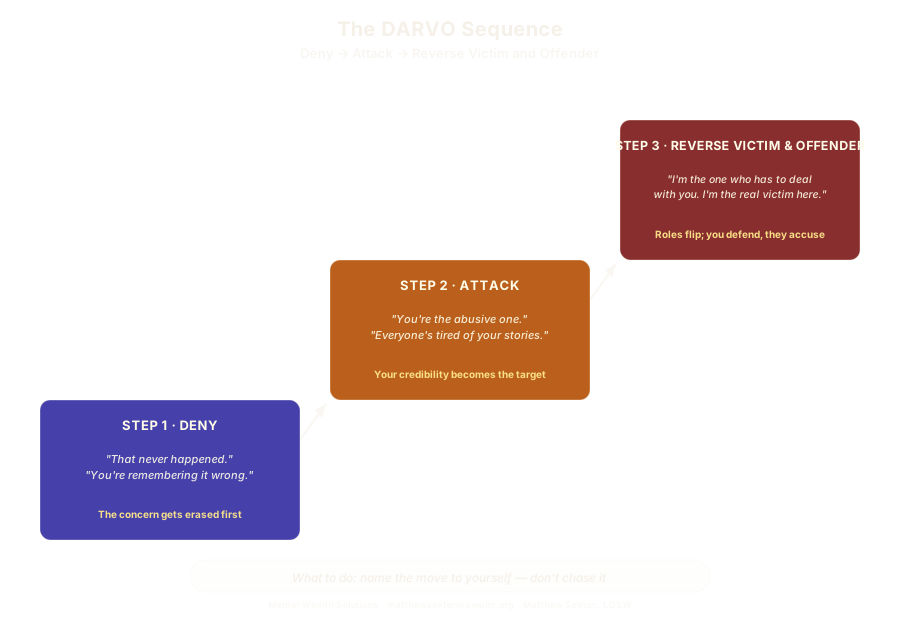
You raise a legitimate concern, they deny it, they attack your memory and motives, and then they flip the roles until you are the one apologizing for having brought it up. DARVO is not just infuriating; it is measurably effective. In a study by Harsey and Freyd, observers exposed to DARVO responses rated the accused perpetrator as more believable and the actual victim as more blameworthy — and notably, that effect was reduced when people were educated about DARVO ahead of time (Harsey and Freyd, Journal of Aggression, Maltreatment and Trauma, 2020). Naming the move is part of what disarms it.
Spotting DARVO in real time often feels like motion sickness. You came in with a clear point — "We agreed you'd cover Thursday" — and two minutes later you are defending whether you are a good person. That topic swap is the signal. You do not have to rebut all three moves; return to the concrete issue once, and if the response stays evasive or abusive, end it. A short internal label keeps your footing: topic switch, reversal, do not chase. If the story about you is starting to spread through friends, relatives, or a workplace, the mechanics in this guide to how smear campaigns actually work will make the pattern easier to track and harder to be blindsided by.
How Do You Respond to Contempt and Baiting in Real Time?
Here is the practical core, the part you can use tonight. It requires you to be boring on purpose and to protect the process rather than win the persuasion.
Name the move to yourself, silently. When you feel the baited hook, label it internally: that's a bait, that's contempt, that's the reversal. The label creates a half-second of distance between the provocation and your response, and that half-second is where your choice lives. Cleveland Clinic makes a similar point about gaslighting specifically — recognizing the tactic as a tactic is what keeps it from eroding your trust in your own perception (Cleveland Clinic, "Gaslighting").
Slow your body, then your language. Feel your feet. Drop your shoulders. Exhale longer than you inhale. The faster an exchange moves, the more likely you are to react instead of respond, so build in delay: "Let me think about that and get back to you." A pause is not weakness. It is you refusing to play at their pace.
Refuse the premise without a lecture. When someone asks a loaded question — "Why are you being so difficult about this?" — you do not have to answer inside their frame. Short lines that return to the point or end the conversation do more than a paragraph of defense:
"I'm not going to debate my character. The issue is Thursday's schedule."
"I'm willing to talk about the plan. I'm not available for insults."
"I don't agree with that description."
"This conversation is over for today."
Notice what those lines do not do. They do not catalog anyone's childhood, prove your goodness, or invite a deposition.
Use the broken record when they rephrase the bait. State your position once. You are not obligated to re-litigate it every time they reopen the case. Repeating a calm, unchanged line — "That's my decision" — gives them nothing new. Novelty is fuel; consistency starves it.
Decide your exit criteria in advance. Name-calling, threats, bringing your kids up as leverage, the third topic switch — pick the line ahead of time, and when it hits, leave the room, hang up, or stop replying. "I'm going to end this call now" is a full sentence.
A boundary holds when it names what you will do, not what the other person must become. "You need to respect me" depends on their cooperation; "if you call me names, I will end the call" identifies your own action, and you can carry it out no matter how they respond. Make the consequence proportionate and genuinely possible, and do not announce one you will not enforce — an empty warning just teaches them where your line can be pushed. An antagonistic person may ridicule your boundary, test it, or reframe it as the real abuse; their reaction does not decide whether your limit is legitimate. If guilt keeps pulling you back into the same exchange, that specific hook is a large part of what therapy for setting boundaries against family guilt is built to address.
What About Gray Rock, and When Is Distance Safer Than Better Words?
Going flat and brief is the core idea behind the gray rock method — becoming so unengaging and emotionally neutral that there is nothing to grab onto and pull. Short answers, neutral tone, no new emotional material handed over. It is worth being honest that no formal research has tested how well gray rocking works or whether it reduces the abuse itself, so it is a coping tool, not a cure (Medical News Today, "Grey Rock Method"). Pay attention to whether the other person escalates when they get less of a reaction. For a fuller version — including the "yellow rock" variation that keeps brief, polite civility for co-parenting or work, where total flatness can be framed as hostile — see this walkthrough of gray rock and yellow rock survival strategies.
A few other tools pair well: keep written contact brief, informative, friendly, and firm, so email and parenting-app threads have no drama to feed on; treat a delayed reply as a boundary ("I'll get back to you tomorrow"); and write your agenda on a note before an important call, so that if the conversation leaves the note, you leave the conversation.
Communication skills only help while communication is still a usable channel. Better wording has little value when someone uses access to monitor, punish, threaten, or destabilize you. Consider greater distance when every limit produces retaliation, when private information keeps becoming ammunition, when contact reliably leaves you frightened or unable to function, or when the behavior is escalating. If you fear violence, stalking, or coercive control, treat that as a safety problem first — a domestic-violence advocate can help with individualized safety planning even if you are unsure whether the word "abuse" fits.
When Should You Document Instead of Debate?
Document when the stakes reach past hurt feelings — money, shared property, employment, parenting, healthcare, threats, stalking, housing, or public allegations. Save original messages, emails, dates, agreements, and screenshots. Write factual notes soon after an event, and store copies somewhere the other person cannot reach.
Good documentation is plain: what happened, when, who was present, and what followed, without theories about motive. A clean timeline is useful if you later need help from an attorney, advocate, employer, court, or clinician. It also protects your own memory. When someone routinely denies what was said, a contemporaneous record lets you check the facts without going back to the one person who benefits from your confusion — which is what keeps DARVO from rewriting your history back at you. If a smear campaign is underway, resist chasing every rumor; preserve your evidence, correct falsehoods where it genuinely matters, and focus on the people or institutions that actually affect your life.
What Can You Actually Control Here?
You cannot control whether someone chooses to behave antagonistically, and every hour spent trying to make them see it clearly is an hour taken from your own life. What you can control is concrete: your exposure (how often, through which channels, on what terms), your record, and your response every single time. One distinction trips people up here — caring about someone and staying in unprotected contact with them are two different variables, not one. You are allowed to still love a person and decide they no longer get open access to you. Reclaiming these levers is what taking back your agency actually looks like: a hundred small decisions about what you will and will not hand over, rather than one dramatic confrontation.
When Should You Stop Managing It and Get Support?
Managing an antagonistic person is exhausting, and there is a point where the management itself becomes the problem. Two markers help. The first is functional: if dealing with this person is regularly interfering with your work, your sleep, your other relationships, or your sense of who you are, that has moved past a rough patch. SAMHSA frames the threshold in terms of impact and duration — when changes in your mood, thinking, or daily functioning persist and start getting in the way of ordinary life, that is when to bring in a professional (SAMHSA, "Signs You May Need Support"). Psychological aggression is not rare, either; CDC survey data found that nearly half of women — 49.4 percent — reported experiencing psychological aggression from an intimate partner in their lifetime, so you are in very large company (CDC, National Intimate Partner and Sexual Violence Survey, 2016/2017).
The second marker is erosion: if you have started doubting your own memory, apologizing for things you did not do, or losing track of what is reasonable, that is the specific damage these patterns cause. A therapist is not there to help you win against the other person. They are there to help you get yourself back — your read on reality, your boundaries, your sense that your own needs count — and to make room for the grief of accepting that someone you love may keep choosing dominance over repair. Deciding how much contact to keep, and whether to keep any at all, is its own hard question, and there is a real clinical framework for it in this guide to the no-contact decision. You do not have to be in crisis to deserve support.
How do I deal with an antagonistic person without escalating things?
Keep your responses short, calm, and consistent, and slow the tempo whenever you feel the heat rising. These exchanges run on speed and reaction, so building in delay ("Let me get back to you on that") and refusing to hand over fresh emotional material de-escalates more reliably than arguing your point harder. You are aiming to be boring to engage with, not to win. If the person uses contact to threaten or control you, prioritize distance, documentation, and outside support over persuasion.
What is DARVO, and how do I respond to it?
DARVO stands for Deny, Attack, Reverse Victim and Offender — a manipulation sequence, coined by psychologist Jennifer Freyd, where the person denies your concern, attacks your credibility, and flips the roles so you become the accused (Freyd, 1997). Research found DARVO makes observers see the real victim as more blameworthy, but that effect drops when people know the pattern (Harsey and Freyd, 2020). Recognize the reversal as it happens, name it to yourself, return to the concrete issue once, and refuse to start defending or apologizing for having raised it.
What does DARVO sound like in a normal conversation?
You say, "Please don't call me names in front of the kids." They reply, "I never called you names — you're inventing drama because you can't handle feedback, and I'm exhausted from walking on eggshells around you." That is denial, attack, and reversed victimhood in three clauses. The move is to drop the name-calling loop and either return to the boundary or leave.
Does the gray rock method actually work?
It can reduce how much fuel an interaction gives an antagonistic person by making you neutral and unengaging, so there is nothing to grab onto. But no formal research has tested whether it reduces the abuse itself or is universally safe (Medical News Today), so treat it as a coping and self-protection tool rather than a fix, and watch whether the person escalates when they get less of a reaction.
When should I see a therapist about a difficult or manipulative relationship?
When managing the relationship is regularly interfering with your sleep, work, other relationships, or sense of self, or when you have started doubting your own memory and apologizing for things you did not do. SAMHSA points to persistent impact on daily functioning as the threshold for professional support. You do not need to be in crisis, and you do not need the other person's cooperation to start rebuilding your own footing.
Sources
- American Psychiatric Association, "Alternative DSM-5 Model for Personality Disorders" (antagonism trait domain: manipulativeness, deceitfulness, grandiosity, callousness, hostility), Focus / DSM-5 Section III. psychiatryonline.org
- Freyd, J.J., "Violations of Power, Adaptive Blindness, and Betrayal Trauma Theory," Feminism & Psychology, 1997 (origin of the DARVO concept). jjfreyd.com
- Harsey, S., and Freyd, J.J., "Deny, Attack, and Reverse Victim and Offender (DARVO): What Is the Influence on Perceived Perpetrator and Victim Credibility?" Journal of Aggression, Maltreatment & Trauma, 2020. tandfonline.com
- Medical News Today, "Grey Rock Method: What It Is and How to Use It Effectively." medicalnewstoday.com
- Cleveland Clinic, "Gaslighting: Definition & How To Spot It." health.clevelandclinic.org
- Centers for Disease Control and Prevention, "The National Intimate Partner and Sexual Violence Survey (NISVS): 2016/2017 Report on Intimate Partner Violence." cdc.gov
- SAMHSA, "Signs You May Need Support." samhsa.gov
This article is for educational and informational purposes only. It does not constitute medical, clinical, legal, or therapeutic advice, and reading it does not create a therapist-client relationship with Matthew Sexton, LCSW or Matthew Sexton LCSW PLLC. Although the author is a licensed clinical social worker, the content in this article is not clinical assessment, diagnosis, or treatment.
The patterns described here reflect published research and general clinical observation about antagonistic behavior and manipulation, not an individualized assessment of your situation or anyone else's. People and relationships vary, and a strategy that protects one person may not fit another's circumstances, particularly where physical safety is a concern. If you are trying to figure out how to respond to a specific, high-stakes relationship, please consult a licensed mental health professional who can look at your actual circumstances.
If you are in immediate emotional crisis, you can reach the 988 Suicide & Crisis Lifeline by calling or texting 988 (US). If you are experiencing domestic violence or are in physical danger, contact the National Domestic Violence Hotline at 1-800-799-7233 or visit thehotline.org. In a life-threatening emergency, call 911.