A loud, unpredictable childhood home changes how a kid's nervous system develops, whether or not a parent ever meets criteria for a diagnosis. A 2024 twin study of 4,732 pairs found that teens who saw more chaos in their own home than their co-twin did, a design built to rule out shared genes and shared family background, showed significantly worse anxiety, depression, and self-control by early adulthood (von Stumm, Psychological Science, May 2024). The volume of a household leaves a mark on its own.
If you grew up somewhere the temperature could shift in a single sentence, where tone mattered more than the actual words, you probably already know something about your own nervous system that's hard to put into words yourself. Maybe your parents never crossed a clear line. Maybe you can't point to one specific thing and say "that's why." They were just loud, reactive, the kind of parent who filled a room without trying. And somewhere in there, you learned to take up less of it.
This isn't a piece about diagnosing your parents. Most loud households never involve anything close to a personality disorder or abuse in the clinical sense. They involve a parent who is dysregulated, stressed, or simply wired for intensity, in a home where a kid never quite knew which version of the day they were going to get. What matters clinically isn't whether a parent would meet a diagnostic threshold. What matters is what your body learned to do to stay safe inside that unpredictability, and whether it's still doing it now, in a room with someone who isn't your parent at all.
Family gatherings this time of year tend to be when the old pattern gets loud again, even for people who've built a genuinely calm adult life. It doesn't take much of a trigger to switch the scanning habit back on.
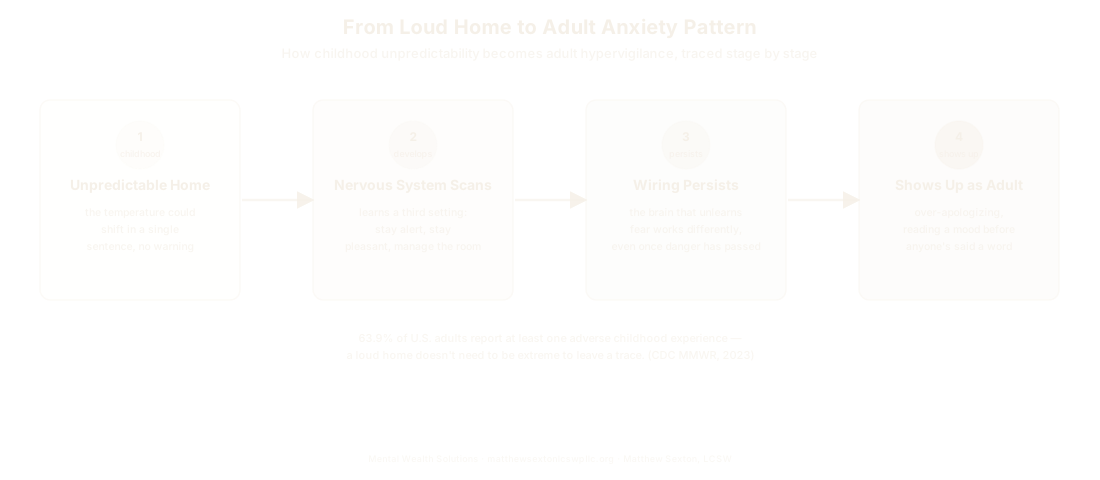
What a loud, unpredictable home does to a developing nervous system
A nervous system raised on unpredictability doesn't get a clean "danger" or "safe" signal. It learns a third setting: stay alert, stay pleasant, keep managing the room. Researcher Stephen Porges describes the body oscillating between its calm "social engagement" mode and a more primitive shutdown response, and kids in a loud-but-not-fully-dangerous home often get stuck somewhere in between the two (Porges, Frontiers in Integrative Neuroscience, May 2022).
A loud household teaches a specific skill: read the room before the room asks anything of you. That skill gets praised, usually. Kids who do it well get called easy, mature for their age, the responsible one. From the inside, it can feel less like a compliment and more like a job that never had an off switch.
The popular term for the most visible version of this is the "fawn response," coined by psychotherapist Pete Walker as a fourth stress response alongside fight, flight, and freeze: appeasing someone as the safest available move when that person is also the one you depend on. It's a clinical shorthand, not a research finding on its own, but it names something real. Staying pleasant becomes the strategy when leaving, arguing back, or going silent all carry their own risk.
Do overbearing parents cause anxiety in adult children even without a diagnosis?
Yes, and the strongest evidence comes from a study built specifically to rule out every other explanation. Researchers compared twins raised in the same house and found that the twin who perceived more chaos in that shared home, not more genes, not more poverty, not a different set of parents, went on to show measurably worse depression, anxiety, self-control, aggression, antisocial behavior, and alcohol use by early adulthood (von Stumm, Psychological Science, May 2024).
This detail matters more than it sounds like it should. Twin studies that compare siblings raised together are one of the few tools that can separate "this family was hard" from "I happened to experience it as harder." Two kids can grow up under the same roof and walk away with different nervous systems, because they sat closer to the blow-ups, absorbed more of the tension aimed at a sibling, or simply read the same loud parent differently. The chaos didn't have to be extreme. It just had to feel unpredictable to that particular kid.
This is the throughline researchers keep finding: overbearing parents and anxiety in adult children are linked, not because the parent was necessarily disordered, but because a kid's developing brain responds to unpredictability itself. None of it requires a diagnosable parent. It just requires a home where you couldn't reliably predict the next ten minutes.
Why you can't just "get over" a loud childhood once you're grown
Because the part of the brain that unlearns fear appears to work differently in adults who grew up with unpredictable caregiving. In a Yale study of 45 healthy adults ages 18 to 30, people with a history of unpredictable childhood care showed greater amygdala activity toward a formerly threatening cue during extinction learning, the process where the brain is supposed to update and let a fear go once the danger has passed (Duda, Keding, Kribakaran, and colleagues, Developmental Cognitive Neuroscience, May 2025).
In plain terms, your brain got very good at learning what was dangerous, and comparatively worse at unlearning it once the danger left the room. That's not a lack of effort or a character issue. It's a measurable difference in how the fear-processing system runs, still showing up years after anyone stopped raising their voice at you. It's part of why "just relax, that was a long time ago" doesn't actually reach the mechanism doing the work.
Why do you still end up managing everyone else's mood?
If your role in a loud home was to keep the peace, that role tends to keep going long after you've moved out. Parent-focused parentification, where a child manages a parent's emotions and needs rather than the reverse, is linked to higher depression and anxiety in young adulthood, in a 2026 study of 448 university students (Gavcar and Gavcar, BMC Psychology, February 2026).
This is a specific role, not a vague personality trait. In a loud home, one workable strategy is to become the household's emotional weather forecaster: notice the shift in tone before it fully lands, step in with a joke or a distraction, offer an apology that was never actually yours to give, and keep the room from tipping over. It works. It also puts a kid in charge of an adult's nervous system, years before that kid has one of their own fully formed.
That role rarely retires when you move out. It shows up as over-apologizing for things that aren't your fault, reading a partner's or a boss's mood before they've said a word, and a low, steady sense that keeping everyone comfortable is your job. It's exhausting in a way that's hard to explain to anyone who didn't grow up doing it, because none of it looks like work from the outside.
How does this show up in your body, not just your thoughts?
A nervous system that spent years on alert tends to run "on" at a higher baseline and react less to new stress, which sounds protective but usually isn't. Research on youth with a history of chronic caregiving stress found higher overall daily cortisol alongside a blunted cortisol response to new acute stress, an effect that grew stronger the more chronic and severe the exposure had been (Marques-Feixa, Palma-Gudiel, Romero, and colleagues, Psychological Medicine, February 2023).
Unpredictability, separate from how strict, poor, or harsh a household was, is increasingly treated by researchers as its own distinct developmental risk factor, one that shapes cognitive, social, and biological development on its own terms (Doom, Han, Rivera, and Tseten, Development and Psychopathology, 2024). A home can be financially stable and free of anything anyone would formally call abuse, and still teach a nervous system to run at a near-constant low simmer, because a kid never knew which parent was walking through the door.
For context on how common some version of a hard childhood actually is: nationally, 63.9% of U.S. adults report at least one adverse childhood experience, and 17.3% report four or more (CDC MMWR 72(26), June 2023). A loud or unpredictable home doesn't need to check every box on that list to leave a real, physiological trace.
What actually helps rewire this pattern?
Therapy that works with the nervous system directly, not just insight into what happened, tends to be what moves this kind of pattern. Somatic and trauma-focused approaches address the automatic scanning and appeasing at the level where it actually lives, rather than asking you to reason your way out of a reflex.
Naming the pattern is the first real step, and it doesn't require blaming or diagnosing anyone from your childhood. It just means noticing what your body still does when a room gets loud: the tightening, the fast read of everyone's face, the urge to smooth things over before you've even decided you want to.
If this is landing and you're looking for support that goes further than a blog post can, I offer telehealth therapy for adults across New York. A short call is a low-pressure way to see if it's a fit.
Do overbearing parents cause anxiety in adult children even if nothing "bad" ever happened?
Yes. A 2024 twin study of 4,732 pairs found that perceived household chaos alone, apart from shared genes or family background, predicted worse anxiety, depression, and self-control by early adulthood (von Stumm, Psychological Science, 2024). The pattern doesn't require a diagnosable parent or one specific bad event.
What's the difference between a "loud" home and an abusive one?
Clinically significant abuse involves specific, identifiable harm. A loud or unpredictable home may involve none of that and can still shape a child's stress-response system, because the nervous system reacts to unpredictability itself, not only to clear-cut danger (Doom and colleagues, Development and Psychopathology, 2024).
Why do I still scan a room for tension, years after leaving home?
Because the brain's fear-unlearning process appears to work differently in adults with a history of unpredictable childhood caregiving. A Yale study of 45 adults found greater amygdala activity toward previously threatening cues during fear-extinction tasks, even long after any real threat had passed (Duda and colleagues, Developmental Cognitive Neuroscience, 2025).
Is being "the responsible one" or the family peacekeeper actually a trauma response?
It can be. Managing a parent's emotions rather than the reverse, known as parent-focused parentification, is linked to higher depression and anxiety in young adulthood in a 2026 study of 448 university students (Gavcar and Gavcar, BMC Psychology, 2026). The role that kept a household calm in childhood often persists as an adult habit.
Can this kind of nervous system pattern actually change?
Yes. Approaches that work with the body, not just insight, such as somatic therapy and trauma-focused treatment, can reduce automatic scanning and appeasing behaviors over time. Change tends to be gradual rather than a single breakthrough, and that's normal.
Sources
- von Stumm, S. Twin study on perceived household chaos and young-adult mental health and behavioral outcomes. Psychological Science, May 2024. https://pubmed.ncbi.nlm.nih.gov/?term=von+Stumm+household+chaos+twins+2024
- Duda, J. M., Keding, T. J., Kribakaran, S., et al. Amygdala activity during fear-extinction learning in adults with a history of unpredictable childhood caregiving. Developmental Cognitive Neuroscience, Yale University, May 2025. https://pubmed.ncbi.nlm.nih.gov/?term=Duda+Keding+Kribakaran+amygdala+childhood+unpredictability
- Doom, J. R., Han, D., Rivera, K., and Tseten. Childhood unpredictability as a distinct developmental risk dimension: a review. Development and Psychopathology, Vol. 36, Issue 5, 2024. https://pubmed.ncbi.nlm.nih.gov/?term=Doom+childhood+unpredictability+development+psychopathology+2024
- Marques-Feixa, L., Palma-Gudiel, H., Romero, S., et al. Cortisol reactivity and childhood maltreatment: a dose-response study. Psychological Medicine, February 2023. https://pubmed.ncbi.nlm.nih.gov/?term=Marques-Feixa+cortisol+maltreatment+anxiety+2023
- Gavcar and Gavcar. Parent-focused parentification and its association with depression and anxiety in young adults. BMC Psychology, February 2026. https://bmcpsychology.biomedcentral.com/articles?query=parentification+depression+anxiety
- Porges, S. W. Polyvagal Theory: A Science of Safety. Frontiers in Integrative Neuroscience, May 2022. https://doi.org/10.3389/fnint.2022.871227
- Centers for Disease Control and Prevention. Adverse Childhood Experiences Among U.S. Adults. MMWR 72(26), June 2023. https://www.cdc.gov/mmwr/volumes/72/wr/mm7226a2.htm
- Walker, P. Complex PTSD: From Surviving to Thriving. Azure Coyote, 2013. Source of the popular term "fawn response," cited as clinical shorthand, not a research finding.
This article is for educational and informational purposes only. It does not constitute medical, clinical, legal, or therapeutic advice, and reading it does not create a therapist-client relationship with Matthew Sexton, LCSW or Matthew Sexton LCSW PLLC. Although the author is a licensed clinical social worker, the content in this article is not clinical assessment, diagnosis, or treatment.
The patterns and concepts described here reflect nervous-system and developmental research on childhood unpredictability, not a diagnosis of any parent or family. Individual experiences vary widely, and what is described here may not match your own story. A loud or intense household does not, on its own, mean a parent had a personality disorder or was abusive, and this article should not be used to diagnose a family member. If you are working through the effects of an unpredictable childhood, please consult a licensed mental health professional who can understand your specific situation.
If you are in immediate emotional crisis, you can reach the 988 Suicide & Crisis Lifeline by calling or texting 988 (US). If you are experiencing domestic violence or are in physical danger, contact the National Domestic Violence Hotline at 1-800-799-7233 or visit thehotline.org. In a life-threatening emergency, call 911.