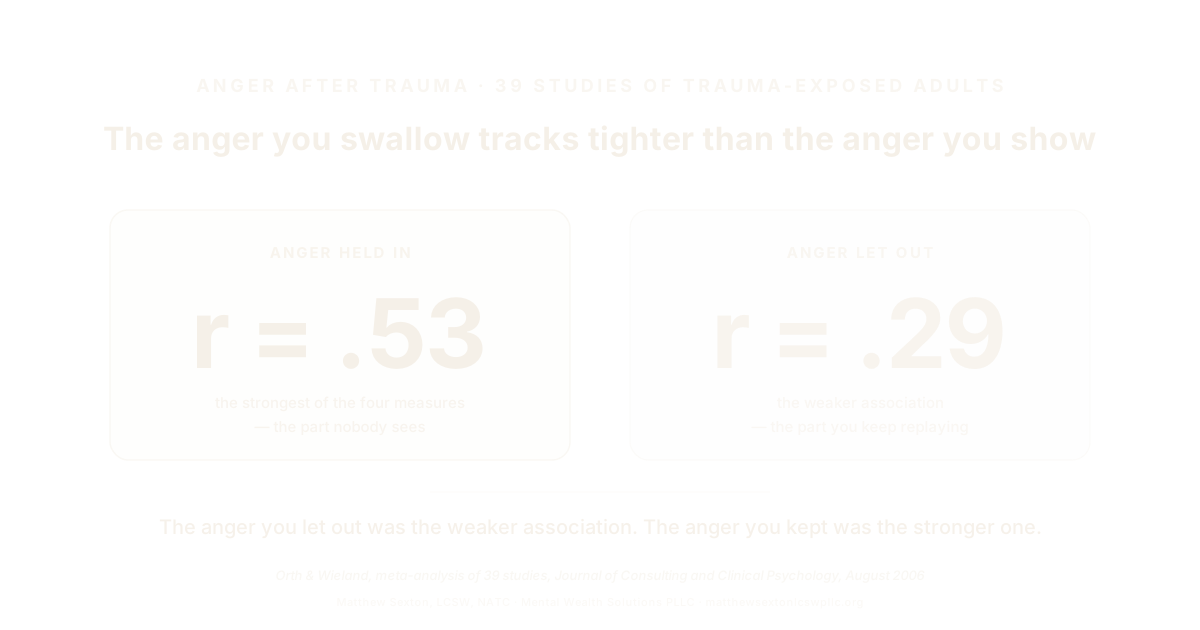
Anger after trauma is a documented symptom, not a verdict on your character. A meta-analysis of 39 studies of trauma-exposed adults found anger and hostility strongly associated with post-traumatic stress. The single strongest association was with anger held in rather than let out: a weighted r of .53 for suppressed anger, compared with r = .29 for anger expressed outward (Orth & Wieland, Journal of Consulting and Clinical Psychology, August 2006). The associations also grew larger the more time had passed since the event. So if you snapped at someone you love and have felt sick about it ever since, the research points somewhere you may not have looked. The more telling part of the pattern is probably everything you held before it.
By Matthew Sexton, LCSW, NATC · Licensed clinical social worker in private practice in New York · Telehealth across NY, ME, DE, and FL
You know the moment I mean. A question asked twice. A tone in your kid's voice that you would have laughed off on any other Tuesday. And your voice came out at a volume that did not belong to the size of the thing, and you watched it register on someone's face.
Then came the part that lasts much longer than the moment did. The apology that felt too small. The replay at 1 a.m. And underneath it, a question most people are too ashamed to say out loud: am I turning into the person who did this to me?
That question is one of the most common things people carry into a first session and one of the last things they actually say. So let me give you the research, because it is a good deal kinder than the story you have been telling yourself.
Is anger actually a trauma symptom, or am I just a bad-tempered person?
It is a listed symptom, and has been for a long time.
In the DSM-5, the arousal and reactivity criterion for PTSD covers "marked alterations in arousal and reactivity associated with the traumatic event(s), beginning or worsening after the traumatic event(s) occurred." The very first item under it is "irritable behavior and angry outbursts (with little or no provocation)" (SAMHSA, Trauma-Informed Care in Behavioral Health Services, TIP 57, 2014). The VA's National Center for PTSD renders that same item in plainer language: irritability or aggression, appearing or worsening after the trauma (National Center for PTSD, "PTSD and DSM-5," updated December 9, 2025).
Notice the two conditions built into that wording. It is a change that begins or worsens after the event, and it fires with little or no provocation, meaning the trigger is often out of proportion to what an outside observer would see. That is not a description of a personality. It is a description of a threshold that moved.
The ICD-11 framework for Complex PTSD tells a similar story. It keeps the standard post-traumatic clusters and adds three more that researchers group under disturbances in self-organization: affective dysregulation, negative self-concept, and difficulty in relationships. On the International Trauma Questionnaire, the affective dysregulation cluster is measured with nine items and splits into a hyperactivated presentation and a hypoactivated one (Karatzias et al., European Journal of Psychotraumatology, January 2018). One person runs hot and another goes numb, and both are versions of the same trouble with turning the volume up and down at will.
Recent work pins down which flavor tracks most broadly. In a study of 151 community-dwelling adults with probable PTSD, irritability was related to all PTSD subscales, while anger, hostility, and aggression each mapped onto only some (American Psychological Association, "Irritability in PTSD," January 21, 2025). Which fits what people actually describe. Not rage. Sandpaper.
Why the anger you swallow matters as much as the anger that escapes
Here is the finding I most want you to sit with.
Orth and Wieland pooled 39 studies of trauma-exposed adults and looked separately at four things: general anger and hostility, anger expressed outward, anger held inward, and anger control. Anger and hostility overall came in at a weighted r of .48. Anger expressed outward came in at .29. Anger held in came in at .53, the largest of the set. Anger control ran the other way, r = −.44 (Orth & Wieland, August 2006).
Read those two middle numbers again. The anger you let out was the weaker association. The anger you kept was the stronger one.
That is not permission to yell. But the thing you have been treating as your whole problem, the outburst, is the visible tip of something that has been accumulating quietly for a long time. The seven times this week you said "it's fine" while your jaw did something else counts, and it counts more, statistically, than the one time it got away from you.
If you grew up learning that your anger was the least safe thing in the room, you probably got extremely good at holding it. That skill kept you functional, and it may well have kept you safe. It also has a load limit. People who have spent years managing everyone else's weather often recognize themselves in the fawn response pattern, and the flip side of it is a reservoir with no drain.
One more piece of that meta-analysis matters if you have been waiting this out. The effect sizes grew substantially with more time elapsed since the event. This is not a thing that reliably fades on its own.
What is happening in the seconds before you snap
Your threat system gets there first. Your braking system arrives late.
The leading model is that in PTSD the prefrontal regions that normally damp down an amygdala-driven threat response are less active in exactly the moments they are needed. A review in Neuropsychopharmacology describes decreased ventromedial and dorsolateral prefrontal activation to stressful and trauma-related cues, often alongside increased dorsal anterior cingulate activation. That pattern is associated with greater PTSD symptoms and with weaker responses to exposure-based therapies (Kredlow et al., September 2021). In people without PTSD, that circuit inhibits the alarm. In PTSD, that regulatory control is impaired.
I want to hedge that properly. A meta-analysis of 19 symptom-provocation neuroimaging studies confirmed hyperactivation of the amygdala and the pregenual and anterior cingulate to trauma-relevant material. It explicitly failed to support the hypothesized inhibition of anterior cingulate activation, and it noted that amygdala hyperreactivity is not specific to PTSD (Sartory et al., PLOS ONE, March 2013). Threat detection runs hot and regulation does not arrive in time. The popular line about trauma switching your prefrontal cortex off overstates a real finding.
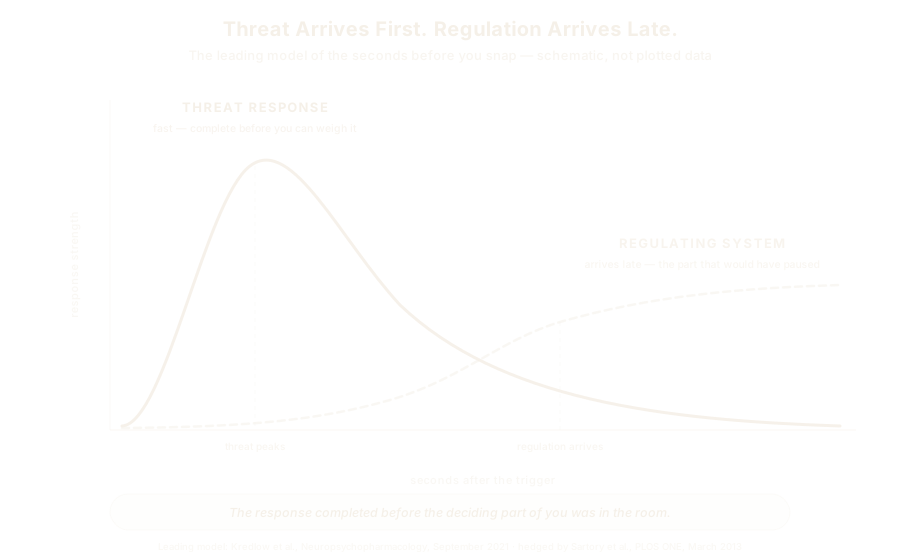
Practically, the snap was not a decision you made badly. It was a response that completed before the deciding part of you was in the room. Which is why willpower is such a poor tool here, and why body-based approaches to slowing the response down, like somatic therapy and basic nervous system regulation, tend to get further than trying harder to be patient.
The shame spiral afterward, and why it is shame rather than guilt
The hours after are usually worse than the moment itself. The distinction that helps most here is between guilt and shame.
Guilt is about the act. I did something bad. Shame is about the self. I am something bad. They feel similar from the inside and behave differently.
A 2025 structural model in young adults tested both. Guilt proneness showed the strongest association with PTSD symptoms, β = 0.305. Shame proneness showed the strongest association with the disturbances-in-self-organization symptoms, β = 0.531, the cluster covering affect dysregulation, negative self-concept, and relationship difficulties. The strongest indirect pathways ran from trauma to PTSD by way of guilt, and from trauma to self-organization by way of shame. The authors concluded that the two operate as distinct mechanisms in trauma response (Oasi et al., Clinical Psychology & Psychotherapy, July 2025).
Look at what that means for the loop you are stuck in. Guilt about what you said is workable, because it points at an action, and actions have repairs. Shame attaches to identity and makes you avoid the very person you would need to talk to in order to fix anything. Shame is why an outburst that lasted forty seconds turns into three days of distance.
Shame is also the machinery behind "I'm becoming the person who hurt me." That thought does not arrive because it is true. It arrives because shame's job is to convert an event into a statement about who you are, and someone who has been on the receiving end of harm already has a ready-made template for what a person who does harm looks like. Your brain hands you the worst identity in the file. That is a documented post-trauma emotion with a measurable pathway of its own.
"Am I becoming the person who hurt me?"
Let me be clear about what kind of answer this is. What follows is clinical framing rather than a research finding, and it is a lens for looking at your own conduct, not a tool for evaluating anybody else.
There is a real difference between losing regulation and doing harm on purpose, and it is not primarily about volume.
Dysregulation tends to look like an episode. It flares, it is out of proportion to the trigger, and the person who did it is horrified afterward. It is followed by repair, or at the very least by a desperate wish to repair. The internal experience is loss of control, and the aftermath is regret pointed inward.
Deliberate harm tends to look like a pattern rather than an episode, and it works. It gets someone to comply, to apologize, to stop asking. It is strategic about its timing and its audience. Repair does not follow, or repair arrives as a move that buys quiet until the next time. The other person's experience over time is of being managed and made smaller.
Notice which of those two has been running in your head. If you are reading a post about anger at two in the morning, sick about something you said, you are describing regret about your own conduct. That is a different phenomenon from a person who has never once questioned the effect they have on the people around them.
I will say the other half too. Regret is not a permission slip. Feeling terrible afterward does not undo the effect on the person who was standing there, and "I have trauma" is an explanation rather than a resolution.
The reason to take this seriously is not that you are dangerous. It is that you love these people and you do not want them reading your mood before they say hello.
— Matthew Sexton, LCSW, NATC
If you are genuinely unsure what is happening in your home, that question has its own frame, which is what walking on eggshells versus an unsafe relationship is about. Do not try to settle it alone at 2 a.m.
Does this actually get better?
Yes, and the honest version comes with a number attached.
A systematic review of 16 studies covering 1,846 participants found that roughly 73% showed significant anger reduction from baseline to the end of treatment. The accompanying meta-analysis of 8 randomized controlled trials with 417 participants compared trauma-focused psychotherapy against non-trauma-focused treatment. The pooled effect was a Hedges' g of 0.33, 95% CI [0.12, 0.53], p < .001 (Wells et al., Psychological Trauma: Theory, Research, Practice, and Policy, published online March 2024).
That is a small-to-medium advantage, and it is the honest number. Treating the trauma underneath moves the anger in the direction you want it to move. It does not make the anger evaporate.
The picture gets more specific when you look at who improves. In a study comparing people who responded to PTSD treatment against those who did not, responders showed large drops in trait anger, Hedges' g = −1.16, and large improvements in anger control, g = .86. Anger control kept improving after treatment ended. People who dropped out showed minimal gains across anger measures (Galovski et al., Psychological Trauma, February 2013).
There is a caution buried in that. In a study comparing two established trauma therapies, women with higher pretreatment anger were more likely to drop out of prolonged exposure (Rizvi et al., Behaviour Research and Therapy, 2009). Note precisely what that says. Anger is a reason people leave therapy early. It is not evidence that therapy cannot help them, and whether pretreatment anger predicts a worse outcome for the people who stay is mixed in the literature.
So the anger has to be named as a treatment target. Otherwise it becomes the thing that quietly ends the work before the work has done anything. This is also part of why different symptoms improve on different timelines, which is the subject of how CPTSD recovery actually unfolds.
What the research on anger after trauma supports, and what it does not
Here is the whole evidence base for this article in one place, including the limits, because the limits are where people quietly write themselves the worst verdict.
| What the research supports | The figure | What it does not say |
|---|---|---|
| Anger held in tracks post-traumatic stress more closely than the other anger measures | r = .53, against r = .29 for anger expressed outward (Orth & Wieland, 2006) | That the outburst is the whole problem. That was the weaker of the two associations. |
| Irritability specifically is related to every PTSD symptom cluster | All subscales, in 151 community-dwelling adults with probable PTSD; the other anger measures mapped onto only some (APA, 2025) | That irritability is a personality trait. It is a threshold that moved after the event. |
| Shame proneness carries the strongest association with the disturbances-in-self-organization cluster | β = 0.531, against β = 0.305 for guilt proneness and PTSD symptoms (Oasi et al., 2025) | That the shame is accurate. It is a documented post-trauma emotion with a pathway of its own. |
| Trauma-focused psychotherapy outperforms non-trauma-focused treatment on anger | Hedges' g = 0.33, 95% CI [0.12, 0.53], p < .001, across 8 randomized trials (Wells et al., 2024) | That the anger evaporates. It is a small-to-medium advantage, and that is the honest number. |
| Higher pretreatment anger predicts leaving prolonged exposure early | A dropout finding, with no outcome effect size attached (Rizvi et al., 2009) | That anger predicts a worse outcome for the people who stay. That question is mixed in the literature. |
Read the right-hand column as carefully as the left. Every row of it is a conclusion someone in your position reaches on their own at 1 a.m., and none of them are in the research.
The relationships you are afraid you are ruining
The cruelty here is that you snap at the people closest to you, who are also where your recovery resources live.
One meta-analysis screened 2,647 studies, included 68 of them, and tested seven predictors of how post-traumatic symptoms go. Post-trauma social support carried a weighted r of .28, in the direction of less support predicting more symptoms, which put it above prior trauma, prior adjustment, and family psychiatric history, each at .17 (Ozer et al., Psychological Bulletin, 2003).
There is also something worth knowing about rupture and repair, with a scope limit I will state up front. In the therapy relationship, researchers can watch this closely. A meta-analysis of 11 studies covering 1,314 patients found that resolving a rupture in the working alliance was moderately associated with better patient outcome, r = .29, d = .62, p = .003 (Eubanks, Muran & Safran, Psychotherapy, December 2018). That research is about clinicians and clients. It is not a finding about marriages, parenting, or friendships, and I will not stretch it into one. What I will say is that it matches what clinicians see: a rupture is not automatically the end of anything.
Avoidance after an outburst feels like protecting people from you. It usually functions as a second injury, because the other person is left holding the moment alone with no account of what happened. Repair does not require a speech. It requires naming the thing without a defense attached, saying what you are working on, and then doing the working-on part where they can see it.
Where to start
Start by saying it out loud. It is the step people skip.
Most people bring in the anxiety, the sleep, or the relationship strain, and leave the anger out, because it feels like the piece that would make a therapist think less of them. It will not. It sits on the symptom list of the condition you are describing, and a clinician who works with trauma has heard it many times before you walked in.
A few things worth asking a prospective therapist directly. Do you treat anger and irritability as a trauma symptom, or as a separate anger-management issue? What do you do when someone's regulation goes offline faster than they can catch it? Will this be on my treatment plan, or only in the intake notes? Rule out physical contributors with a medical provider too, since poor sleep, chronic pain, and medication side effects all shorten a fuse.
If you are in New York and any of this sounded like your last few months, I would be glad to talk it through with you. A call is a low-stakes way to find out what this work would look like and whether the two of us would be a good fit for it. If I am not the right clinician for you, I will say so and point you toward someone better suited.
Is anger a symptom of PTSD or a character flaw?
It is a listed symptom. The DSM-5's arousal and reactivity criterion for PTSD names "irritable behavior and angry outbursts (with little or no provocation)" as its first item, defined as beginning or worsening after the traumatic event (SAMHSA TIP 57, 2014), and the VA's National Center for PTSD renders it as irritability or aggression (updated December 2025). ICD-11's Complex PTSD framework adds an affective dysregulation cluster (Karatzias et al., 2018). A threshold that moved after trauma is a symptom.
Why do I snap at my family and hold it together with everyone else?
Partly because home is the only place where the performance stops. The meta-analytic pattern is that anger held in tracks post-traumatic stress more tightly than anger expressed outward, r = .53 versus r = .29 (Orth & Wieland, 2006). If you spend the day suppressing, the reservoir is full by the time you walk through your own door.
Why do I feel so ashamed afterward, way out of proportion to what happened?
Because shame and guilt do different jobs. Guilt attaches to the act and tracks PTSD symptoms; shame attaches to the self and showed the strongest association with the disturbances-in-self-organization cluster, β = 0.531 (Oasi et al., 2025). Shame converts a forty-second event into a statement about who you are, which is the mechanism behind the fear of becoming the person who hurt you.
Does treating the trauma actually reduce the anger?
Measurably, yes. Across 16 studies with 1,846 participants, about 73% showed significant anger reduction by the end of treatment, and a meta-analysis of 8 randomized trials found trauma-focused therapy outperformed non-trauma-focused treatment with a pooled Hedges' g of 0.33 (Wells et al., 2024). People who respond show large drops in trait anger; people who leave early show minimal gains (Galovski et al., 2013). High anger at the start predicts a higher chance of dropping out, so name it as a target up front (Rizvi et al., 2009).
Sources
- Orth, U., & Wieland, E. (August 2006). Anger, hostility, and posttraumatic stress disorder in trauma-exposed adults: a meta-analysis. Journal of Consulting and Clinical Psychology, 74(4), 698–706. https://pubmed.ncbi.nlm.nih.gov/16881777/
- Oasi, O., Shevlin, M., Lasalvia, A., et al. (July 29, 2025). Shame and Guilt Proneness as Mediators of PTSD/DSO Symptoms in Young Adults. Clinical Psychology & Psychotherapy. https://pmc.ncbi.nlm.nih.gov/articles/PMC12307099/
- Wells, S.Y., Patel, T.A., Halverson, T.F., et al. (published online March 28, 2024). The Impact of Trauma-Focused Psychotherapies on Anger: A Systematic Review and Meta-Analysis. Psychological Trauma: Theory, Research, Practice, and Policy. https://pmc.ncbi.nlm.nih.gov/articles/PMC11436488/
- Substance Abuse and Mental Health Services Administration (2014). DSM-5 Diagnostic Criteria for PTSD, Exhibit 1.3-4, in Trauma-Informed Care in Behavioral Health Services, Treatment Improvement Protocol (TIP) 57. https://www.ncbi.nlm.nih.gov/books/NBK207191/box/part1_ch3.box16/
- U.S. Department of Veterans Affairs, National Center for PTSD (last updated December 9, 2025). PTSD and DSM-5. https://www.ptsd.va.gov/professional/treat/essentials/dsm5_ptsd.asp
- Karatzias, T., Cloitre, M., Maercker, A., et al. (January 15, 2018). PTSD and Complex PTSD: ICD-11 updates on concept and measurement in the UK, USA, Germany and Lithuania. European Journal of Psychotraumatology. https://pmc.ncbi.nlm.nih.gov/articles/PMC5774423/
- Kredlow, M.A., Fenster, R.J., Laurent, E.S., Ressler, K.J., & Phelps, E.A. (September 20, 2021). Prefrontal cortex, amygdala, and threat processing: implications for PTSD. Neuropsychopharmacology. https://pmc.ncbi.nlm.nih.gov/articles/PMC8617299/
- Sartory, G., Cwik, J., Knuppertz, H., et al. (March 25, 2013). In Search of the Trauma Memory: A Meta-Analysis of Functional Neuroimaging Studies of Symptom Provocation in Posttraumatic Stress Disorder (PTSD). PLOS ONE. https://pmc.ncbi.nlm.nih.gov/articles/PMC3607590/
- Galovski, T.E., Elwood, L.S., Blain, L.M., & Resick, P.A. (February 25, 2013). Changes in Anger in Relationship to Responsivity to PTSD Treatment. Psychological Trauma: Theory, Research, Practice, and Policy. https://pmc.ncbi.nlm.nih.gov/articles/PMC4100723/
- Rizvi, S.L., Vogt, D.S., & Resick, P.A. (2009). Cognitive and affective predictors of treatment outcome in Cognitive Processing Therapy and Prolonged Exposure for posttraumatic stress disorder. Behaviour Research and Therapy, 47(9), 737–743. https://pubmed.ncbi.nlm.nih.gov/19595295/
- Ozer, E.J., Best, S.R., Lipsey, T.L., & Weiss, D.S. (2003). Predictors of posttraumatic stress disorder and symptoms in adults: a meta-analysis. Psychological Bulletin, 129(1), 52–73. https://pubmed.ncbi.nlm.nih.gov/12555794/
- Eubanks, C.F., Muran, J.C., & Safran, J.D. (December 2018). Alliance rupture repair: A meta-analysis. Psychotherapy (Chicago), 55(4), 508–519. https://pubmed.ncbi.nlm.nih.gov/30335462/
- American Psychological Association (January 21, 2025). Irritability in PTSD, summarizing Zhan, N., Zhang, L., Gong, M., & Geng, F. (2024), Clinical correlates of irritability, anger, hostility, and aggression in posttraumatic stress disorder, Psychological Trauma: Theory, Research, Practice, and Policy, 16(6), 1055–1062. https://www.apa.org/pubs/highlights/spotlight/irritability-ptsd
This article is for educational and informational purposes only. It does not constitute medical, clinical, legal, or therapeutic advice, and reading it does not create a therapist-client relationship with Matthew Sexton, LCSW or Mental Wealth Solutions PLLC. Although the author is a licensed clinical social worker, the content in this article is not clinical assessment, diagnosis, or treatment.
The patterns and research described here reflect published findings on anger, irritability, and shame after trauma, along with general observations from trauma recovery work. Individual experiences vary widely, and what is described here may not match your situation. Nothing in this article can tell you what diagnosis you or anyone else has, and the distinction drawn here between dysregulation and deliberate harm is offered as a lens for reflecting on your own conduct rather than as a tool for evaluating another person. If anger, irritability, or shame after trauma is affecting your relationships, please consult a licensed mental health professional who can assess your specific circumstances.
If you are in immediate emotional crisis, you can reach the 988 Suicide & Crisis Lifeline by calling or texting 988 (US). If you are experiencing domestic violence or are in physical danger, contact the National Domestic Violence Hotline at 1-800-799-7233 or visit thehotline.org. In a life-threatening emergency, call 911.