A chatbot can be a decent place to sort out your thoughts. It should never be your therapist. Nearly 1 in 5 people ages 12 to 21 (19.2%, about 8.2 million young people) now use AI chatbots like ChatGPT for mental health advice, up from 13.1% a year earlier (RAND Corporation, in JAMA Pediatrics, June 2026). Use it for small things. Talk to a real person for the big ones.
So, is it safe to talk to an AI chatbot about your mental health? It depends on what you ask it to do. These tools are good at helping you think out loud. They are not built to treat you, and they cannot keep you safe in a crisis. More people reach for them every year. In that same RAND survey, about 92% of young users said the advice felt somewhat or very helpful. That is exactly why it helps to know where the line sits. None of this means the tools are bad. It means they are the wrong tool for some jobs, and a fine tool for others. This guide walks through what chatbots do well, what they get wrong, and when to call a person.
What can an AI chatbot actually help with?
Plenty, if you keep it small. About 92% of young people who used AI chatbots for advice said the help felt somewhat or very useful (RAND Corporation, in JAMA Pediatrics, June 2026). That matches what many people report. A chatbot is a patient, always-awake place to put your thoughts into words. Used that way, it can take some weight off a hard night.
Here are uses that tend to be low-risk:
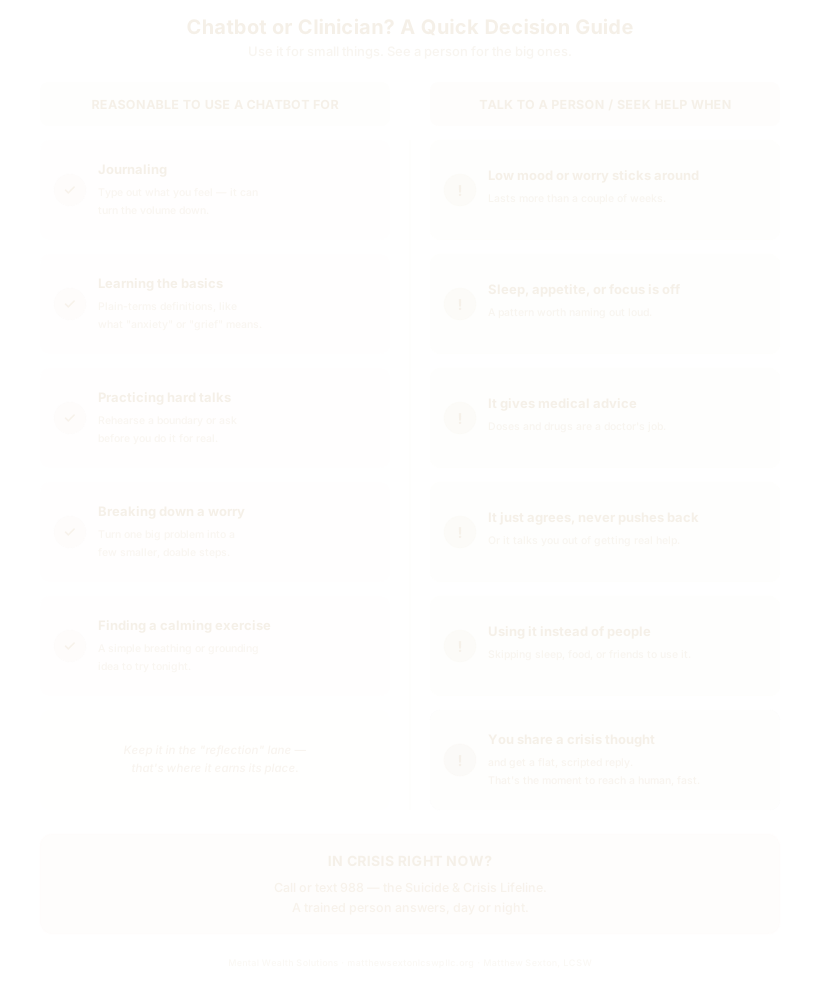
- Journaling. Type out what you feel. Getting it out of your head can turn the volume down.
- Learning the basics. Ask what a word like "anxiety" or "grief" means in plain terms.
- Practicing hard talks. Rehearse asking for a day off or setting a boundary before you do it for real.
- Breaking down a worry. Turn one big problem into a few smaller steps you can act on.
- Finding a calming exercise. Get a simple breathing or grounding idea to try tonight.
Here is one way it can earn its keep. Say you have a hard talk coming up, maybe with a family member or a manager. You can type out what you want to say. Then ask the chatbot to help you make it shorter and calmer. You walk in with clearer words and a steadier plan. That is a real, low-stakes win.
Why does it feel so helpful? A chatbot is free, it is there at 3 a.m., and it never sighs or looks at the clock. For a lot of people, that lowers the fear of being judged. That comfort is real, and it counts for something. Just keep one thing in mind. "This feels helpful" and "this is treatment" are two different things. A kind reply can still miss what a trained person would catch.
Think of it as a smart notebook. It can help you notice a pattern or name a feeling. It cannot know your history, and it cannot care about you. Keep it in the "reflection" lane, and it earns its place. Push it past that lane, and the risks start to show up.
What can an AI chatbot not do?
It cannot treat you, diagnose you, or handle a crisis. The American Psychological Association put out a health advisory in November 2025 telling people not to rely on AI chatbots for therapy. The group wrote plainly that these tools "were not created to deliver mental health care" (American Psychological Association, November 2025). Privacy is one of its eight main warnings.
The crisis gap is the part that worries clinicians most. By OpenAI's own estimate, about 0.15% of ChatGPT's 800 million-plus weekly users send messages with clear signs of suicide planning. That works out to more than a million people every week (TechCrunch, October 2025). A chatbot cannot see your face. It cannot hear your voice shake. It cannot call someone to come sit with you. The APA said a chatbot's ability to handle a person in crisis is "limited and unpredictable."
Real treatment is more than good answers. A clinician builds a plan with you, checks how you are doing over weeks, and changes course when something is not working. A chatbot starts fresh each time you open it. It does not track your progress over time. It will not notice if you slowly slide downhill.
A chatbot also cannot diagnose you. It can guess, and it can sound sure while it does. A real diagnosis needs a trained person who asks follow-up questions and knows your story. If you have already brought a chatbot's guess to a session, that is fine, and it is common. Here is what to tell your therapist about an AI diagnosis.
Is what you type private?
Mostly, no. There is no legal privacy when you use a chatbot as a therapist. OpenAI's own CEO, Sam Altman, said this out loud in July 2025. He warned that these chats carry no therapist-patient privilege, and that the company could be forced to hand them over in a lawsuit (TechCrunch, July 2025). Privilege is the legal shield that keeps what you tell a licensed therapist private. A chatbot chat does not have it.
Here is the part people miss. When you see a licensed therapist, your records are protected by health privacy law. A general chatbot like ChatGPT is not a health provider, so those same protections do not apply. That is why the APA listed privacy near the top of its concerns.
Picture this. You vent to a chatbot about a rough week and you name your boss and your workplace. That text may sit on a server you do not control. It could be used to train the tool, or pulled into a court case later on. You would never hand a stranger that page. The chat box can feel just as private, and it simply is not.
States are starting to act. In August 2025, Illinois passed a law that bars AI from acting as a therapist, with fines up to $10,000 for each violation (Illinois Department of Financial and Professional Regulation, August 2025). AI can still book appointments and handle paperwork. It just cannot be the one giving the care.
One simple habit helps. Do not type your full name, your address, or anything you would not want read out loud someday. Treat the chat box like a postcard, not a locked drawer.
What are the warning signs to watch for?
Watch for answers that drift from "helpful" to "risky." When RAND researchers tested three popular chatbots on 30 suicide-related questions, the bots refused the most dangerous ones but gave shaky, uneven answers to the middle-risk questions (Psychiatric Services, American Psychiatric Association, August 2025). The guardrails work sometimes, not always. That gap is where people can get hurt.
Here are red flags that mean it is time to step back:
- It gives medical or medicine advice. Doses and drugs are a doctor's job, not a bot's.
- It agrees with everything you say. A good therapist gently pushes back. A bot often just mirrors you.
- You feel worse or more alone after. More screen and less relief is a bad trade.
- You use it instead of sleeping, eating, or seeing people. That is a pattern worth naming out loud.
- It talks you out of real help. Anything that steers you away from a person is a stop sign.
- You share a crisis thought and get a flat script. That is the moment to reach a human, fast.
If you notice one of these, you have not failed at anything. You have just found the edge of what the tool can do.
When should you talk to a real person?
When the hard feeling sticks around, or when it scares you. About 12% of U.S. adults say they are likely to turn to AI chatbots for therapy in the next six months, and 1% already do (NAMI/Ipsos poll, November 2025). That is a lot of people leaning on a tool that was never meant to carry the weight. A person can carry it. A chatbot cannot.
Reach out to a real clinician when:
- The low mood or the worry lasts more than a couple of weeks.
- Your sleep, appetite, or focus is off.
- You are using AI to avoid the people in your life. If solitude has tipped into loneliness, here is the difference.
- You have thoughts of not wanting to be here.
That last one is not a chatbot moment. If you are thinking about suicide or self-harm, call or text the 988 Suicide and Crisis Lifeline. A trained person will answer, day or night.
One more sign is quiet but telling. In the RAND survey, 63% of young users told no one they were using AI for support (RAND Corporation, in JAMA Pediatrics, June 2026). Secrecy tends to grow the longer you wait. If you have been keeping it to yourself, that alone is a good reason to loop in a person. Not sure if you have crossed the line? Here is an honest guide to telling normal stress from something more.
What does a real person add that a chatbot cannot? A therapist reads your tone and your pace, not only your words. They can build a safety plan with you and hold you to it. They notice the small changes from one week to the next. And they carry some of the weight with you, so you are not doing the hard part alone.
If you are in New York and want to talk it through with a person, that is what a first conversation is for. You can look at how to find a therapist who fits, or reach out and book a free call whenever you feel ready.
Frequently asked questions
Is it safe to talk to an AI chatbot about your mental health? It can be, for small things like journaling or learning basic facts. It is not safe as a stand-in for therapy or crisis care. Nearly 1 in 5 people ages 12 to 21 now use these tools for advice (RAND Corporation, JAMA Pediatrics, June 2026). Keep the stakes low, and see a person for the rest.
Can ChatGPT be my therapist? No. The American Psychological Association advised in November 2025 that people not rely on AI chatbots for therapy, because they "were not created to deliver mental health care" (APA, November 2025). A chatbot cannot diagnose you, treat you, or keep you safe in a crisis. It can help you think, and that is the limit.
Is my chat with an AI chatbot private? No, not in the legal sense. OpenAI's CEO said in July 2025 that these chats carry no therapist-patient privilege and could be handed over in a lawsuit (TechCrunch, July 2025). A general chatbot is not a health provider, so health privacy law does not protect it the way it protects a therapist's records.
Can an AI chatbot diagnose my mental health condition? No. A chatbot can guess, and it can sound confident while it guesses. A real diagnosis needs a trained clinician who knows your history and can ask follow-up questions. If you already have an AI's guess, bring it to a session. It is common, and a good clinician will work with it.
Sources
- RAND Corporation, "Nearly 1 in 5 US Adolescents and Young Adults Use AI Chatbots for Mental Health Advice" (survey published in JAMA Pediatrics), rand.org, June 2026.
- NAMI/Ipsos poll on AI and mental health tools, nami.org, November 2025.
- TechCrunch, "OpenAI says over a million people talk to ChatGPT about suicide weekly," techcrunch.com, October 27, 2025.
- American Psychological Association, Health Advisory on Generative AI Chatbots and Wellness Applications, apa.org, November 2025.
- Psychiatric Services (American Psychiatric Association), RAND study by McBain et al. on chatbot responses to suicide-related questions, psychiatryonline.org, August 2025.
- TechCrunch, "Sam Altman warns there's no legal confidentiality when using ChatGPT as a therapist," techcrunch.com, July 25, 2025.
- Illinois Department of Financial and Professional Regulation, "Gov. Pritzker Signs State Legislation Prohibiting AI Therapy in Illinois," idfpr.illinois.gov, August 2025.
Disclaimer
This article is for educational and informational purposes only. It does not constitute medical, clinical, legal, or therapeutic advice, and reading it does not create a therapist-client relationship with Matthew Sexton, LCSW or Matthew Sexton LCSW PLLC. Although the author is a licensed clinical social worker, the content in this article is not clinical assessment, diagnosis, or treatment.
AI tools, their privacy settings, and the laws that govern them vary by app, by state, and over time, and they may change after this article is published. Nothing here is a substitute for talking with a licensed clinician about your own situation, or for reading a specific tool's own privacy terms. Individual circumstances differ, and what is described here may not match yours.
If you are in immediate emotional crisis, you can reach the 988 Suicide & Crisis Lifeline by calling or texting 988 (US). If you are experiencing domestic violence or are in physical danger, contact the National Domestic Violence Hotline at 1-800-799-7233 or visit thehotline.org. In a life-threatening emergency, call 911.
Sources
- RAND Corporation, "Nearly 1 in 5 US Adolescents and Young Adults Use AI Chatbots for Mental Health Advice" (survey published in JAMA Pediatrics), rand.org, June 2026.
- NAMI/Ipsos poll on AI and mental health tools, nami.org, November 2025.
- TechCrunch, "OpenAI says over a million people talk to ChatGPT about suicide weekly," techcrunch.com, October 27, 2025.
- American Psychological Association, Health Advisory on Generative AI Chatbots and Wellness Applications, apa.org, November 2025.
- Psychiatric Services (American Psychiatric Association), RAND study by McBain et al. on chatbot responses to suicide-related questions, psychiatryonline.org, August 2025.
- TechCrunch, "Sam Altman warns there's no legal confidentiality when using ChatGPT as a therapist," techcrunch.com, July 25, 2025.
- Illinois Department of Financial and Professional Regulation, "Gov. Pritzker Signs State Legislation Prohibiting AI Therapy in Illinois," idfpr.illinois.gov, August 2025.
This article is for educational and informational purposes only. It does not constitute medical, clinical, legal, or therapeutic advice, and reading it does not create a therapist-client relationship with Matthew Sexton, LCSW or Matthew Sexton LCSW PLLC. Although the author is a licensed clinical social worker, the content in this article is not clinical assessment, diagnosis, or treatment.
AI tools, their privacy settings, and the laws that govern them vary by app, by state, and over time, and they may change after this article is published. Nothing here is a substitute for talking with a licensed clinician about your own situation, or for reading a specific tool's own privacy terms. Individual circumstances differ, and what is described here may not match yours.
If you are in immediate emotional crisis, you can reach the 988 Suicide & Crisis Lifeline by calling or texting 988 (US). If you are experiencing domestic violence or are in physical danger, contact the National Domestic Violence Hotline at 1-800-799-7233 or visit thehotline.org. In a life-threatening emergency, call 911.