"Floor time," lying flat on the floor for a stretch to decompress, is not just an aesthetic wellness habit. Two separate mechanisms back it up: pressure against a firm surface calms the nervous system, and lying down itself shifts your body toward its calmer setting. It is a legitimate, low-effort grounding tool. It is also not a substitute for care if the underlying anxiety or low mood sticks around for weeks.
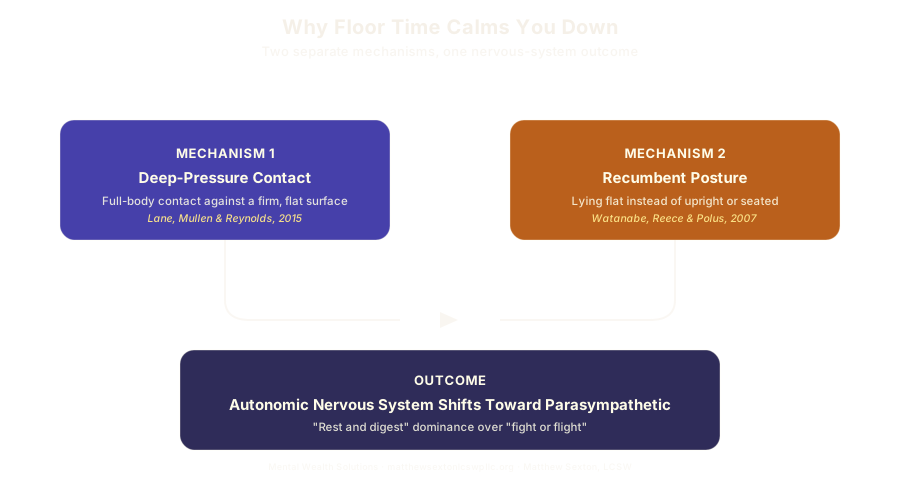
If lying flat on the floor for ten minutes has actually calmed you down, there is a real reason for that. Full-body contact against a firm, flat surface delivers deep-pressure input that measurably lowers stress-related arousal and raises the body's calming response, according to a 2015 study in the American Journal of Occupational Therapy (Lane, Mullen and Reynolds, 2015). Lying down itself changes the math too: body position shifts the balance of your autonomic nervous system, with recumbent posture favoring the "rest and digest" side over the "fight or flight" side (Watanabe, Reece and Polus, Chiropractic and Osteopathy, 2007).
You have probably seen it by now: someone in leggings, flat on their back on a rug or hardwood floor, arms and legs loose, sometimes with a caption about "nervous system reset" or "just needed the floor today." It is a trend that has been circulating across TikTok and wellness coverage since early 2026, and health outlets have taken it seriously enough to explain why it might actually work (IOL, March 18, 2026; Yahoo Health). The honest answer is that it is doing something real, just not everything the captions imply.
What Is the "Floor Time" Trend, Exactly?
Floor time means exactly what it sounds like: lying flat on the floor, usually on your back, for anywhere from a few minutes to twenty, with no phone, no pillow fort, just your body against a hard, stable surface. Health press picked it up as a genuine grounding practice worth explaining, not dismissing, framing it as a low-cost way to interrupt a stressful stretch of the day (IOL, 2026).
Part of why it spread is that it asks nothing of you. No app, no equipment, no subscription, no instructor telling you that you are breathing wrong. You just get down on the floor. For anyone whose stress response has been getting managed with more stuff, more supplements, more tracked metrics, a trend that is basically "lie on the ground and do nothing" is a relief by contrast.
Why Lying on the Floor Actually Calms Your Body Down
The floor itself is doing physiological work, not just symbolic work. When your whole back, legs, and arms make firm, even contact with a hard surface, that is deep-pressure stimulation: a broad, steady input your nervous system reads very differently than a light touch or no touch at all. A 2015 study measuring this directly found deep-pressure stimulation reduced markers of stress-related arousal and increased markers of the body's calming response in adult participants (Lane, Mullen and Reynolds, American Journal of Occupational Therapy, 2015).
That is a different mechanism than a weighted blanket alone, though it is a cousin of it. The floor is unforgiving in a useful way. A mattress or couch gives, absorbs, redistributes. A hard floor pushes back evenly against your entire backside at once, and that even, sustained contact is the specific input the research is pointing to. It is not about the floor being cold or hard for its own sake. It is about full, uninterrupted contact.
Your Body Position Also Changes Your Nervous System
Yes, separately from the pressure question, and this is the part most floor-time explainers skip. Standing and sitting are metabolically demanding postures that keep your sympathetic nervous system, the accelerator, more active by default. Lying down changes that balance. Foundational research on posture and autonomic function found that recumbent (lying-flat) position shifts cardiovascular regulation toward parasympathetic, vagal dominance, compared with upright posture, where sympathetic activity predominates (Watanabe, Reece and Polus, Chiropractic and Osteopathy, 2007).
In plain terms: your body has been working, quietly, to keep you upright and functional all day, and that work has a cost. Getting fully horizontal removes that job for a few minutes. Your heart rate variability and vagal tone, the signals researchers use to track how much your body is leaning toward "rest" versus "alert," measurably shift toward rest when you are lying flat. That is likely why floor time feels different from just sitting down for a break: sitting still keeps you upright and working. Lying flat is the position change itself doing part of the job.
Is Floor Time a Legitimate Grounding Technique, or Just a Trend?
It is a legitimate one. Cleveland Clinic's current patient guide on grounding techniques lists body-based methods, ones that use physical sensation and contact to anchor a person in the present moment, as clinically recommended tools for calming anxiety (Cleveland Clinic, updated March 9, 2026). Floor time fits that description almost exactly: full-body physical sensation, present-moment, no cognitive heavy lifting required.
In practice, the people who find floor time useful tend to be the ones who have already burned out on the more effortful version of calming down, the ones involving apps, journaling prompts, or a ten-step breathing sequence they have to remember correctly. Floor time does not ask you to do it right. You just have to get down there.
That said, "legitimate grounding technique" and "sufficient treatment" are two different claims. Grounding techniques are designed to interrupt a spike, to bring you back into your body for the next twenty minutes. They were never designed to resolve what is causing the spikes in the first place.
When Is Floor Time Not Enough, and It's Time for More Support?
There is a clear, well-established marker for this, and it has nothing to do with how many times you have done floor time this week. SAMHSA's guidance on recognizing when to seek professional help points to duration and impact, not the technique you have tried: if two or more weeks of changed thoughts, mood, or body sensations are making it hard to manage work, school, home, or relationships, that is the signal to bring in a professional (SAMHSA). NIMH frames anxiety the same way: it is not the presence of anxiety that indicates a problem, it is anxiety that does not resolve and starts interfering with daily functioning (NIMH, Generalized Anxiety Disorder).
That two-week functional-impact test is a genuinely useful one to run on yourself, because it does not require you to rate your feelings or diagnose anything. It just asks: is this still getting in the way? If floor time, a walk, and a good night's sleep are reliably bringing you back to baseline, that is your nervous system doing what it is supposed to do under normal stress. If you have been reaching for the floor most days for two weeks and the underlying tightness, dread, or flatness is still there when you stand back up, that is not a floor-time failure. That is information. It is also a familiar shape for anyone whose "I'm fine" has been doing more work than it should, a pattern worth recognizing on its own.
There's a particular version of this worth naming, because it's the one that hides best. If you're the competent one, the person everyone leans on, the one who answers every email and holds the whole thing together and then needs the floor to function, the floor isn't the problem and it isn't the fix. It's a readout. High-functioning anxiety works exactly like that: the competence stays intact while the nervous system quietly runs a deficit, and the floor is where the bill comes due at the end of the day. If that's you, the useful question isn't "how do I get better at the floor," it's "what is the floor covering for," and that's what therapy for high-functioning anxiety is built to answer.
None of this means floor time stops being useful once you are also in therapy. Grounding techniques and treatment are not competing options, they are often used together: the floor handles the spike in the moment, and the work in session addresses what keeps producing spikes in the first place. The floor gives you ten minutes of relief. The goal is a nervous system that doesn't need the floor every night to get through — and that's a thing you can actually take back.
How Do You Actually Try Floor Time?
Keep it simple, because the simplicity is the point. Find a firm, flat surface, a rug over hardwood works fine, and lie fully on your back with your arms and legs a little apart from your body, palms up if that is comfortable. Ten to fifteen minutes is a reasonable starting range. You do not need a specific breathing pattern, though slow exhales tend to help the effect along.
Let your weight actually settle into the floor rather than hovering, tense, an inch above it. That settling is the deep-pressure input doing its work. If your mind wanders, that is fine. This is not a concentration exercise. The physiological benefit does not depend on your thoughts behaving.
A few honest caveats: if you have a health condition that makes lying flat uncomfortable or risky, a firm bed works too, the surface matters more than the exact floor. And if getting down on the floor and back up is physically difficult, a supported version with your legs up on a chair or wall gets you most of the same contact and position benefit.
Does lying on the floor actually help with anxiety, or is it just a trend?
Both mechanisms behind it are backed by research, not just aesthetics. Deep-pressure contact with a firm surface lowers stress-related arousal and raises calming arousal (Lane, Mullen and Reynolds, 2015), and lying flat itself shifts your nervous system toward its calmer, parasympathetic side compared with sitting or standing (Watanabe et al., 2007). It is a real, if modest, physiological effect.
Why does lying flat feel different from just sitting down and resting?
Sitting still keeps your body in an upright posture that your sympathetic nervous system has to keep working to maintain. Lying flat removes that job. Research on posture and autonomic regulation found recumbent position favors parasympathetic dominance in a way upright rest does not fully replicate (Watanabe et al., 2007).
How long should I do floor time for it to help?
There is no clinically established minimum, but ten to fifteen minutes is a reasonable, sustainable starting point. The mechanism, sustained pressure and a position change, does not require a long session to register. Consistency during a stressful stretch of your day likely matters more than any single session's length.
Is floor time a substitute for therapy?
No, and it is not trying to be. Grounding techniques like floor time are designed to interrupt a moment of stress, not to address what is producing that stress repeatedly. SAMHSA's guidance points to a two-week functional-impact marker: if changed mood, thoughts, or body sensations are interfering with work, relationships, or daily life for two weeks or more, that is the signal to bring in a professional (SAMHSA).
Is it safe to lie on the floor if I have a bad back or a health condition?
For most people, occasional floor time is low-risk, but it is not universal. If lying flat is uncomfortable or contraindicated for a specific condition, a firm bed offers similar pressure and position benefits, and a legs-up-the-wall variation can approximate the effect for people who find getting down to the floor and back up difficult. When in doubt, check with your physician about what positions are safe for your specific situation.
Sources
- IOL Lifestyle, "5 Ways TikTok's 'Floor Time' Trend May Support Your Mental Health and Well-Being," March 18, 2026. iol.co.za
- Yahoo Health, "Could 'Floor Time' Really Help?" health.yahoo.com
- Watanabe, K., Reece, J., and Polus, B., "Effects of Body Position on Autonomic Regulation of Cardiovascular Function in Young, Healthy Adults," Chiropractic and Osteopathy, 2007. pmc.ncbi.nlm.nih.gov
- Lane, S.J., Mullen, B., and Reynolds, S., "Effects of Deep Pressure Stimulation on Physiological Arousal," American Journal of Occupational Therapy, July 2015. ajot.aota.org
- Cleveland Clinic, "Grounding Techniques," updated March 9, 2026. health.clevelandclinic.org
- SAMHSA, "Signs You May Need Support." samhsa.gov
- National Institute of Mental Health, "Generalized Anxiety Disorder." nimh.nih.gov
This article is for educational and informational purposes only. It does not constitute medical, clinical, legal, or therapeutic advice, and reading it does not create a therapist-client relationship with Matthew Sexton, LCSW or Matthew Sexton LCSW PLLC. Although the author is a licensed clinical social worker, the content in this article is not clinical assessment, diagnosis, or treatment.
The physiological mechanisms and grounding concepts described here reflect published research and general clinical observation about body-based calming techniques, not an individualized assessment of your situation. Individual bodies, health conditions, and stress responses vary, and a technique that helps one person may not help another, or may not be appropriate given a specific physical condition. If lying flat is uncomfortable or unsafe for you, check with your physician before adopting the practice, and if anxiety or low mood persists for two weeks or more despite grounding techniques, please consult a licensed mental health professional who can assess your specific circumstances.
If you are in immediate emotional crisis, you can reach the 988 Suicide & Crisis Lifeline by calling or texting 988 (US). If you are experiencing domestic violence or are in physical danger, contact the National Domestic Violence Hotline at 1-800-799-7233 or visit thehotline.org. In a life-threatening emergency, call 911.