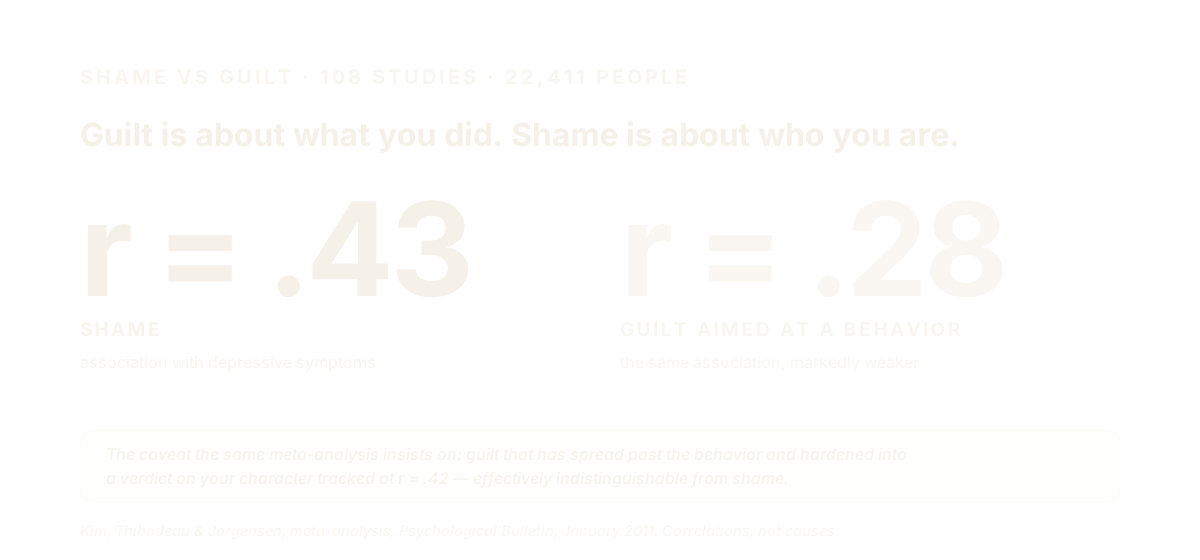
Guilt is a judgment about something you did. Shame is a judgment about who you are. That one difference changes what the feeling makes you want to do, and it shows up in the research. Across 108 studies covering 22,411 people, shame was significantly more strongly associated with depressive symptoms (r = .43) than guilt was (r = .28), according to a 2011 meta-analysis in Psychological Bulletin by Kim, Thibodeau and Jorgensen. One caveat matters here. When guilt stops being about a specific act and hardens into a standing verdict on your character, it starts behaving in the data like shame.
Matthew Sexton, LCSW, NATC — Licensed clinical social worker in private practice, providing telehealth psychotherapy to adults in New York.
If you have ever apologized properly, made the repair, been forgiven, and found that the feeling did not move at all, you have already met this distinction from the inside. An apology closes a loop when the problem is something you did. It has nothing to close when the problem, as you experience it, is you.
That is the whole idea, and it is far better tested than the vocabulary lesson it usually gets reduced to.
Shame vs guilt: the difference is where the feeling is aimed
Psychology has had a working answer to this since Helen Block Lewis proposed it in 1971. Shame involves a negative evaluation of the whole self. Guilt involves a negative evaluation of one specific behavior. June Tangney and colleagues, reviewing the field in Annual Review of Psychology in 2007, describe this self-versus-behavior focus as the most dominant basis for distinguishing the two, supported across experimental, correlational, narrative, and attributional research.
The plain-language contrast people reach for is I did a bad thing versus I am a bad person. That framing is a paraphrase rather than anyone's exact words, and the original is subtler. Tangney prints nearly the same sentence twice and moves the emphasis. Once the weight lands on the I. Once it lands on that horrible thing. The words barely change, and everything that follows from them does.
Guilt keeps the act at arm's length from your identity. It produces remorse and regret that stay attached to the thing that was done, and it leaves you standing there, intact, as the person who can now respond to it.
Shame skips past the act and delivers a finding about the person. There is nothing specific to fix, because the thing that is wrong is not a thing. It is you.
The two feelings point in different directions rather than sitting at different volumes, and that direction determines whether the feeling has anywhere to go.
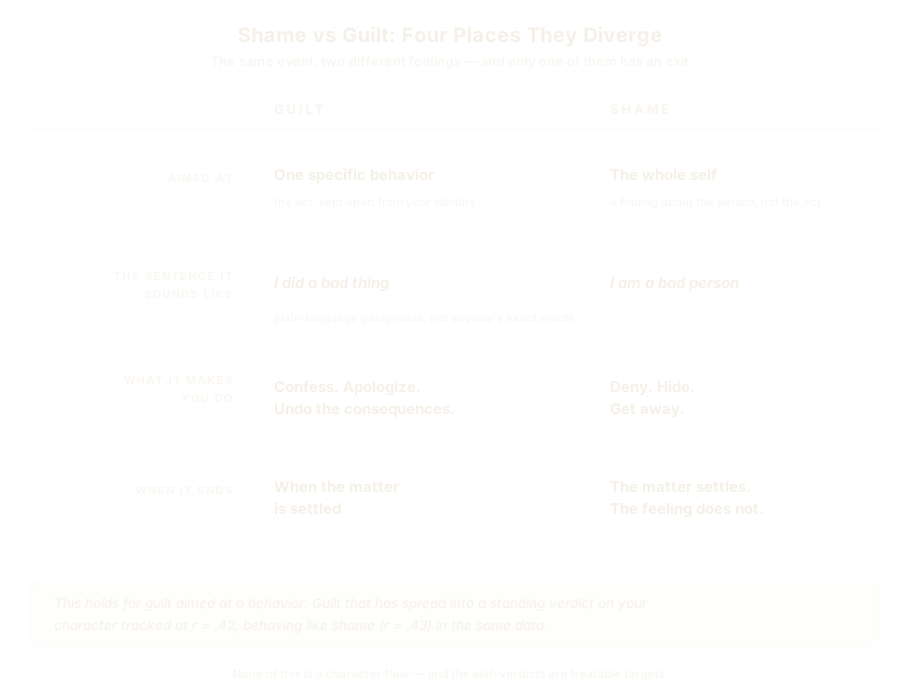
Laid out side by side, the difference is easier to hold on to:
| Guilt | Shame | |
|---|---|---|
| Aimed at | One specific behavior — the act, kept apart from your identity | The whole self — a finding about the person, not the act |
| The sentence it sounds like | I did a bad thing | I am a bad person |
| What it makes you do | Confess. Apologize. Undo the consequences. | Deny, hide, get away |
| When it ends | When the matter is settled | The matter settles. The feeling does not. |
Two things belong with that table. Those two sentences are the plain-language paraphrase described above, not anyone's exact words. And the guilt column describes guilt aimed at a behavior. Guilt that has spread into a standing verdict on your character behaves differently, and differently enough that it gets its own section further down.
What each one makes you do
Tangney's own subheading for this section is "Hiding versus amending," which is about as clear as clinical writing gets.
Guilt has an exit that leads somewhere. Confess. Apologize. Undo the consequences. Do it differently next time. Research on what psychologists call action tendencies consistently finds that guilt pushes toward reparative behavior and tends to promote constructive, proactive pursuits.
Shame has exits too, and they all lead away. The same body of research finds that shame corresponds with attempts to deny, hide, or escape the situation that produced it, and that it promotes defensiveness and interpersonal distance.
That is the mechanism the rest of this rests on. Guilt gives you somewhere to go. Shame gives you nowhere to go except away.
Researchers have mapped the escape routes. The Compass of Shame Scale names four, and most people recognize their own before they finish the list:
- Attack self. Turning on yourself first, harder than anyone else would, partly because getting there first feels like control.
- Withdrawal. Going quiet. Cancelling. Leaving the group chat. Not answering the text you fully intend to answer.
- Avoidance. Minimizing it, joking about it, staying busy, deciding it was not a big deal. Numbing lives here too.
- Attack other. Getting there before they do. Contempt, blame, the preemptive strike.
None of these are character flaws, and none of them mean you are handling this badly. They are what people do when a feeling arrives with no available repair. The behavior looks irrational only if you assume a better option was on the table. Shame's defining feature is that there is not one.
That list contains a second problem, and it is why shame is so stubborn. Concealment is the symptom. So the part of your life shame has its hands on is, by design, the part you are least likely to say out loud, including in a therapist's office. People describe a difficult decade in careful detail and leave out the one sentence they actually believe about themselves.
Saying it out loud feels like handing someone the evidence.
— Matthew Sexton, LCSW, NATC
Why "guilt is healthy, shame is not" is too simple
Most articles on this topic stop at the slogan, and the research underneath it is more interesting.
The clean version says guilt is the good one and shame is the bad one. Tangney's review supports part of that. Proneness to shame is linked with a wide range of psychological symptoms, and when researchers use measures that properly separate the two, proneness to what they call shame-free guilt turns out to be essentially unrelated to those symptoms.
Then the meta-analyses complicate it, and the complication is the useful part.
Kim and colleagues did not only compare shame with guilt. They compared different kinds of guilt. Guilt tied to a specific situation and handled adaptively tracked with depression at r = .28. Maladaptive guilt about a specific situation came in at r = .39, and generalized guilt came in at r = .42, effectively indistinguishable from shame's r = .43. Cândea and Szentagotai-Tătar found the same shape in their 2018 meta-analysis of anxiety symptoms. Shame showed generally medium associations, guilt generally small ones, and when the researchers statistically removed the variance the two share, in most cases only shame remained significantly associated with anxiety. Their generalized and maladaptive guilt variants again behaved like shame.
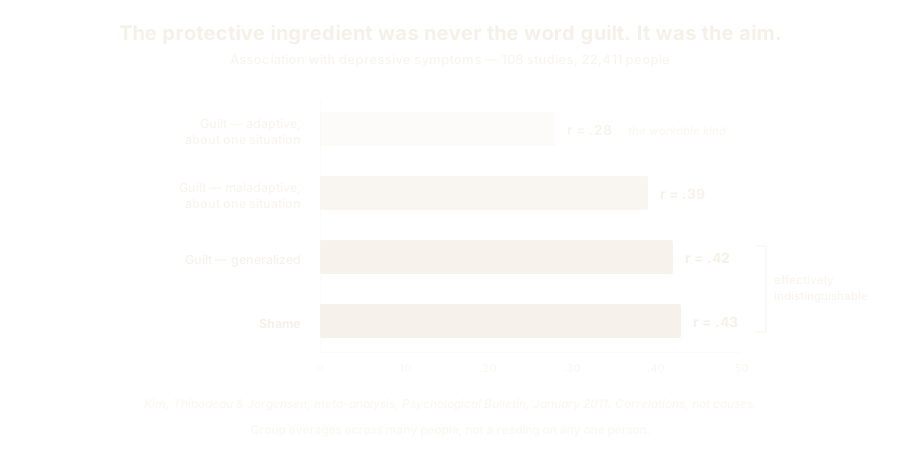
Depressive-symptom correlations from Kim, Thibodeau and Jorgensen's 2011 meta-analysis in Psychological Bulletin, covering 108 studies and 22,411 people. These are correlations, and group averages rather than a reading on any one person.
So the protective ingredient was never the word "guilt." It was the aim.
Guilt that stays pointed at a behavior is workable, because a behavior is something you can act on. Guilt that has spread outward until it covers your whole character has already become shame, whatever you call it. The tell is not how bad it feels. The tell is whether the feeling ends when the matter is settled. If you made the repair a year ago and the sentence in your head has quietly upgraded from "that was wrong of me" to "there is something wrong with me," the feeling has changed categories. That is not a failure to feel guilty correctly. It is a known pattern with a name.
This is also why advice about "healthy guilt" lands so badly on someone carrying real shame. They are being handed a tool for a feeling they do not have. It is the same reason generic self-help tends to fail trauma survivors. The instructions assume a problem one layer up from the one in the room.
One more finding from the Kim meta-analysis is worth sitting with. The researchers separated shame about how you appear in other people's eyes from shame about how you appear to yourself. The external kind, the felt sense of being seen as defective, showed the strongest association with depressive symptoms of anything they measured, at r = .56, against r = .42 for internal shame. Shame is deeply social. It is organized around a verdict you believe has already been handed down by everyone else.
A necessary note on these numbers. They are correlations from cross-sectional research, and the authors of the depression meta-analysis say plainly that their data are ambiguous with respect to causal interpretation. Shame tracks with these symptoms. Nothing here establishes that it produces them.
Why so much of this lands on people who were harmed
Shame and trauma travel together closely enough that researchers have stopped treating shame as a side effect.
A 2019 meta-analysis in the Journal of Traumatic Stress pooled 25 studies with 3,663 trauma-exposed participants and found a moderate association between shame and posttraumatic stress symptoms, r = .49. What makes that result unusual is the absence of between-study heterogeneity. The relationship held steady across a diverse set of populations rather than varying by who was studied. The authors concluded that shame warrants a central role in understanding the affective structure of PTSD.
A separate 2023 meta-analysis, also of 25 studies, looked at shame tied specifically to the traumatic event and found moderate associations with symptoms of psychopathology (r = .44), with trauma-related distress (r = .49), and with depression (r = .35). Neither study quality nor sample characteristics moderated the effect.
Why would harm route a person into shame rather than guilt, when the person did nothing that needs amending? Tangney offers two mechanisms that are recognizable without any clinical training. The first is secrecy. Harm that stays hidden, that nobody names, teaches a specific lesson about what is unspeakable, and unspeakable slides easily into shameful. The second is that harsh and punitive treatment can produce helplessness and self-blame, which then generalize into a global sense that something is wrong with you.
Read that second mechanism slowly. Self-blame is often the more bearable option at the time. A child who concludes "I am bad" still lives in a world with rules and a lever they can pull. A child who concludes "the people responsible for me are dangerous and I cannot change that" lives somewhere much harder to survive. Shame frequently starts as the cheaper of two impossible conclusions, then outlives the situation that required it. If you have spent years telling yourself it was never bad enough to count, that pattern has its own piece: minimizing your own trauma.
Two honest limits belong here. Tangney describes the evidence linking childhood maltreatment to later shame as mixed, with studies using different measures of both. The supportable statement is that people harmed as children are somewhat more vulnerable to difficulty with shame later, and nothing stronger. The reverse inference does not hold at all. Carrying a great deal of shame does not tell you what happened to you, and no article can tell you which route was yours.
If shame has organized how you move through relationships, some downstream patterns may look familiar: chronic people-pleasing as a way to stay ahead of the verdict, or perfectionism as a way to outrun it.
Does any of this actually shift?
Yes, and there is trial evidence rather than reassurance, though the honest version comes with limits attached.
The most direct evidence involves the frozen conclusions people draw about themselves after something happens. Cognitive Processing Therapy is built around finding those conclusions, which the model calls stuck points, and testing them against the actual event. A randomized clinical trial of 150 adult women with PTSD following interpersonal harm was published in the Journal of Consulting and Clinical Psychology in 2008. All three active trauma-focused conditions produced large reductions in trauma-related guilt cognitions from pre-treatment to post-treatment: d = −1.08 for Cognitive Processing Therapy, d = −1.19 for the cognitive-only version, and d = −1.06 for written accounts. Those are large effects on the cognitions this article is about.
A different approach goes after the self-attacking voice directly. A 2023 meta-analysis in the British Journal of Clinical Psychology pooled 14 studies of Compassion-Focused Therapy and found decreases in self-criticism alongside increases in the capacity for self-soothing. In the seven controlled trials (N = 640), the effect on the hated-self form of self-criticism was d = .42, on the inadequate-self form d = .30, and on reassured-self, meaning the ability to comfort yourself, d = −.58.
Now the limits, because you deserve the whole picture rather than the brochure version. Those compassion-focused effects are modest to moderate in controlled trials, and the evidence does not establish that any one approach outperforms the others. The 2008 trial reports guilt outcomes, not shame outcomes. All of these are group averages from research samples, and no result predicts what will happen for a specific person.
What the evidence does support is worth saying plainly. The self-verdicts are treatable targets. They respond to being examined out loud, which is the opposite of what shame instructs you to do with them. And approaches exist that were built for the self-attacking voice, rather than treating it as something that will clear up once the other symptoms do. Different pieces of this work move on different timelines, which is the pattern described in how complex trauma recovery actually unfolds.
How to tell which one you are sitting in
This is not a quiz and it will not tell you anything diagnostic. These are questions you can ask yourself.
Where is the sentence aimed? Listen to the phrasing in your head. Does it describe an action, or does it describe you? "I snapped at her" and "I am a cruel person" are not two intensities of one feeling.
Is there an available action? Guilt usually comes with an obvious next move, even an unpleasant one. Shame comes with an urge to leave the room.
Does it end? Guilt aimed at a behavior tends to resolve when the matter resolves. If the repair was made and the feeling did not move, it has stopped being about the event.
How old does it feel? Some verdicts predate the events they attach themselves to. A feeling that arrives fully formed and out of proportion to what just happened is often an old conclusion finding a new occasion.
None of this asks you to decide what you have. It gives you a way to describe what is happening that does not begin with the assumption that you are the problem.
Where to start
The first move is smaller than it sounds. It is saying the sentence out loud to one person whose job is to hear it without flinching. Shame runs on concealment, which is why the work eventually involves one other person hearing it. Not all of it, and not on anyone's schedule but yours.
If you are looking for a therapist, two questions are worth asking directly. Do you work with shame as its own target, or only as part of something else? And what happens if I cannot get the words out for a while?
If you want to talk through what this would look like for you, book a call. We can talk about what you are actually carrying and whether working together makes sense.
What is the difference between shame and guilt?
Guilt is a negative evaluation of a specific behavior. Shame is a negative evaluation of the whole self. The distinction was proposed by Helen Block Lewis in 1971 and supported across decades of research summarized by Tangney and colleagues in 2007. The practical consequence is what each one makes you want to do. Guilt points toward repair, such as apologizing or undoing the consequences. Shame points toward denial, hiding, and getting away. Guilt gives you somewhere to go. Shame does not.
Is guilt ever unhealthy?
Yes, and this is the part usually left out. In the 2011 meta-analysis by Kim and colleagues, guilt tied to a specific situation and handled adaptively correlated with depressive symptoms at r = .28, while maladaptive guilt about a situation reached r = .39 and generalized guilt reached r = .42, statistically close to shame at r = .43. Cândea and Szentagotai-Tătar found a comparable pattern for anxiety in 2018. Guilt that has spread from "I did something wrong" into a standing verdict on your character is functioning as shame regardless of what you call it.
Why do people who were harmed feel so much shame when they did nothing wrong?
Shame and posttraumatic stress symptoms are reliably linked. A 2019 meta-analysis of 25 studies with 3,663 participants found a moderate association, r = .49, with no variation across the populations studied. Tangney describes two plausible mechanisms: harm that stays hidden teaches that it is unspeakable and therefore shameful, and harsh treatment can produce self-blame that generalizes into a global sense that something is wrong with you. One clarification matters here. The evidence linking childhood harm to later shame is mixed, and feeling a great deal of shame does not tell you what happened to you.
Can shame actually change, or is it just who I am?
The self-verdicts are treatable targets, and there are trial results rather than only encouragement. A 2008 randomized clinical trial of 150 women with PTSD found large reductions in trauma-related guilt cognitions across all three active treatments (d = −1.08, −1.19, and −1.06), and Cognitive Processing Therapy is built around identifying and testing the frozen self-blaming conclusions it calls stuck points. A 2023 meta-analysis of Compassion-Focused Therapy found reductions in self-criticism and gains in the capacity to self-soothe, with modest to moderate effects in controlled trials. These are group averages, individual results vary, and no approach has been shown to be superior to the others.
How do I bring this up with a therapist if I cannot say it out loud?
Say that instead. "There is something I cannot say yet" is a complete and useful sentence in a first session, and a therapist who works with shame will recognize it and will not push. Writing it down and handing it over works. So does describing the shape of it before the content. Naming it early stops it being the one thing in the room nobody is allowed to mention, which is the condition shame needs in order to keep going.
Sources
- Tangney, J. P., Stuewig, J., & Mashek, D. J. (2007). Moral Emotions and Moral Behavior. Annual Review of Psychology, 58, 345–372. Full text: its.caltech.edu · Journal record: annualreviews.org
- Kim, S., Thibodeau, R., & Jorgensen, R. S. (2011, January). Shame, guilt, and depressive symptoms: A meta-analytic review. Psychological Bulletin, 137(1), 68–96. pubmed.ncbi.nlm.nih.gov/21219057
- Cândea, D.-M., & Szentagotai-Tătar, A. (2018, August). Shame-proneness, guilt-proneness and anxiety symptoms: A meta-analysis. Journal of Anxiety Disorders, 58, 78–106. pubmed.ncbi.nlm.nih.gov/30075356
- López-Castro, T., Saraiya, T., Zumberg-Smith, K., & Dambreville, N. (2019, August). Association Between Shame and Posttraumatic Stress Disorder: A Meta-Analysis. Journal of Traumatic Stress, 32(4), 484–495. pmc.ncbi.nlm.nih.gov/articles/PMC7500058
- DeCou, C. R., Lynch, S. M., Weber, S., Richner, D., Mozafari, A., Huggins, H., & Perschon, B. (2023, July). On the Association Between Trauma-Related Shame and Symptoms of Psychopathology: A Meta-Analysis. Trauma, Violence, & Abuse, 24(3), 1193–1201. pubmed.ncbi.nlm.nih.gov/34715765
- Resick, P. A., Galovski, T. E., Uhlmansiek, M. O., Scher, C. D., Clum, G. A., & Young-Xu, Y. (2008, April). A randomized clinical trial to dismantle components of cognitive processing therapy for posttraumatic stress disorder in female victims of interpersonal violence. Journal of Consulting and Clinical Psychology, 76(2), 243–258. pmc.ncbi.nlm.nih.gov/articles/PMC2967760
- Vidal, J., & Soldevilla, J. M. (2023, March). Effect of compassion-focused therapy on self-criticism and self-soothing: A meta-analysis. British Journal of Clinical Psychology, 62(1), 70–81. pmc.ncbi.nlm.nih.gov/articles/PMC10087030
This article is for educational and informational purposes only. It does not constitute medical, clinical, legal, or therapeutic advice, and reading it does not create a therapist-client relationship with Matthew Sexton, LCSW or Mental Wealth Solutions PLLC. Although the author is a licensed clinical social worker, the content in this article is not clinical assessment, diagnosis, or treatment.
The distinctions, mechanisms, and research findings described here reflect published studies and general clinical understanding of shame, guilt, and trauma. The figures cited are correlations and group averages from research samples, which means they describe patterns across many people rather than predictions about any one person. Individual experiences vary, and what is described here may not match your situation. Nothing in this article can tell you what happened to you, what you are carrying, or what you need. If shame, self-blame, or the aftermath of harm is affecting your life, please consult a licensed mental health professional who can assess your specific circumstances.
If you are in immediate emotional crisis, you can reach the 988 Suicide & Crisis Lifeline by calling or texting 988 (US). If you are experiencing domestic violence or are in physical danger, contact the National Domestic Violence Hotline at 1-800-799-7233 or visit thehotline.org. In a life-threatening emergency, call 911.