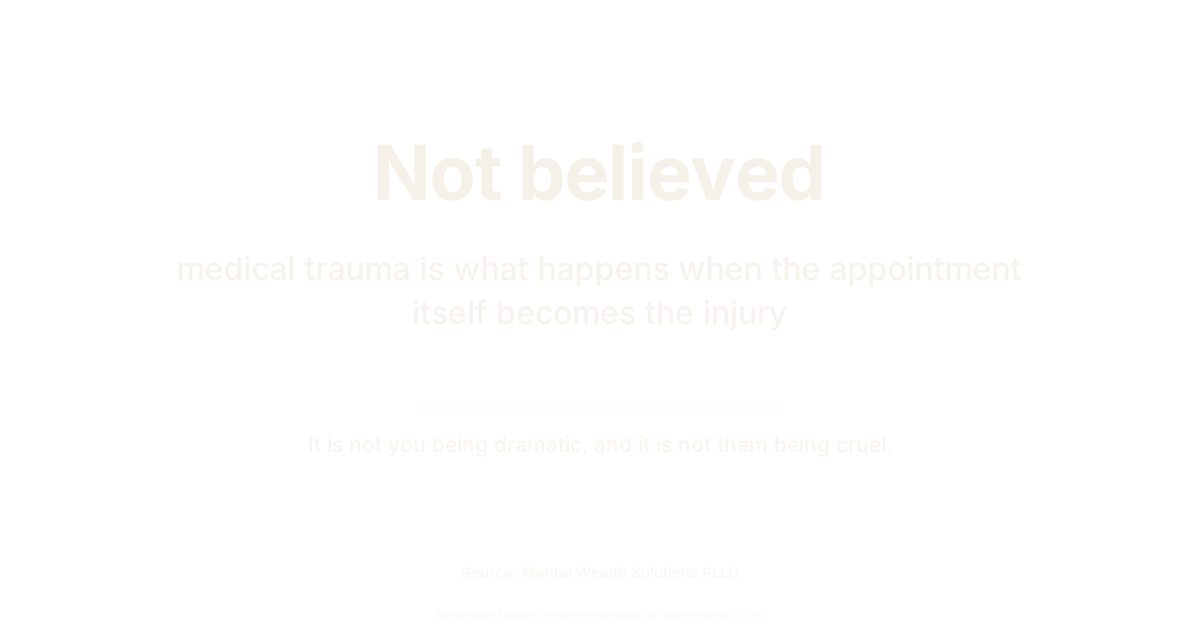
Medical trauma from not being believed is its own injury, separate from whatever is wrong with you. A 2025 systematic meta-synthesis in Psychological Bulletin pulled together 151 qualitative reports covering 11,307 people across 13 illnesses known to generate clinical uncertainty, endometriosis and lupus among them. Where clinicians dismissed or minimized symptoms, the same four things kept turning up in people's accounts: painful emotional states including shame and suicidality; anxiety and trauma attached to health care itself; avoidance of medical services; and delayed diagnosis. Separately, the patient-safety organization ECRI named dismissing patient, family and caregiver concerns the number one patient safety concern of 2025. So if you have started to wonder whether you are the problem, the research is not on the side of that suspicion.
Matthew Sexton, LCSW, NATC — Licensed clinical social worker in private practice, providing telehealth psychotherapy to adults in New York.
There is a specific kind of tiredness that comes from rehearsing your own symptoms in the car before an appointment. Deciding which ones to lead with. Deciding which ones to leave out because mentioning them makes you sound like someone who reads too much. Working out how to seem concerned but not anxious, informed but not difficult, sick but not that kind of sick.
If you do that, you already know what this article is about. And the reason it is worth naming is that the exhaustion usually gets filed under the illness, when a lot of it belongs to the appointments.
The injury of not being believed is measurable
For a long time, people treated "my doctor didn't believe me" as a customer-service complaint. Unpleasant, not clinical.
That has changed, and the clearest evidence is the 2025 meta-synthesis by Bontempo, Bontempo and Duberstein in Psychological Bulletin. A meta-synthesis is what you do when the useful evidence lives in people's accounts rather than in numbers: you gather the qualitative studies systematically and look for what repeats. They gathered 151 reports representing 11,307 individuals, deliberately focusing on illnesses that produce clinical uncertainty: conditions where tests are often unremarkable and diagnosis is slow or contested.
What repeated fell into categories:
- Painful emotional states, including shame and, in some accounts, suicidality
- Distress about health care visits themselves: health-care-related anxiety, and in some accounts trauma
- Avoidance of health services
- Diagnostic delay
Read that last pair together. People describe them as linked: being dismissed, then putting off the next appointment, then a diagnosis that arrives late — and a long, vague, hard-to-pin-down history is exactly the picture that draws more doubt. A synthesis of accounts cannot prove which way that runs. It can show how consistently people report it.
A separate 2025 review in Frontiers in Health Services by Faytong-Haro walks the same terrain across long COVID, endometriosis, chronic vulvovaginal disorders, heart attack, mental health conditions and intellectual disabilities. It names five consequences: erosion of trust, emotional distress including self-doubt, psychological harm to the point of questioning one's own sanity, missed or delayed diagnoses, and avoidance of medical care.
Questioning your own sanity appears in this literature as an outcome. Not as a personality trait.
| What each 2025 review found | Bontempo et al., Psychological Bulletin | Faytong-Haro, Frontiers in Health Services |
|---|---|---|
| Method | Meta-synthesis of 151 qualitative reports, 11,307 people | Narrative review |
| Emotional harm | Painful emotional states, incl. shame and suicidality | Emotional distress, incl. self-doubt |
| Harm to self-trust | Health-care-related anxiety or trauma | Psychological harm, up to questioning one's sanity |
| Effect on care-seeking | Avoidance of health services | Avoidance of medical care |
| Effect on diagnosis | Diagnostic delay | Missed or delayed diagnoses |
| Trust | — | Erosion of trust |
It is not you being dramatic, and it is not them being cruel
Here is where I want to be careful, because there are two easy stories and both are wrong.
The first easy story is that you are exaggerating. The research cannot settle that about any one person, and I would not try to from here. What it does show is that avoidance of care is among the most consistently reported outcomes in this literature — and people looking for more attention do not usually stop going. That is my reading of the pattern, not a finding of the study.
The second easy story is that clinicians are callous. ECRI studies patient safety for a living. It put dismissing patient, family and caregiver concerns at the top of its 2025 list of patient safety concerns, and it used the phrase medical gaslighting for an environment in which, in ECRI's own words, clinician biases or misconceptions may result in dismissing patient symptoms. But look at what ECRI blames. It points at conditions: increasingly complex patients, multiple communication technologies to manage, and time constraints that squeeze out empathetic, patient-centered care. Its recommendations are systemic: examine scheduling policies so clinicians have enough time with patients, teach empathetic listening, educate about conditions that are commonly misunderstood or minimized.
That is a diagnosis of a system, not of a villain. Most clinicians who dismiss a symptom are not choosing to. They are pattern-matching at speed inside a short appointment, and conditions that do not match a familiar pattern lose that contest.
Knowing this does not make it hurt less in the room. It does change what you conclude about yourself afterward, which is the part that follows you home.
How medical trauma changes the way you tell your own story
The clinical thing I see most often is not anger at a doctor. It is a slow erosion of a person's authority over their own experience.
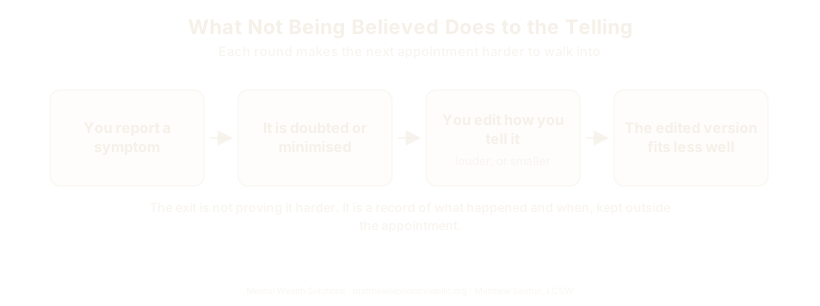
It tends to progress in a recognizable way. First comes pre-editing, pruning the symptoms that got a flat response last time. Then over-preparing, arriving with timelines and printouts, which is a rational response to not being believed and reliably reads as anxiety. Then hedging out loud: this is probably nothing, but. And eventually some people arrive at the position that is hardest to work with, which is not believing themselves, feeling a real symptom and waiting to find out whether it counts.
That last state is worth getting help for, because it does not resolve on its own and it is not really about medicine. Somewhere in there the question stopped being what is happening in my body and became am I allowed to say what is happening in my body. Those need completely different kinds of attention.
Why this lands harder on some people
The literature on clinical uncertainty is fairly blunt about which conditions generate it, and a pattern keeps recurring in the examples: endometriosis, chronic vulvovaginal disorders, lupus, long COVID. Conditions with fluctuating symptoms, unremarkable initial tests, and long diagnostic paths.
Faytong-Haro's review also lists acute myocardial infarction and intellectual disabilities, which points at something worth saying plainly: this is not only about contested chronic illness. It also happens with conditions nobody doubts exist, when the person presenting does not match the picture the clinician expects. A heart attack that does not look like the textbook heart attack still has to get past the expectation.
Being repeatedly not-believed also compounds with anything else that has taught you to doubt your own read on reality. If you grew up in a house where your version of events was routinely corrected, a dismissive appointment does not land as one bad appointment. It lands as confirmation. I have written elsewhere about the habit of asking whether it was bad enough to count, and this is the medical version of that same reflex. It also runs in both directions with the feedback loop between health anxiety and body sensations. Once appointments become threatening, the body gets louder, and the louder body is harder to report calmly.
What actually helps
I want to be honest that most of what helps here is not in your control, and I am not going to hand you a communication script that promises to make clinicians listen. That framing puts the repair job on the person who was dismissed, which is where it has been sitting for years.
What does seem to help, in the room and out of it:
Separating the two problems. The medical question and the being-doubted question are genuinely separate and need separate work. Therapy cannot diagnose your body. It can take on the part where you stopped trusting your own reporting, and that part is treatable.
Keeping your own record. Not to win an argument. Because invalidation works by making you unsure what you actually experienced, and a plain contemporaneous note (date, what happened, how long, what you did) keeps your own account intact independent of whether anyone else credits it.
Bringing a witness where you can. A second person in the appointment changes the dynamic, and it means you are not the only one holding the memory of how it went.
Naming it in therapy, even vaguely. "I don't trust myself about my body anymore" is a complete and workable opening sentence. It does not require you to have organized the whole history first. If the idea of a first appointment is its own obstacle, that is normal after this kind of history and it can be the first thing you talk about.
Noticing when avoidance has started. Care avoidance is one of the documented outcomes here, and it is the one with real medical stakes. If you have been putting off an appointment for reasons that are about how the last one felt rather than about time or money, that is worth saying to someone.
The reframe worth keeping
The finding I would want you to take from the research is narrow and specific: the shame, the self-doubt, the anxiety about appointments, the drift toward avoiding care: those are documented consequences of being dismissed, not evidence about whether you were right.
They are what people describe, again and again across these accounts, when their reports are not credited. The fact that you have them is information about what you have been through in medical settings. It is not information about whether your symptoms are real.
You are allowed to be sick without an explanation yet. You are also allowed to be exhausted by the process of asking, and that exhaustion is a legitimate thing to bring to therapy in its own right.
If this is where you are stuck, book a call and we can look at it together.
Related reading
- Was it bad enough? Minimizing your own trauma
- Health anxiety and the body feedback loop
- Brain fog after trauma and prolonged stress
- Anxiety about starting therapy
Is "medical trauma" a real diagnosis?
No, and that matters for how to use the phrase. There is no diagnosis called medical trauma in the DSM. What exists is a well-documented pattern: research on symptom invalidation in health care describes health-care-related anxiety and trauma as outcomes people report, and the 2025 Psychological Bulletin meta-synthesis of 151 qualitative reports found this pattern repeating across 11,307 people. So the experience is real, and the literature describes it. It is a description of what happens, not a label anyone can give you. If distress about medical settings is affecting your health decisions, that is worth clinical attention regardless of what it is called.
How do I know if I'm being dismissed or if I really am overreacting?
This is the question the pattern produces, and it is worth noticing that being unable to answer it is itself one of the documented effects. One thing I notice: avoidance of care is among the most consistently reported outcomes in the invalidation research, and avoidance is a strange direction for someone chasing reassurance to move in. That is an observation to bring to a clinician, not a test you can run on yourself. It also helps to look at process rather than conclusion, whether anyone actually heard your account before ruling it out. A clinician can reach a correct conclusion that nothing serious is wrong and still not have listened. Both things can be true, and only one of them is about your body.
Should I keep pushing for a diagnosis or accept the answer I've been given?
I cannot answer that, and I would be careful with anyone who offers to from outside your chart. It is a medical question specific to your history, and it belongs with a clinician who can examine you. What I can say is that the decision often gets made for the wrong reason. People stop pursuing answers because the appointments have become unbearable, not because they are satisfied. If that is what is happening, the thing to address first is the unbearable part, so that whatever you decide about your medical care is an actual decision rather than avoidance.
Can therapy help if my problem is physical?
Therapy cannot diagnose or treat a physical illness, and it should not try. What it can address is the second injury described in this article: the shame, the loss of trust in your own reporting, the anxiety that has attached itself to medical settings, and the avoidance that follows. Those are psychological consequences with psychological treatments, and working on them does not require anyone to decide your symptoms are psychological. It is entirely coherent to have an undiagnosed physical illness and also need help with what the search for a diagnosis has cost you.
Sources
- Bontempo, A. C., Bontempo, J. M., & Duberstein, P. R. (2025). Ignored, Dismissed, and Minimized: Understanding the Harmful Consequences of Invalidation in Health Care: A Systematic Meta-Synthesis of Qualitative Research. Psychological Bulletin, 151(4), 399–427. supp.apa.org
- ECRI. Top 10 Patient Safety Concerns 2025. Number one: risks of dismissing patient, family, and caregiver concerns. home.ecri.org
- Faytong-Haro, M. (2025). Medical gaslighting: navigating patient-clinician mistrust in healthcare. Frontiers in Health Services, 5, 1633672. pmc.ncbi.nlm.nih.gov
This article is for educational and informational purposes only. It does not constitute medical, clinical, legal, or therapeutic advice, and reading it does not create a therapist-client relationship with Matthew Sexton, LCSW or Mental Wealth Solutions PLLC. Although the author is a licensed clinical social worker, the content in this article is not clinical assessment, diagnosis, or treatment.
The findings described here come from qualitative research, systematic syntheses of people's own accounts, which describe patterns across many people rather than predictions about any one person. A qualitative synthesis cannot tell you how common dismissal is, and it cannot tell you whether it happened in your case. Individual experiences vary. If distress connected to medical care is affecting your life or your health decisions, please consult a licensed mental health professional, and keep working with a medical clinician who can assess your physical symptoms. Nothing here is medical advice about your symptoms, and nothing here should be used to decide whether to seek, continue, or stop medical care. This article is published by Matthew Sexton, LCSW, NATC, PLLC. Nothing here is a screening instrument, and nothing here can tell you what happened to you.
If you are in immediate emotional crisis, you can reach the 988 Suicide & Crisis Lifeline by calling or texting 988 (US). If you are experiencing domestic violence or are in physical danger, contact the National Domestic Violence Hotline at 1-800-799-7233 or visit thehotline.org. In a life-threatening emergency, call 911.