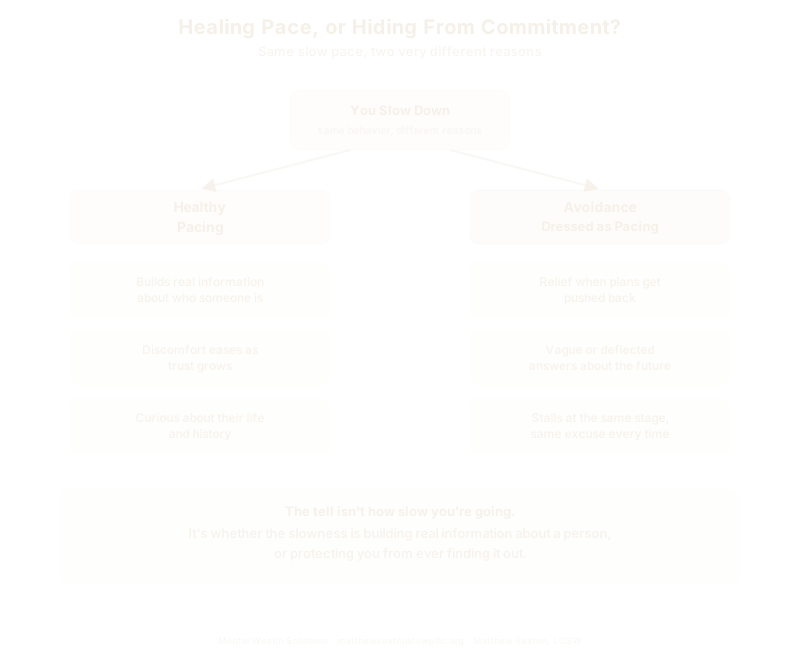
Pacing itself isn't the problem. A 2023 study of 1,345 daters found relationship length changes how strongly anxious attachment predicts satisfaction, meaning slow pacing can mask attachment struggles rather than resolve them. The tell isn't how slow you're going. It's whether the slowness is building real information about a person, or protecting you from ever finding it out.
Slowing down in dating isn't the red flag people assume it is. What actually predicts trouble is a specific attachment pattern, and a 2023 study of 1,345 young adult daters found something counterintuitive: anxious attachment becomes a stronger predictor of low relationship satisfaction and commitment the longer a relationship runs, not the shorter one (Freeman, Simons & Benson, International Journal of Environmental Research and Public Health, 2023). Taking things slow doesn't make attachment problems disappear. It can just push them further down the road.
This season's dating vocabulary is full of terms like these: soft dating, slow dating, low-pressure dating. Most of it points at the same idea, more talking before meeting, more meeting before anything physical, more time overall before calling it a relationship. Some of that pacing is genuinely protective. Some of it is commitment avoidance wearing a self-care T-shirt. Here's how attachment research helps tell the two apart.
What Do "Soft Dating" and "Slow Dating" Actually Mean?
Soft dating and slow dating describe the same broad shift: fewer matches, longer conversations before meeting, and delayed physical intimacy. Match's 14th annual Singles in America study, surveying 5,001 US singles in 2025, found 62% are looking for a committed, exclusive relationship, and 46% say they're ready for one right now (Match/Kinsey Institute 14th Annual Singles in America Study, June 2025, as reported by Global Dating Insights). That's not a generation avoiding commitment. That's a generation trying to reach it by a different route.
The same study found average monthly spending on dating has climbed to $213, up from $188 in 2022 (Match/Kinsey Institute 14th Annual Singles in America Study, June 2025, as reported by Global Dating Insights). People are investing more time and more money into fewer, deeper attempts rather than volume dating. Logan Ury, Hinge's Director of Relationship Science and author of How to Not Die Alone, has argued for years that daters should favor "the slow burn over the spark," pushing past a flat first date to a second or third before judging chemistry (Ury, "The Myth of the Relationship Spark," Behavioral Grooves podcast, Feb 13, 2023). Her reasoning: instant chemistry often measures familiarity, not compatibility, and it can mislead you both ways.
Why Are So Many People Choosing to Date Slower?
Gen Z daters are driving much of this shift, and the numbers explain the tension underneath it. Hinge's second annual Gen Z D.A.T.E. Report, surveying roughly 30,000 daters in November 2025, found 84% want new ways to build deeper connection, while Gen Z respondents were 36% more hesitant than Millennials to start a deep conversation on a first date (Hinge, November 2025).
That's worth sitting with. A generation says it wants depth, then hesitates most right when depth is on the table. Some of that hesitation is earned. Pew Research found in 2023 that 53% of US online daters described their overall experience as very or somewhat positive, versus 46% who called it negative (Pew Research Center, "The Experiences of U.S. Online Daters," Feb 2, 2023). That's close to a coin flip. Slower pacing, for a lot of daters, is a rational response to an activity that disappoints almost as often as it delivers.
Is Slow Pacing About Healing, or Is It Commitment Avoidance?
The honest answer is that pacing alone can't tell you. Moe Ari Brown, LMFT, a licensed marriage and family therapist who serves as Hinge's Love & Connection Expert and has published clinical work on relationship dynamics (Black Couples Therapy: Clinical Theory and Practice, Cambridge University Press), frames healthy pacing as active engagement that builds real information about a partner, not a stall tactic. The difference isn't measured in weeks. It's measured in whether the relationship is moving somewhere, or just staying comfortably still.
Healthy slow pacing usually feels like mild, tolerable discomfort that eases as you learn more about someone. You're a little anxious before a big conversation, then genuinely relieved and closer afterward. Avoidance dressed up as pacing tends to feel like relief whenever things get pushed back, followed by a vague unease you can't quite locate. One version of "going slow" is collecting information. The other is postponing the moment you'd have to be known.
What Does the Research Say About Attachment and Relationship Pacing?
The clearest evidence on this comes from that same 2023 peer-reviewed study, which followed 1,345 young adult daters and found relationship duration moderates the link between attachment insecurity and relationship quality (Freeman, Simons & Benson, International Journal of Environmental Research and Public Health, 2023). Specifically, anxious attachment predicted lower satisfaction and commitment more strongly in longer relationships than shorter ones.
That finding cuts against the popular assumption that slowing things down automatically protects a relationship. If you carry anxious attachment, more time together doesn't necessarily calm the underlying pattern. It can give the pattern more room to compound, since every additional month is another chance for reassurance-seeking, testing, or withdrawal cycles to take hold. Going slow buys you more data about a partner. It doesn't automatically buy you a different relationship with your own anxiety.
Avoidant attachment complicates the picture from the other direction. Established attachment research links avoidant attachment to reduced comfort with closeness, difficulty trusting a partner, lower responsiveness to a partner's needs, and lower overall relationship commitment (general attachment literature, e.g. PMC8841843). From the outside, an avoidantly attached person moving slowly can look identical to someone healing well. The difference usually only becomes visible over multiple relationships, once you notice the pattern stalls at roughly the same point every time.
How Can You Tell If Your Pace Is Healthy?
Healthy pacing tends to have a direction, even an undefined one. Vulnerability increases gradually as trust builds. You're curious about the other person's life, history, and daily texture, not just managing your own exposure. Some anxiety about intimacy is normal, and it eases as you gather more real information about who this person actually is.
Avoidance dressed up as pacing tends to have the opposite shape. There's relief, not disappointment, when plans get pushed back or the relationship quietly stalls on its own. Questions about the future get vague or deflected answers. And if you look across your last several relationships, a pattern is worth noticing: does the "getting to know you" phase always stretch out, then stall at roughly the same stage, with roughly the same excuse? That repetition, more than any single relationship's timeline, is the signal.
When Should Slow Dating Become a Conversation With a Therapist?
Slow dating on its own doesn't need clinical attention. It's worth bringing to a therapist when the pattern repeats itself across multiple relationships in a similar way, when you can name the avoidance but can't shift it on your own, or when closeness produces more dread than curiosity no matter how much time you've given it. Those are signs the pacing is protecting you from something specific, not simply building trust at a comfortable rate.
Attachment patterns formed early tend to run quietly in the background of every close relationship, not just romantic ones. Therapy doesn't work by convincing you to trust faster. It works by helping you see what you're actually protecting yourself from, and what a different response might feel like in practice, not just in theory. If some of this sounds familiar, you're welcome to reach out through this site to schedule a call.
What's the difference between soft dating and slow dating?
In practice, the terms overlap. Both describe reducing the volume and speed of dating in favor of longer conversations, delayed physical intimacy, and a slower path to exclusivity. Neither term has a single fixed clinical definition; they're descriptive labels for a pacing preference more than a formal category.
Is slow dating actually healthier than fast dating?
It can be, but pacing alone doesn't determine the outcome. Logan Ury, Hinge's Director of Relationship Science, has long recommended favoring "the slow burn over the spark" and giving a second or third date before judging chemistry (Ury, Behavioral Grooves podcast, Feb 2023). What matters clinically is whether the extra time is producing real information about a partner or simply delaying vulnerability.
How do I know if my slow pace is healing or avoidance?
Ask how you feel as things get more real, not just how slow things are moving. Healthy pacing brings mild, easing discomfort as trust builds. Avoidance dressed as pacing brings relief when things get pushed back and dread, or vagueness, whenever the future comes up (Freeman, Simons & Benson, 2023).
Does anxious attachment get better on its own if I just take things slow?
Not automatically. A 2023 study of 1,345 daters found anxious attachment predicts lower satisfaction and commitment more strongly in longer relationships, not less (Freeman, Simons & Benson, 2023). Time alone doesn't resolve the underlying pattern; it can give the pattern more room to operate unless it's addressed directly.
When should I talk to a therapist about my dating pace?
Bring it up when the same stall point keeps repeating across different relationships, when you can identify the avoidance but can't change it alone, or when closeness produces persistent dread rather than easing anxiety over time. A therapist can help distinguish a genuinely protective pace from one that's protecting you from ever being known.
Sources
- Freeman, H., Simons, L.G., & Benson, M.J., "Relationship Duration as a Moderator of the Association Between Attachment Insecurity and Relationship Quality," International Journal of Environmental Research and Public Health, 2023 (n=1,345 young adult daters). pmc.ncbi.nlm.nih.gov
- Match/Kinsey Institute, 14th Annual Singles in America Study, June 10, 2025 (n=5,001 US singles); figures (62% seeking committed/exclusive, 46% ready now, $213/mo average spend vs. $188 in 2022) as reported by Global Dating Insights. globaldatinginsights.com
- Hinge, 2nd Annual Gen Z D.A.T.E. Report, November 19, 2025 (n≈30,000 daters), co-developed with Logan Ury and Moe Ari Brown, LMFT. hinge.co/newsroom
- Logan Ury, Hinge Director of Relationship Science and author of How to Not Die Alone, "The Myth of the Relationship Spark," Behavioral Grooves podcast, Feb 13, 2023. behavioralgrooves.com
- Moe Ari Brown, LMFT, Hinge Love & Connection Expert; contributing author, Black Couples Therapy: Clinical Theory and Practice, Cambridge University Press. psychologytoday.com/us/therapists/moe-a-brown-atlanta-ga
- Pew Research Center, "The Experiences of U.S. Online Daters," Feb 2, 2023 (53% positive vs. 46% negative; n=6,034 U.S. adults, surveyed July 2022). pewresearch.org/internet/2023/02/02/the-experiences-of-u-s-online-daters
- General attachment research on avoidant attachment and relationship closeness, trust, and commitment. pmc.ncbi.nlm.nih.gov
This article is for educational and informational purposes only. It does not constitute medical, clinical, legal, or therapeutic advice, and reading it does not create a therapist-client relationship with Matthew Sexton, LCSW or Matthew Sexton LCSW PLLC. Although the author is a licensed clinical social worker, the content in this article is not clinical assessment, diagnosis, or treatment.
The patterns described here around dating pace, attachment style, and avoidance reflect general clinical and behavioral-science research, not an individualized assessment. Whether a slower pace in your own dating life reflects healthy caution or avoidance depends on your specific history and relationships, and what's described here may not match your situation. If dating pace or attachment patterns are something you'd like to work through, please consult a licensed mental health professional who can assess your specific circumstances.
If you are in immediate emotional crisis, you can reach the 988 Suicide & Crisis Lifeline by calling or texting 988 (US). If you are experiencing domestic violence or are in physical danger, contact the National Domestic Violence Hotline at 1-800-799-7233 or visit thehotline.org. In a life-threatening emergency, call 911.