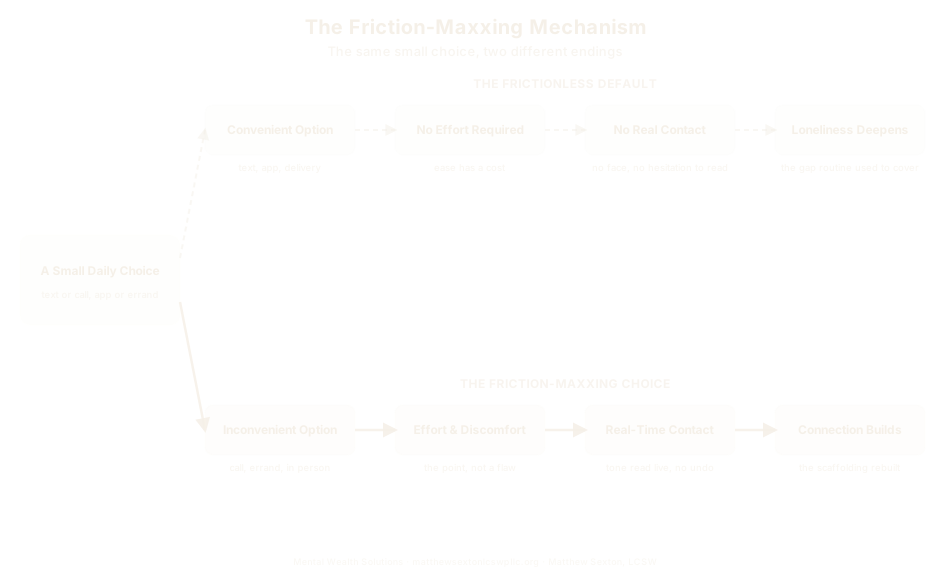
Friction-maxxing means seeking out inconvenience on purpose, a phone call instead of a DM, an in-person errand instead of an app, because ease has quietly eroded the small frictions that used to build resilience and connection. Summer strips away a lot of the invisible routine that generates low-effort social contact, so the loneliness underneath gets harder to ignore. Choosing a little more friction this season is a small, concrete way to push back against that.
Friction-maxxing is the practice of deliberately choosing the less-convenient option, a call instead of a text, a walk instead of a delivery app, on the theory that tech has quietly engineered away the ordinary friction that used to build tolerance and connection. The term comes from writer Kathryn Jezer-Morton's January 2026 essay "In 2026, We Are Friction-Maxxing" (The Cut, 2026). It lands at an odd moment: 40% of US adults 45 and older now report being lonely, up from 35% in 2010 (AARP, Dec 2025).
What Is Friction-Maxxing, Actually?
Friction-maxxing means choosing the harder path on purpose, an idea Kathryn Jezer-Morton named in her January 2026 Brooding column for The Cut, arguing that tech has engineered away friction like boredom, waiting, and social awkwardness (The Cut, Jan 2026). The behavior, not the label, is the point: seeking out ordinary inconvenience because avoiding it has costs of its own.
Jezer-Morton's framing wasn't really about romanticizing hardship. It was about noticing what gets lost when every friction point in daily life has a frictionless workaround. Boredom used to force you to strike up a conversation with a stranger. Awkwardness used to be the price of admission for meeting someone. Apps removed both, and something quietly went with them.
By June 2026, the term had crossed into workplace commentary. Fortune covered friction-maxxing as a career skill for Gen Z, arguing that automation removes entry-level tasks but not the friction of disagreement or negotiation, the unscripted discomfort of making a phone call to a stranger, where you can't read their face and there's no undo button (Fortune, June 23, 2026). That piece was about career durability, not loneliness. But the underlying mechanism, real-time contact with another person, no script, no edit button, is exactly what a lot of summer social life has quietly lost.
Why Does Summer Make Loneliness Worse?
Summer doesn't create loneliness out of nowhere. It removes the routine that was masking it, the school drop-off, the office hallway, the standing Tuesday meeting, all of which generate low-effort social contact without anyone having to try. This is a pattern clinicians commonly observe rather than a number in a study, but it tracks with a documented rise in loneliness generally: reported loneliness among US adults 45+ climbed from 35% in 2010 to 40% by late 2025 (AARP, Dec 2025).
Think of it as invisible scaffolding. During the school and work year, you don't have to plan to see people, you just show up somewhere and they're there. The barista who knows your order, the coworker at the next desk, the parent you nod to at pickup, none of that required effort. It happened by default.
Summer takes the default away. No school run, no office proximity, an irregular schedule that used to force contact whether you wanted it or not. The loneliness people notice in July isn't new. It's the same gap that was there in March, just no longer covered by a routine doing the social work for free.
A related shift shows up in who reports feeling it. Men now report higher loneliness than women, 42% versus 37%, a reversal from parity in 2018 (AARP, Dec 2025). Men are also statistically less likely to have workplace and school-adjacent routines replaced by another social structure once those default touchpoints disappear.
What the Loneliness Numbers Actually Say
The Harvard Making Caring Common project found that 21% of US adults report feeling lonely, and more tellingly, 70% or more say they want more community events or better public spaces as a fix (Harvard Making Caring Common, Oct 2024). People aren't asking for less connection. They're asking for more accessible ways into it.
That same report found 75% of respondents believe that helping others or community service would reduce their own loneliness (Harvard Making Caring Common, Oct 2024). That number is worth sitting with. It's not "someone should reach out to me." It's "if I did something effortful for someone else, my own loneliness would probably ease." That's friction-maxxing logic before the term existed: the fix runs through effort, not through more convenience.
Put the two data sets together and a pattern emerges. Loneliness has been climbing for over a decade (AARP, Dec 2025), and the people experiencing it already suspect that the remedy is participation, not passivity (Harvard Making Caring Common, Oct 2024). The friction-maxxing frame just gives that instinct a name and a method.
How Is This Different From Solo-Maxxing?
Solo-maxxing is about embracing time alone as a legitimate, even restorative, way to live. Friction-maxxing is close to the opposite instinct: it's about deliberately seeking out effortful contact with other people or with the world, not avoiding it. The two trends can look similar from a distance, both push back against a frictionless default, but they point in different directions.
A solo-maxxer chooses the solo museum morning because the aloneness itself is the value. A friction-maxxer picks up the phone and calls the museum to ask a question instead of looking it up, or takes the longer walk to the ticket counter instead of the app, because the small effortful exchange is the value. Neither is wrong. They're just solving for different things, and conflating them misses what each one is actually for.
If solitude has started to feel like the only mode available to you rather than a chosen one, that's a different conversation than the one this piece is having. Friction-maxxing assumes you want contact and are looking for a lower-stakes way back into it.
What Does Friction-Maxxing Actually Look Like This Summer?
In practice, friction-maxxing is smaller and less dramatic than the name suggests. It's a phone call instead of a text to the friend you keep meaning to see. It's asking a neighbor a real question instead of scrolling past them. It's showing up to the same coffee shop enough times that a person there starts to recognize your face, which used to happen for free at the office and now has to be built on purpose.
None of this requires a personality change or a summer of forced extroversion. It requires picking one or two low-stakes moments a week where the easy option is a screen and the harder option is a person, and choosing the person. A weekly volunteer shift, a recurring outdoor class, a standing coffee with someone you'd otherwise only text, are all ways to rebuild the scaffolding summer quietly removed.
The Fortune piece's phone-call example is a useful test case here too (Fortune, June 23, 2026). Calling a stranger, or even an acquaintance, forces real-time reading of tone and hesitation that a text thread never demands. That discomfort is the point, not a side effect to minimize.
When Effort Alone Isn't Enough
Friction-maxxing is a habit, not a treatment. It's a reasonable way to counter the specific loneliness that comes from routine collapsing for a season, but it isn't built to address loneliness that's persistent, that predates this summer, or that comes with a low mood that doesn't lift when the schedule fills back in come fall.
If the loneliness has been there for years, if it's tangled with a low mood or a sense of dread that doesn't track with the calendar, or if you've noticed yourself pulling away from contact even when it's easily available, that's worth talking through with a therapist rather than solving with a checklist. A conversation can help sort out which parts are seasonal and situational, and which parts have been there longer than this particular summer. If that sounds like where you are, start with a call and we can talk through it.
What does friction-maxxing mean?
Friction-maxxing means deliberately choosing the less convenient option, a call instead of a text, an in-person errand instead of an app, because technology has engineered away the ordinary friction that used to build tolerance for boredom, awkwardness, and unscripted contact. Writer Kathryn Jezer-Morton named the practice in a January 2026 essay for The Cut (The Cut, Jan 2026).
Is friction-maxxing the same as digital detoxing?
Not quite. A digital detox is usually about removing screens or apps altogether for a stretch of time. Friction-maxxing is narrower: it's about choosing the harder version of a specific interaction, even while still using your phone for other things, because the effort itself, not the absence of technology, is the point.
Why does loneliness get worse in summer specifically?
There's no tier-1 study quantifying a summer-specific spike, but clinicians commonly observe that summer removes routines like school drop-off, office proximity, and standing schedules that generate social contact without effort. When that scaffolding disappears, the loneliness it was quietly covering becomes harder to ignore. This tracks with broader loneliness trends: 40% of US adults 45+ report being lonely, up from 35% in 2010 (AARP, Dec 2025).
How is friction-maxxing different from solo-maxxing?
Solo-maxxing is about embracing time alone as restorative. Friction-maxxing is about deliberately seeking effortful contact with other people, the opposite instinct. Both push back against digital convenience, but one leans toward solitude and the other leans toward unscripted human contact.
What's one small way to start friction-maxxing for connection?
Pick one weekly moment where texting or an app is the default, and choose the phone call or in-person version instead. Harvard's Making Caring Common found 75% of people believe helping others or community service would reduce their own loneliness (Harvard Making Caring Common, Oct 2024), which is a reasonable place to start looking for that one moment.
Sources
- In 2026, We Are Friction-Maxxing, Kathryn Jezer-Morton, The Cut / New York Magazine, January 2026
- Gen Z: if you want to succeed at work, you need to start friction-maxxing, Michelle Sobel, Fortune, June 23, 2026
- Disconnected: The Growing Loneliness Gap, AARP Research, December 2025
- Loneliness in America 2024, Making Caring Common Project, Harvard Graduate School of Education, October 2024
This article is for educational and informational purposes only. It does not constitute medical, clinical, legal, or therapeutic advice, and reading it does not create a therapist-client relationship with Matthew Sexton, LCSW or Matthew Sexton LCSW PLLC. Although the author is a licensed clinical social worker, the content in this article is not clinical assessment, diagnosis, or treatment.
This article is for educational and informational purposes only. It does not constitute medical, clinical, legal, or therapeutic advice, and reading it does not create a therapist-client relationship with Matthew Sexton, LCSW or Matthew Sexton LCSW PLLC. Although the author is a licensed clinical social worker, the content in this article is not clinical assessment, diagnosis, or treatment.
If you are in immediate emotional crisis, you can reach the 988 Suicide & Crisis Lifeline by calling or texting 988 (US). If you are experiencing domestic violence or are in physical danger, contact the National Domestic Violence Hotline at 1-800-799-7233 or visit thehotline.org. In a life-threatening emergency, call 911.